
Aluminum vs Stainless Steel Cookware: Which Is Best for Commercial Sourcing and High-Volume Cooking?
Aluminum moves heat about 10x faster than 304 stainless. That matters for hot spots, not boil times. Here’s how each metal handles searing, acidic sauces, dishwashers and your product line.

Nobody gets into the restaurant business because they love metallurgy.
You find out about aluminum vs stainless steel cookware the hard way. It’s Friday, 8:40 p.m., the rail is full of tickets, and somebody drops a cold ribeye into a thin aluminum pan. No sizzle. Just a sad, grey hiss while the steak stews in its own juice. Meanwhile, the dish pit hands back an aluminum stock pot that went in silver and came out looking like it worked a shift in a coal mine.
So which metal is actually wrong here? Neither, really. They’re just good at different jobs.
Here’s the short version. Aluminum alloy 3003 conducts heat at roughly 159–190 W/m·K, while 304 stainless sits at 16.2 W/m·K (alloy datasheets, 2026). That’s about a 10x gap. But speed isn’t the whole story.
Key takeaways
- Aluminum conducts heat about
10xfaster than 304 stainless (159–190 vs 16.2 W/m·K), so it spreads heat evenly and kills hot spots. - Bare aluminum shouldn’t hold acidic or salty food. EFSA caps aluminium intake at
1 mg/kg bw/week, and BfR advises against it. - Tri-ply stainless gets you both: an aluminum core for spread, stainless on the surface.
Why Does Aluminum Heat Faster Than Stainless Steel?
Aluminum 3003 carries heat at 159–190 W/m·K depending on temper, and 304 stainless manages just 16.2 W/m·K (alloy datasheets, 2026). In practice, heat that lands on an aluminum base races sideways across the whole floor of the pan. On bare stainless, it mostly stays where the flame touched it.
Think of it as traffic.
Aluminum is an empty eight-lane highway at 3 a.m. Heat gets on and goes anywhere it wants. Single-ply stainless is a one-lane farm road behind a tractor. The heat’s still moving, just not far, and not fast.
That’s why a thin stainless pan on a narrow burner gives you a scorched ring in the middle and lukewarm edges. Garlic burns at the center while the onions on the rim haven’t noticed anything happened.
There’s a better number than conductivity for this, though. Engineers use thermal diffusivity, which tells you how fast a temperature difference evens out. Run the datasheet figures and aluminum 3003 comes out around 78 mm²/s. 304 stainless comes out around 4 mm²/s. That’s roughly a 19x difference in how quickly a hot spot flattens out. It’s the real reason aluminum cores exist.
For the construction side of this, see our breakdown of stainless steel cookware heat distribution types.
Does a Faster-Conducting Pot Really Boil Water Faster?
Barely. Heating 10 liters of water from 20°C to 100°C takes about 3,350 kJ (10 kg × 4.186 kJ/kg·K × 80 K). The pot itself only soaks up a few percent of that. So the metal you pick changes boil time far less than most sales sheets suggest.
Surprised? Most buyers are.
We ran the numbers for a typical 10-liter stock pot (about 26 cm wide, 20 cm tall):
- A 4 mm aluminum version weighs around 2.4 kg and absorbs roughly 170 kJ getting to a boil. That’s about 5% of the total.
- A 1.2 mm stainless version weighs around 2.1 kg and absorbs roughly 80 kJ. That’s about 2.5%.
Either way, the water is doing almost all the eating. What really decides boil time is the burner: how much of its output actually reaches the pot, and whether the base sits flat on the grate.
So where does aluminum genuinely earn its keep in a stock pot? Evenness. Thick soups, beans, rice and dairy scorch on hot spots. Water doesn’t care much. A heavy aluminum or aluminum-core base keeps the bottom of a 40-quart pot of chili from welding itself to the metal.
Is Aluminum Cookware Safe With Tomato Sauce and Other Acidic Food?
EFSA set a tolerable weekly intake for aluminium of 1 mg per kg of body weight, and found many Europeans already reach it from diet alone (EFSA Journal, 2008). That’s why Germany’s BfR advises against cooking or storing acidic or salty food in uncoated aluminum (BfR, 2026).
Here’s what actually happens in the pan.
Bare aluminum protects itself with a very thin oxide skin. Acid and salt attack that skin, and aluminum starts moving into the food. Tomato sauce, wine reductions, sauerkraut, citrus marinades and brined meats are the usual suspects. Time and heat make it worse. BfR’s work on catering found that keeping food warm in uncoated aluminum, or storing it there for hours, sharply increases how much aluminum migrates.
Then there’s the taste. Ever had marinara that tasted faintly like licking a battery? That’s often the pot. Light sauces can also turn a dingy grey.
Stainless steel plays by different rules. Grade 304 contains roughly 18% chromium and 8% nickel. The chromium forms a passive oxide film, only a few nanometers thick, and if you scratch it, it reforms on its own when exposed to air. That’s why a stainless pan can take a whisk, a wire brush and a gallon of red sauce without flinching.
For European buyers, there’s a hard number too. The Council of Europe’s technical guide on metals and alloys sets a specific release limit for aluminium of 5 mg per kg of food (EDQM, Council of Europe, 2020 edition). BfR has noted uncoated aluminum can exceed that with acidic or salty food.
Want the full list of reactive and non-reactive materials? Read non-reactive vs reactive cookware materials compared, plus our explainer on why metal migration in food contact matters.
Which Sears a Steak Better: an Aluminum or Stainless Steel Pan?
Per cubic centimeter, 304 stainless stores about 64% more heat than aluminum 3003. Stainless is about 8.0 g/cm³ at 0.50 J/g·K; aluminum about 2.73 g/cm³ at 0.89 J/g·K (alloy datasheets, 2026). Stored heat is what keeps a pan hot when cold meat lands on it.
Here’s the bit the packaging never mentions. Moving heat fast isn’t the same as holding heat.
A thin aluminum pan heats in a flash. Then a cold 16-ounce steak hits it, the surface temperature drops off a cliff, and the pan can’t refill fast enough. You get steam instead of a crust.
A heavy stainless pan is slower to get going. Once it’s there, though, it behaves like a flywheel. The steak lands, the pan barely flinches, and the Maillard reaction does its thing. You also get fond, those brown bits stuck to the bottom that turn into a pan sauce.
To be fair to aluminum, thickness changes everything. A thick aluminum pan holds plenty of heat. The steak-killer is the thin, cheap one.

Aluminum vs Stainless Steel Pots and Pans: Side-by-Side Specs
The numbers below come from published alloy datasheets and the Type III hard-anodizing spec (MIL-A-8625). The biggest single difference is weight: 304 stainless is roughly 3x denser than aluminum, which is great for heat storage and less great for a cook tossing a sauté pan 400 times a night.
| Property | Bare aluminum (3003) | Hard-anodized aluminum | 304 stainless | Tri-ply (304 / Al / 430) |
|---|---|---|---|---|
| Thermal conductivity | 159–190 W/m·K | Same core (coating ~25–50 µm) | 16.2 W/m·K | Aluminum core spreads heat |
| Density | ~2.73 g/cm³ | ~2.73 g/cm³ | ~8.0 g/cm³ | In between |
| Melting point | ~640–655°C | ~640–655°C | ~1,400–1,455°C | Limited by the aluminum core |
| Acidic or salty food | Avoid (BfR) | OK while coating is intact | Fine | Fine (stainless surface) |
| Commercial dishwasher | Discolors, corrodes | Hand-wash advised | Fine | Fine |
| Induction | No | No | Not on its own | Yes (430 exterior) |
| Metal utensils | Scratches easily | Hard coating, can chip | Fine | Fine |
What Does Tri-Ply Stainless Steel Cookware Actually Fix?
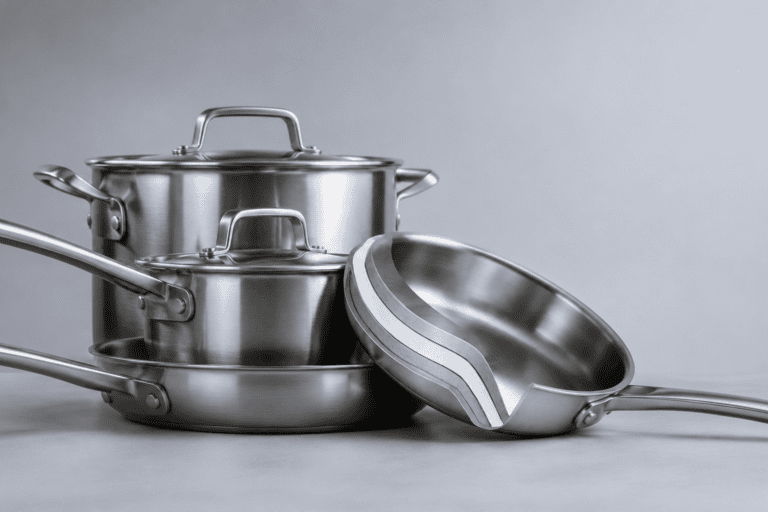
Tri-ply bonds an aluminum core between two stainless layers. The core spreads heat roughly 19x faster than 304 (our diffusivity calculation from datasheet values), the 304 inside handles acidic food, and a magnetic 430 outer layer makes the pan work on induction. It’s the answer to “why not both?”
For decades, buyers got stuck with a bad choice. Fast but reactive and soft? Or tough but patchy on heat? Clad construction stopped forcing the trade-off.

Picture a metal ice cream sandwich:
- Inside: 304 stainless. This is what touches the food. It’s non-reactive, cleanable, and fine with steel utensils.
- Middle: aluminum. The filling. It spreads heat across the base and, in fully clad pans, up the walls too.
- Outside: 430 stainless. It’s ferritic, so it’s magnetic, which is what induction hobs need.
There’s a second option on the market: the disc base (also called impact-bonded or encapsulated). Only the bottom has the aluminum layer, and the walls are plain stainless. It costs less, and it’s perfectly good for stock pots and boiling. For sauté pans, where food climbs the sides, full cladding behaves better.
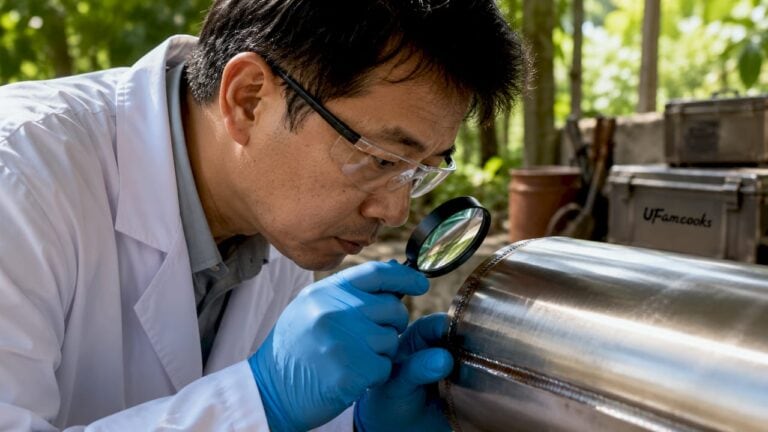
Checking a sample before you sign the PO. Three quick tests, no lab coat required:
- Read the rim. On a fully clad pan, the cut edge shows the layers as thin stripes. No stripes on the walls means the aluminum lives only in the base.
- Run the flour test. Dust the dry pan with a thin layer of flour and heat it on medium. Even browning means the core is spreading heat. A dark ring right over the burner means the aluminum is too thin for the job.
- Bring a magnet. If it doesn’t grab the base firmly, the pan won’t work on induction, whatever the box says.
Choosing between 3-ply and 5-ply next? Our guide on tri-ply vs 5-ply clad cookware covers it.
Which One Survives a Commercial Dishwasher?
Aluminum’s protective oxide is only stable in a fairly narrow window, roughly pH 4 to 8.5, according to standard corrosion references (Pourbaix, Atlas of Electrochemical Equilibria). Commercial dish detergents are strongly alkaline, so bare aluminum comes out dull, dark and chalky. Properly passivated 304 handles those cycles fine.
Think of a commercial dish machine as a hot chemical car wash. It’s very good at removing grease. It’s also very good at removing aluminum.
That’s not the only way cheap aluminum costs you money over time:
- Warped bases. Thin aluminum softens with heat and can bow after enough hard use. A bowed base rocks on the grate, touches the flame in fewer places, and wastes gas.
- Loose handles. Aluminum is soft, so rivet holes can slowly stretch with years of shaking and banging. A wobbly handle on a full stock pot is a burn waiting to happen.
- Replacement churn. Even when the upfront price is lower, pots that get thrown out sooner can cost more over time. Run your own numbers with real replacement rates.

We dug into this in detail in is 304 stainless steel dishwasher safe?
Sourcing Cheat Sheet: Which Metal for Which SKU?
BfR specifically tells caterers not to keep acidic or salty food warm or stored in uncoated aluminum (BfR, 2026). That one rule sorts most product lines. Use aluminum where the food is neutral and short-lived. Use stainless, or aluminum-core stainless, wherever acid, salt, holding time or dishwashers show up.
Where aluminum makes sense
- Big boiling pots for neutral liquids. Pasta water, blanching, steaming crab. Quick in, quick out.
- Heavy-gauge pans where weight matters and the kitchen hand-washes.
- Hard-anodized lines if you want aluminum’s feel with a tougher surface, and the customer accepts hand-washing.
Where stainless (or tri-ply) makes sense
- Sauté pans, skillets and saucepans. This is where wine, tomato and lemon live.
- Anything that holds food. Steam-table pans, storage, keep-warm service.
- Retail and private-label sets. Shoppers expect dishwasher-safe, induction-ready and no coating to wear off.
- Hotels, hospitals and chains that machine-wash everything and inspect often.
Still working out the commercial side? Our guide to factory-direct sourcing explains MOQs and lead times, and what food-safe stainless steel means covers grades.
Frequently Asked Questions
Is aluminum cookware safe?
Coated and hard-anodized aluminum is generally fine while the surface is intact. Bare aluminum is the problem with acidic or salty food. EFSA set a tolerable weekly intake of 1 mg aluminium per kg body weight (2008), and Germany’s BfR recommends not cooking or storing those foods in uncoated aluminum.
Can aluminum cookware go in a commercial dishwasher?
Bare aluminum shouldn’t. Its oxide layer is only stable around pH 4 to 8.5, according to standard corrosion references, and commercial detergents are strongly alkaline. The result is dark, dull, chalky metal. Hand-wash aluminum with a neutral detergent. Passivated 304 stainless steel handles machine washing well.
Does stainless steel work on induction?
Not 304 on its own. Austenitic 304 is basically non-magnetic, so induction can’t heat it efficiently. The pan needs a magnetic layer, usually 430 ferritic stainless, either as a bonded disc on the base or as the outer layer of tri-ply. A quick test: if a magnet sticks firmly to the base, it’ll work.
Why does tri-ply cost more than plain aluminum?
You’re paying for three metals bonded into one sheet and for harder forming work. 304 stainless alone is about 3x denser than aluminum, by datasheet values, so there’s simply more metal by weight. In exchange, you get even heating, a non-reactive surface, induction compatibility and dishwasher tolerance in one pan.
So, Aluminum or Stainless?
It’s not a religion. It’s a job description.
Aluminum is the sprinter: about 10x more conductive, light, and great for moving heat around. Stainless is the knight in armor: non-reactive, dishwasher-proof, and heavy enough to hold its heat when cold food lands. Tri-ply puts the sprinter inside the armor.
Private-label cookware
Compare tri-ply, disc-base and stainless options against real specs
Send us your target SKUs and use case. We’ll come back with construction options, gauges and sample timing.
Talk to our engineering teamSources
- Aalco / standard alloy datasheets, Aluminium 3003 and Stainless Steel 1.4301 (304) technical data, retrieved 2026-10-13, aalco.co.uk
- European Food Safety Authority, Safety of aluminium from dietary intake (EFSA Journal 754), 2008, retrieved 2026-10-13, efsa.europa.eu
- German Federal Institute for Risk Assessment (BfR), Questions and answers on aluminium in food and food contact materials, retrieved 2026-10-13, bfr.bund.de
- EDQM / Council of Europe, Metals and alloys used in food contact materials and articles (2nd ed., CM/Res(2020)9), retrieved 2026-10-13, edqm.eu
- MIL-A-8625, Anodic coatings for aluminum and aluminum alloys (Type III hard coat)
- Pourbaix, M., Atlas of Electrochemical Equilibria in Aqueous Solutions (aluminium passivity range)
- Calculations (thermal diffusivity, volumetric heat capacity, boil energy) by UFamcooks Engineering from the datasheet values above