
Cookware Weld Quality and Food Safety Impact
Cookware weld quality is defined as the structural and surface integrity of joints in stainless steel cookware, and it directly determines whether a product is safe for food contact.
Cookware weld quality is defined as the structural and surface integrity of joints in stainless steel cookware, and it directly determines whether a product is safe for food contact. Poor welds create crevices and pores that harbor bacteria inaccessible to standard cleaning, making weld integrity a non-negotiable food safety variable. Regulatory bodies including the FDA, EHEDG, and Germany’s LFGB have codified specific weld parameters that manufacturers must meet. For quality control professionals and kitchenware brands, weld integrity is the foundation of every compliant product that ships.
At a glance
- Hygienic-design surface target:
Ra ≤0.8 µm, full penetration, zero defects. - Governing standards: FDA 21 CFR · EHEDG Doc 8 · LFGB · 3-A Sanitary.
- Preferred process: laser welding, for a narrower HAZ and lower oxidation than TIG.
- Filler for acidic or chloride service:
ER316L(molybdenum, low-carbon) over ER308L. - Sensitization guard: low-carbon
304Lor post-weld solution annealing. - Post-weld treatment: pickling + passivation per
ASTM A967/ A380. - QC baseline: batch inspection to
AQL 2.5; acetic-acid (vinegar) soak for weld corrosion.
What are the essential food safety standards for cookware weld quality?
Food-safe weld standards require a surface roughness (Ra) of ≤0.8 µm, full penetration, and zero defects to prevent bacterial biofilm formation. That single parameter, Ra ≤0.8 µm, is the long-standing hygienic-design threshold recognized by the EHEDG and 3-A. Any rougher surface creates microscopic valleys where cleaning agents cannot reach, and biofilms can establish within hours.
Beyond surface texture, the weld itself must meet a strict set of physical properties:
- Continuous and fully penetrating: Incomplete fusion leaves internal voids that corrode from the inside out.
- Free from porosity: Gas pockets trap moisture and organic residue, accelerating microbial growth.
- No crevices or undercuts: Recessed geometry at the weld toe is a direct contamination point.
- No spatter: Weld spatter creates raised, irregular surfaces that are impossible to sanitize reliably.
- Smooth bead profile: A flush or slightly convex bead prevents pooling of food residue.
Chemical leaching is the second major risk category. Germany’s LFGB requires that food-contact materials transfer no harmful substances and cause no change to a food’s taste or odor, verified through mandatory sensory testing that chemical analysis alone can miss. For welds, the practical concern is localized metal release from a corroded or sensitized weld zone rather than the bulk alloy, which is why weld integrity carries its own compliance weight. LFGB is widely treated as a strict benchmark for brands seeking European market access.
| Standard | Key Weld / Surface Requirement | Scope |
|---|---|---|
| FDA 21 CFR | No toxic leaching; food-contact safe | US food-contact materials |
| EHEDG Doc 8 | Ra ≤0.8 µm; full penetration; no defects | Hygienic equipment design |
| LFGB (Germany) | Sensory testing; no taste/odor transfer | German and EU market access |
| 3-A Sanitary | Smooth, crevice-free, cleanable surfaces | Sanitary food-equipment design |
The thresholdFood-safe cookware welds must reach Ra ≤0.8 µm with full penetration and zero defects, the hygienic-design level recognized by EHEDG Doc 8 and 3-A, while FDA 21 CFR and Germany’s LFGB add the chemical and sensory requirements.
Weld zone corrosion susceptibility is a separate concern from surface roughness. Untreated weld zones are more prone to pitting corrosion than the surrounding base metal, especially in acidic or chloride-rich environments, because welding heat can locally deplete chromium and disturb the passive oxide layer. Left uncorrected, that degradation exposes the underlying metal to food contact.
How does welding method choice affect food safety outcomes?
The welding process is the biggest variable manufacturers control for weld quality in cookware. Laser welding produces narrow, clean welds with low heat input, reducing internal oxidation and surface deformation compared to TIG welding. The smaller heat-affected zone (HAZ) means less thermal damage to the surrounding metal’s corrosion-resistant oxide layer.
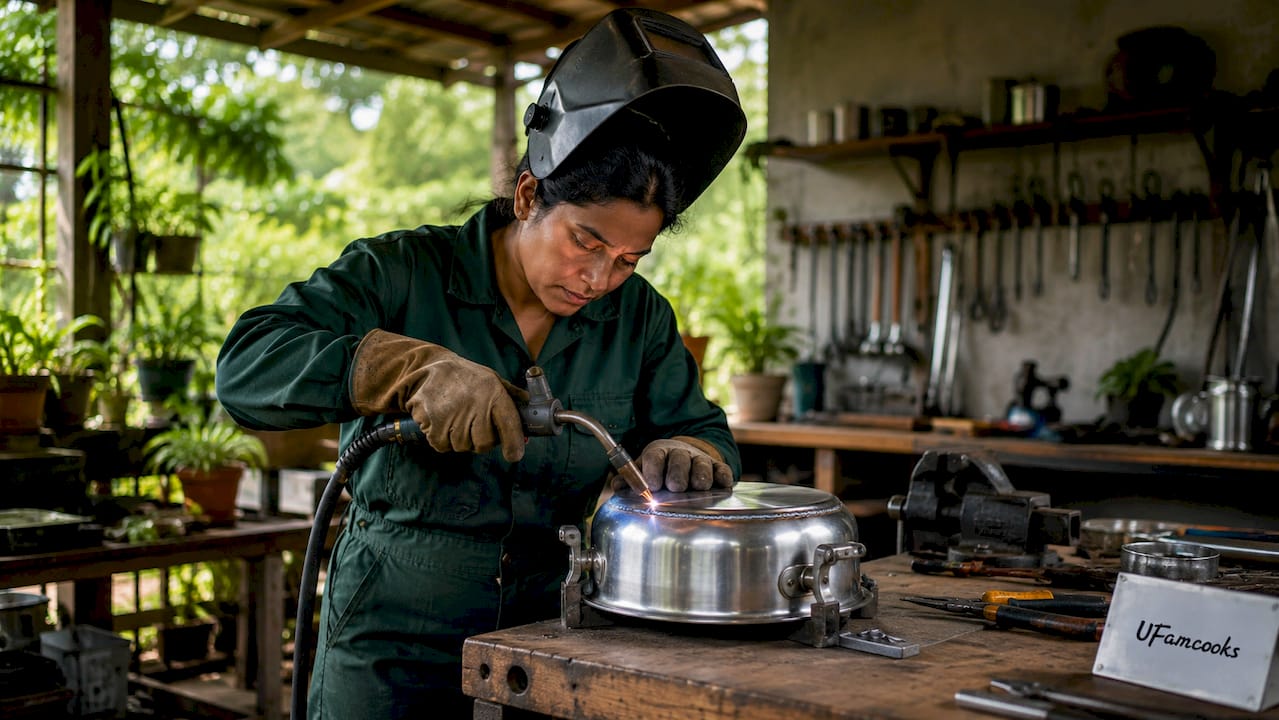
TIG welding remains widely used because of its lower equipment cost and flexibility with complex geometries. The tradeoff is a wider HAZ, more spatter risk, and greater operator skill dependency. For high-volume OEM production where consistency is critical, that variability is a liability.
| Welding Method | Heat-Affected Zone | Surface Roughness (Ra) | Post-Weld Treatment Needed |
|---|---|---|---|
| Laser welding | Narrow | Lower as-welded; meets Ra ≤0.8 µm with light polishing | Passivation recommended |
| TIG welding | Wide | Higher as-welded; needs more finishing to reach Ra ≤0.8 µm | Pickling + passivation required |
Method mattersLaser welding’s narrower heat-affected zone and lower oxidation let a weld reach the Ra ≤0.8 µm threshold with less corrective finishing than TIG, which reduces the risk that post-weld polishing strips the passive layer.
Laser welds typically have a lower as-welded roughness and reach the Ra ≤0.8 µm compliance threshold after light post-weld polishing. TIG welds generally require more aggressive finishing to reach the same threshold. That additional finishing step introduces its own risk: over-polishing can remove the passive oxide layer that protects stainless steel from corrosion.
Filler material selection also determines long-term weld integrity. ER316L filler wire, which contains molybdenum and has a low carbon content, resists pitting corrosion in chloride environments better than standard ER308L. For cookware that contacts acidic foods or salt-heavy recipes, specify ER316L.
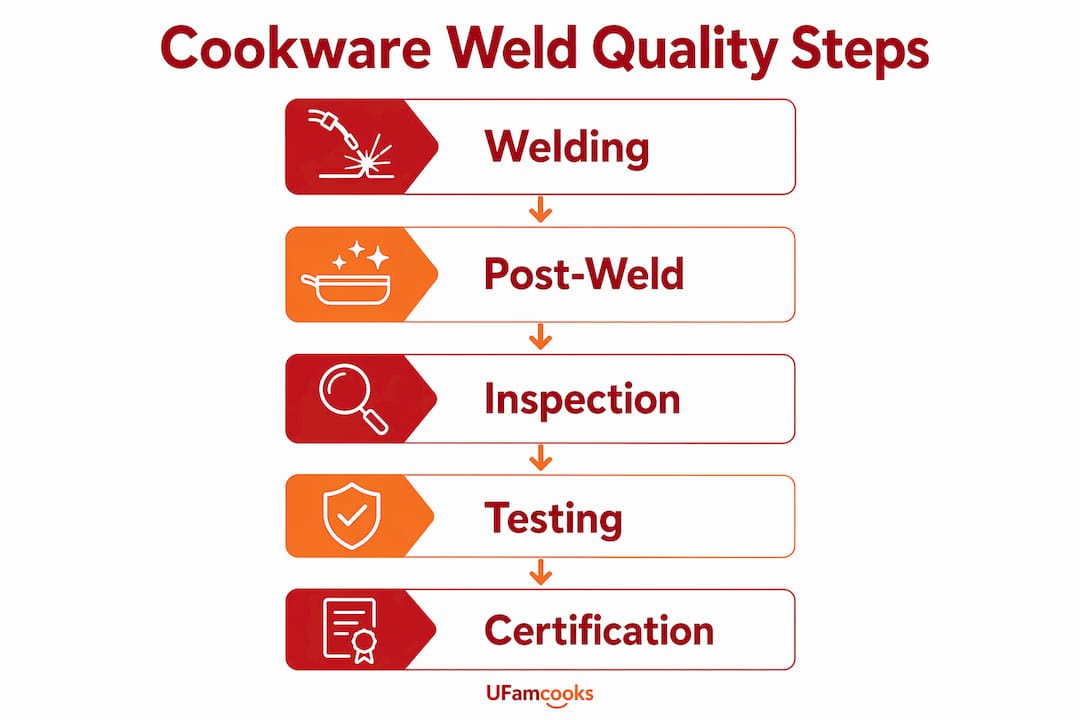
Post-weld treatment is not optional for food-grade applications. Recognized industry practice, codified in standards such as ASTM A967 and A380, specifies pickling and passivation to restore corrosion resistance and remove heat tint discoloration. Pickling removes the chromium-depleted layer created by welding heat. Passivation then rebuilds the protective oxide film that makes stainless steel food-safe.
Pro Tip: Never skip passivation after pickling. Pickling alone leaves the surface chemically active. Passivation, typically a nitric acid or citric acid bath, is what restores the corrosion-resistant oxide layer that food-grade certification requires.
What inspection and testing protocols confirm cookware welds are food safe?
Visual inspection alone fails as a quality gate for cookware weld integrity assessment. Internal weld oxidation is invisible to the naked eye, and surface appearance gives no indication of subsurface porosity or incomplete fusion. A weld that looks clean can still fail within months of use.
A reliable QC protocol for cookware manufacturers uses multiple test layers:
- Visual inspection with magnification: Use at minimum 10x magnification to detect surface cracks, undercuts, and spatter that unaided inspection misses.
- Pressure test: Fill the welded vessel with water, pressurize, and check for leaks. This confirms gross fusion failures but does not detect fine porosity.
- Soapy water test: Apply soapy water to the exterior weld seam under internal pressure. Bubbles indicate micro-leaks that pressure gauges alone cannot locate.
- Dye penetrant testing (ASTM E1417): Apply a penetrant dye, allow dwell time, remove excess, and apply developer. Surface-breaking cracks and porosity show as colored indications. This method detects defects invisible to all other surface tests.
- Acetic acid (vinegar) soak test: Submerge the cookware in a vinegar solution for 24 hours. Pitting or discoloration reveals internal corrosion and sensitization that no visual or pressure test catches.
| Test Method | Defects Detected | Limitation |
|---|---|---|
| Visual (magnified) | Surface cracks, spatter, undercuts | Misses subsurface and internal defects |
| Pressure / soapy water | Gross leaks, micro-leaks | Cannot detect porosity without leakage |
| Dye penetrant (ASTM E1417) | Surface-breaking cracks, porosity | Surface only; requires clean, dry surface |
| Acetic acid soak | Internal corrosion, sensitization | Time-intensive; 24-hour minimum |
The check that catches itThe acetic acid (vinegar) soak test exposes pitting and sensitization in the weld zone that visual and pressure tests cannot see, which is why it belongs in every batch QC protocol alongside AQL 2.5 sampling.
The vinegar soak test is one of the most underused yet revealing tests in cookware QC. Acetic acid soak testing exposes pitting corrosion invisible to standard tests, making it a dependable check for sensitization in the weld zone.
Sampling discipline matters as much as test selection. Batch-level inspection to an AQL of 2.5 reduces product recalls by catching weld defects that factory QC samples miss. Pairing acetic acid soak testing with AQL 2.5 statistical sampling is a practical way to catch weld corrosion problems before products reach retail, where they turn into rust returns and warranty claims.
Pro Tip: Run the acetic acid soak test on every new supplier batch, not just at initial qualification. Weld quality drifts as operators change and equipment ages. Periodic batch testing catches that drift before it reaches your customers.
Common weld defects in cookware and how to prevent them
Weld defects in stainless steel cookware fall into predictable categories, each with a direct food safety consequence. Understanding the failure mode is the first step to eliminating it at the process level.
- Undercuts: Grooves along the weld toe reduce wall thickness and create crevices. Bacteria can colonize undercuts within hours of food contact, and cleaning tools cannot reach the geometry.
- Porosity: Gas trapped during solidification creates voids. In acidic food environments, those voids fill with corrosive liquid and expand, eventually breaking through the surface.
- Cracks: Hot cracks form during solidification; cold cracks form after cooling. Both propagate under thermal cycling from cooking use, eventually creating through-wall defects.
- Heat tint discoloration: The blue, gold, or brown oxidation visible near welds signals chromium depletion in the underlying metal. That depleted zone corrodes faster than the base metal and can leach chromium into food.
- Incomplete penetration: A weld that does not fully fuse the joint leaves a stress concentration and a hidden crevice on the interior surface.
Sensitization is one of the most technically misunderstood defects in stainless steel cookware manufacturing. Welding standard 304 stainless steel risks sensitization, where chromium carbides precipitate at grain boundaries and reduce corrosion resistance in the HAZ. Using low-carbon 304L grade or applying post-weld solution annealing prevents this. The “food grade” label on a material certificate does not guarantee the weld zone retains that food-grade corrosion resistance after welding.
Polishing off exterior heat tint without passivation is a common and dangerous shortcut. The cosmetic discoloration disappears, but the chromium-depleted layer beneath remains. That layer will corrode in service, and the product will fail in the field rather than in QC. Full passivation after any mechanical finishing is what keeps the product food-safe in service.
Process controls that prevent defects at the source include qualified welding procedures (WPS/PQR documentation), certified welder qualification records, calibrated shielding gas flow meters, and inter-pass temperature controls for multi-pass welds. These controls are standard in stainless steel cookware manufacturing at the quality tier that food safety compliance demands.
Key Takeaways
Weld quality in cookware is a direct food safety variable, and manufacturers who control surface roughness, welding method, post-weld treatment, and inspection protocol control their compliance outcomes.
| Point | Details |
|---|---|
| Surface roughness is the baseline | Welds must achieve Ra ≤0.8 µm to prevent bacterial biofilm formation per EHEDG and 3-A hygienic-design criteria. |
| Laser welding reduces risk | Laser welding produces a narrower HAZ and lower oxidation than TIG, requiring less corrective finishing. |
| Post-weld treatment is mandatory | Pickling followed by passivation restores corrosion resistance removed by welding heat. |
| Vinegar soak testing is essential | Acetic acid soak testing reveals internal sensitization and corrosion invisible to visual and pressure tests. |
| AQL 2.5 sampling prevents recalls | Batch-level statistical sampling catches weld defects before products reach retail and end users. |
What I’ve learned about weld quality that most manufacturers get wrong
Working closely with cookware production at the factory level, the most consistent mistake I see is treating weld quality as a cosmetic issue rather than a food safety issue. A weld that looks good in a photo does not mean it is food safe. The defects that cause recalls, the sensitization, the subsurface porosity, the chromium-depleted HAZ, are all invisible until a product fails in a customer’s kitchen.
The second mistake is over-relying on material certification. A “food grade 304” certificate describes the base metal before welding. The welding process changes the metallurgy of the joint. Without post-weld passivation and proper inspection, that certificate is irrelevant to the weld zone’s actual safety.
I recommend that every brand sourcing stainless steel cookware ask their manufacturer three specific questions: What is your post-weld treatment protocol? What sampling standard do you apply to weld inspection? Can you provide dye penetrant or acetic acid soak test records? A manufacturer who cannot answer those questions clearly is not operating at the level that food safety compliance requires.
The shift to laser welding is not just a technology upgrade. It is a risk reduction decision. The narrower HAZ, the lower oxidation, and the more consistent bead geometry all reduce the number of variables that can go wrong. For brands building products that will be used daily with food, that reduction in variability is worth the investment. Vetting your supplier’s welding and QC practices before placing a large order is one of the highest-leverage actions a kitchenware brand can take.
— Jason Gan
How UFamcooks supports cookware brands on weld quality and compliance
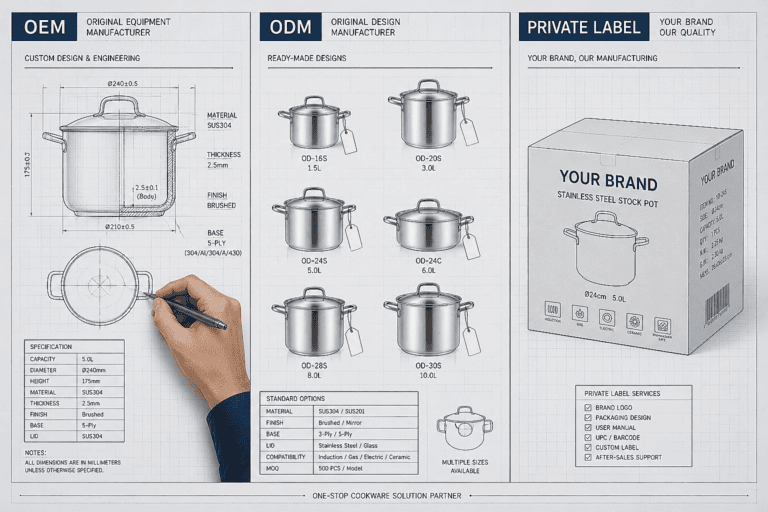
UFamcooks manufactures stainless steel cookware with multi-stage quality control built into every production run, not added at the end. The factory applies post-weld pickling and passivation as standard practice, and weld inspection follows AQL 2.5 statistical sampling on every batch. For brands that need to meet FDA, EHEDG, or LFGB requirements, UFamcooks provides full documentation of welding procedures and material certifications. The OEM and ODM model means you specify the grade, finish, and weld standard, and production is built to those parameters from the first piece. Learn more about stainless steel grade selection and how it connects to weld integrity and food safety compliance, or review the full product catalog to see what UFamcooks produces to these standards.
FAQ
What is the minimum surface roughness for food-safe cookware welds?
Food-safe welds require a surface roughness (Ra) of ≤0.8 µm per EHEDG and 3-A hygienic-design criteria. Rougher surfaces create microscopic valleys that harbor bacteria and resist standard cleaning.
Why does laser welding improve food safety compared to TIG welding?
Laser welding produces a narrower heat-affected zone and lower internal oxidation than TIG welding, reducing corrosion risk and the need for aggressive post-weld finishing. The result is a weld that reaches food-safe surface roughness with less corrective work.
What is sensitization and why does it matter for cookware?
Sensitization occurs when welding heat causes chromium carbides to form at grain boundaries in stainless steel, reducing corrosion resistance in the weld zone. Using low-carbon grades like 304L or applying post-weld solution annealing prevents this failure mode.
How does the acetic acid soak test work for cookware QC?
The acetic acid soak test submerges cookware in a vinegar solution for at least 24 hours to reveal pitting corrosion and sensitization invisible to visual or pressure tests. It reliably detects internal weld degradation before products reach end users.
Which standard is stricter, FDA or LFGB, for cookware chemical limits?
LFGB is generally treated as the stricter benchmark because it adds mandatory sensory testing, requiring that cookware transfer no taste or odor to food on top of the chemical-safety rules that apply in both markets. Brands targeting European markets need to meet LFGB requirements to access those channels.
Recommended
- Stainless Steel Cookware Customization Options: 2026 Guide
- Non-Reactive Cookware and Food Safety: A Pro Guide
- Why Stainless Steel Weld Quality Matters | UFamcooks
- Vetting Stainless Steel Cookware Manufacturers: 2026 Guide
Request for quote
Cookware welded, treated, and inspected to a documented standard
UFamcooks runs stainless steel cookware production with multi-stage quality control, post-weld pickling and passivation as standard practice, and weld inspection to AQL 2.5 on every batch. Specify your grade, finish, and weld standard under our OEM and ODM model, backed by full FDA, EHEDG, or LFGB documentation.
Start a sourcing inquiry