
Benefits of 18/10 Stainless Steel Cookware Explained
18/10 stainless steel is the cutlery and holloware trade name for the AISI 304 family, the austenitic grade specified at 18.0–20.0% chromium and 8.0–10.5% nickel in the SSINA composition tables.
18/10 stainless steel is the cutlery and holloware trade name for the AISI 304 family, the austenitic grade specified at 18.0–20.0% chromium and 8.0–10.5% nickel in the SSINA composition tables. The British Stainless Steel Association is blunt about the second number: the “10” on the box is “purely a marketing ploy”. Both 18/8 and 18/10 live inside the same 304 nickel band, and the genuine nickel step-up is 316L, at 10.0–14.0% with added molybdenum. None of that makes 18/10 cookware a bad buy. It makes the label the wrong thing to buy on. The properties buyers pay for come from chromium chemistry, from clad construction, and from whether anyone verified the alloy before it reached the press line. This guide covers what the label really tells you, what the peer-reviewed migration data shows, and which specifications belong on an order sheet.
18/10 at a glance
- Trade labels 18/8 and 18/10 both map to grade
304: one specified nickel band of8.0–10.5%(SSINA) - The genuine nickel step-up is
316L:10.0–14.0%nickel plus2.0–3.0%molybdenum - EFSA tolerable daily intake for nickel:
13 µg/kg bw/day - EDQM specific release limit:
0.14 mgof nickel per kg of food - Aluminum conducts heat about
13×faster than 304 stainless; copper about24× - Preheat
2–4 minon medium; water drops bead at about365–379°F - Around
95%of stainless steels are collected and recycled at end of life
What does 18/10 actually mean on a stainless steel pan?
The metal itself is limited to grade 304. According to BSSA’s guide for cutlery grades, the 18/8 alloy, containing roughly 18 % chromium and 8 % nickel, is likely the most frequently employed stainless steel, matching AISI 304 and EN 1.4301, while 18/10 serves as another label for the same steel used in cutlery and hollowware. The World Steel Association’s stainless‑steel program, worldstainless, confirms this composition, noting that a typical austenitic alloy consists of 18 % chromium and 8 % nickel, “as found in the popular AISI 304 grade”.
The specification shows there isn’t a second alloy to debate. According to SSINA’s chart, 304 stainless steel contains a single nickel range of 8.0‑10.5 %, meaning a pot marked 18/8 and one marked 18/10 could be cut from the same coil, with both markings technically correct. The common assertion that 18/10 outperforms 18/8 in acidic cooking lacks any measurable evidence, since there are not two distinct alloys to compare. Corrosion resistance is dictated by chromium content, and by molybdenum in the 316 series. Consumer websites often refer to “lab tests” supporting the 18/10 claim, yet no such tests are documented by any standards organization or peer‑reviewed publication.
In brief Both 18/8 and 18/10 fall within the 8.0–10.5 % nickel range defined for grade 304; the true nickel‑rich, corrosion‑resistant alternative is 316L, which contains 10.0–14.0 % nickel and 2.0–3.0 % molybdenum.
Here is the ladder as the standards draw it:
| Trade label | Grade | Chromium | Nickel | Cookware role |
|---|---|---|---|---|
| 18/0 | 430 (ferritic) | nearer 17% per BSSA | 0.75% max | Magnetic; the nickel-free option and the usual induction base layer |
| 18/8 · 18/10 | 304 (austenitic) | 18.0–20.0% | 8.0–10.5% | The standard cookware body; essentially non-magnetic |
| rarely labeled | 316 / 316L (austenitic) | 16.0–18.0% | 10.0–14.0%, plus 2.0–3.0% molybdenum | The genuine nickel and corrosion upgrade |
The crucial entry omitted from the chart is grade 201. According to SSINA, it contains 3.5‑5.5 % nickel and 5.5‑7.5 % manganese to make up the balance, and the substitution for 201 is concealed in a box marked 18/10 that lacks any grade identification on its documentation. The justification is purely procedural. Cite the AISI designation in the spec, reference order published quality grading standards, and regard the commercial label merely as packaging text. Detailed metallurgical data are recorded in 18/8 family’s full property set for those who need it.
How much nickel migrates from stainless steel cookware?
Under normal cooking, no more than food itself already contributes; under long acidic simmering in a newer pan, a measurable amount. Getting to those two clauses takes four public numbers.
Begin by explaining what regulators actually do, because neither the FDA nor EFSA grants approval for cookware. The U.S. food‑contact regulation, 21 CFR 174.5, requires that any component of a food‑contact article be “of a purity suitable for its intended use”; it governs substances and purity, and does not certify pans. EFSA’s role is limited to providing a reference value. Its 2020 nickel assessment established a tolerable daily intake of 13 µg per kg of body weight, derived from a benchmark dose of 1.3 mg/kg in reproductive‑toxicity data, and showed that a normal diet alone would push the highest‑exposed (95th‑percentile) toddlers beyond that TDI in 10 of 14 European surveys. The statement “EFSA says it is safe” never appears in EFSA’s own publications.
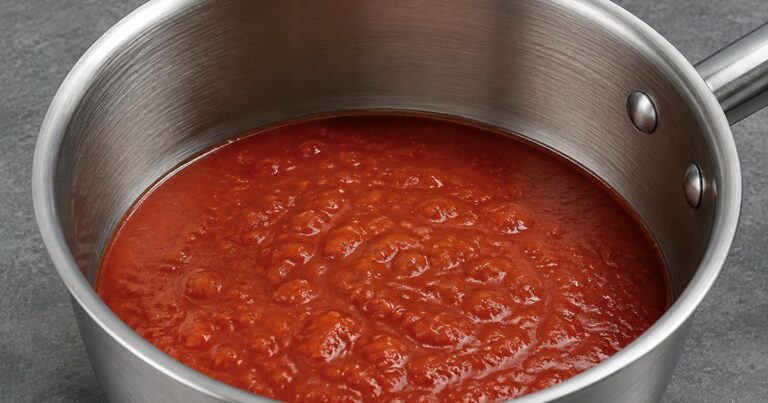
Instead of that, the appropriate reference is the 2013 investigation by Kamerud, Hobbie, and Anderson published in Journal of Agricultural and Food Chemistry. They found that simmering tomato sauce for six hours in a stainless‑steel vessel increased nickel levels up to 26-fold, depending on the steel grade. However, the impact diminishes with repeated use: after ten cooking cycles, the average nickel leaching was about 88 µg per 126 g portion.
Place 88 µg on the balance. According to the Nickel Institute’s food‑contact fact sheet, the average dietary nickel consumption is 90 to 361 µg per day, meaning a worst‑case portion represents roughly a quarter up to almost an entire day’s typical nickel intake. Compared with EFSA’s tolerable daily intake of about 910 µg for a 70 kg adult, this corresponds to roughly 10 % of the limit from a single serving under extreme conditions. The Institute notes that nickel migration from cookware is “in the same order of magnitude” as the nickel already found in food. This is a tangible amount, far larger than the negligible fractions often cited on cookware blogs without supporting research.
The practical product limit is derived from the Council of Europe’s EDQM guideline, which appears in the same fact sheet: a definitive release threshold of 0.14 mg of nickel per kilogram of food and 0.25 mg/kg for chromium, with both values met by compliant stainless‑steel cookware tests. Taken together, this information establishes two operational rules. Using certified cookware for everyday cooking is a settled matter; however, prolonged tomato or wine reductions made in a brand‑new, untested pan introduce a measurable, grade‑specific variable. Both rules ultimately lead to points metal migration control and food-safe grade verification at the manufacturing stage, before the pan is shipped.
In brief EFSA sets the tolerable daily intake of nickel at 13 µg per kilogram of body weight each day; the EDQM permits a maximum of 0.14 mg of nickel per kilogram of food, while the most extreme prolonged acidic simmering scenario yielded 88 µg of nickel per serving.
Nickel sensitivity alters the considerations for a particular population. According to the American Academy of Dermatology, more than 18% of people in North America are allergic to nickel, including 11 million children in the United States, and the European Food Safety Authority warns that acute nickel exposure poses a risk for sensitized individuals. The nickel‑free option already occupies a place on the grade ladder: 18/0, ferritic 430, with nickel limited to 0.75 %. For evaluation, the AAD advises consulting a board‑certified dermatologist.
How does the chromium passive layer protect the cooking surface?
Chromium offers protection at each tier of the scale. Once its content reaches 18 % or higher, it generates a thin oxide layer on the surface, and Worldstainless’s kitchen section explains that this layer continually renews itself when exposed to oxygen, which is why stainless‑steel cookware doesn’t need an applied coating that could wear away. That same source notes the hygienic feature: the surface is non‑porous and “does not absorb liquids, odors, or bacteria”.
Care rules exist to keep that film intact, and the manufacturers publish them in plain terms:
- Heat liquids to a rolling boil before you add salt. Applying a heavy coating of salt to a cold steel pan is what creates the “small white dots or pits”, as All‑Clad’s care guide cautions.
- All-Clad’s prohibition list runs from steel wool and oven cleaners through “detergents containing bleach or peroxide”.
- For routine cleaning, worldstainless recommends warm water, mild detergent, and a soft cloth or non-abrasive sponge.
ZWILLING’s care guide concurs on the salt point: “Adding salt to cold water can lead to discoloration”. Both companies present the damage as aesthetic rather than functional. The dishwasher issue is answered similarly: ZWILLING generally classifies its stainless‑steel cookware as dishwasher‑safe, yet still advises hand washing, allowing you to control the detergent guidelines mentioned above. The extended discussion appears in our guide to putting stainless steel in a dishwasher; the finish itself is a manufacturing choice addressed in selecting finishes for custom stainless kitchenware.
Pro Tip: Salt after the water boils, skip bleach-based detergents, and wash by hand when the polish matters. All three habits come straight from the manufacturers’ own care pages, and all three protect the same oxide film.
Heat flow and induction compatibility are construction specs
The 18/10 designation says nothing about how evenly a pan cooks. In SSINA’s physical-property data, 304 conducts heat at about 16 W/m·K. The reference table maintained by Georgia State University’s HyperPhysics project puts aluminum at 205 W/m·K and copper at 385, with plain carbon steel at 50.2. Aluminum moves heat roughly 13 times faster than 304 stainless, copper roughly 24 times. That gap is the whole engineering case for clad construction, in which a responsive aluminum core is bonded between stainless steel layers, as in All-Clad’s D3 line, rated oven and broiler safe to 600°F.
Induction is the second construction question hidden under the label. Austenitic 304 is only very weakly attracted by a magnet, if at all, per BSSA, while induction cooktops work, in ENERGY STAR’s words, by using “electromagnetic energy to heat up ferromagnetic cookware internally”. An 18/10 cooking body couples with an induction hob only when the construction adds a ferromagnetic layer, typically a base in the 430 family, the grade worldstainless calls “a low-nickel, magnetic grade”.
The ENERGY STAR compatibility test is identical to the one used by a quality‑control inspector: place a refrigerator magnet on the cookware’s base, and if it adheres, the piece will function on an induction stove. For an original‑equipment manufacturer purchaser, this means that induction becomes a specification item, with the body material, core metal, and base coating each listed individually. A vague “induction-compatible 18/10” label provides an inspection laboratory with nothing concrete to evaluate. The performance of the various layers over a burner is discussed in how heat distribution in stainless steel works.
In brief Aluminum conducts heat about 13 times more quickly than 304 stainless steel, while copper does so roughly 24 times faster, and induction cooking needs a ferromagnetic base that can be tested with a refrigerator magnet.
Preheating technique decides whether food sticks
Stainless steel’s sticking reputation is a preheating problem. CNET’s July 2026 guide has a professional chef recommending medium-low heat for about 3 minutes before oil goes in, and names the mechanism: the Leidenfrost effect, also called “film boiling”. America’s Test Kitchen gives the same routine as 2 to 4 minutes on medium, with a water-drop check at a surface temperature of about 365 to 379°F. In Lisa McManus’s words: “When they roll and skitter around like balls, the pan is ready.”
Pro Tip: Flick a few drops of water onto the preheating surface. If they flatten and sizzle away, wait. When they bead up and skate, add oil, let it shimmer, then add food.
Corrected against the sources, here is the working table for the cooking tasks buyers ask about:
| Cooking task | What the record supports |
|---|---|
| High-heat searing and oven finishing | Clad stainless such as All-Clad’s D3 is rated oven and broiler safe to 600°F. |
| Acidic sauces at normal durations | Non-porous, non-absorbing surface per worldstainless; compliant cookware tests under the 0.14 mg/kg nickel release limit. |
| Long acidic simmering in new pans | Measurable and grade-dependent: nickel rose up to 26-fold over six hours in tomato sauce (Kamerud 2013). |
| Induction cooking | Requires a ferromagnetic base layer; verify with the refrigerator-magnet test (ENERGY STAR). |
| Dishwasher cleaning | Dishwasher-safe per ZWILLING, which still recommends hand washing; avoid bleach or peroxide detergents (All-Clad). |
In brief Heat the vacant skillet on medium heat for 2–4 minutes; once a few drops of water sizzle, bead, and dance at roughly 365–379 °F, the pan is primed for adding oil.
Longevity claims deserve the same discipline. No standards body measures cookware service life, so the year-spans quoted in cookware blogs have no measurement behind them. What is on record: stainless steel resists corrosion, staining, high heat, impact and abrasion, per worldstainless, and at end of life around 95% of stainless steels are collected and recycled into new stainless without loss of quality. The material itself is 100% recyclable. In our experience a stainless pan routinely outlives a coated one in the same kitchen; beyond that, no published measurement exists, so we will not invent one.
Key Takeaways
Purchase the alloy and the build, and interpret the 18/10 imprint as the industry shorthand defined by the standards organizations.
| Point | Details |
|---|---|
| 18/10 is a trade name | Both 18/8 and 18/10 sit inside 304’s specified 8.0–10.5% nickel band; no separate 18/10 alloy standard exists. |
| 316L is the real nickel step-up | 10.0–14.0% nickel plus 2.0–3.0% molybdenum is the real corrosion upgrade over the 304 family. |
| Migration is measured, and small in normal use | EFSA’s TDI is 13 µg/kg bw/day; worst-case long acidic simmering reached 88 µg per serving; the EDQM release limit is 0.14 mg/kg of food. |
| Cooking performance is construction | Aluminum conducts about 13 times better than 304, so clad cores decide evenness; induction requires a ferromagnetic 430-family layer, checkable with a magnet. |
| Verification beats the label | Name 304 or 316L, the core metal, and the base layer on the order sheet, then test incoming material against it. |
How the 18/10 label reads from a Jiangmen export factory
Since October 2005, UFamcooks has been producing stainless‑steel cookware and kitchen accessories at its Jiangmen, China facility, which spans 10,000 m² and employs over 80 people. The company ships more than 20 containers each month to customers in over 30 nations. Serving more than 1,000 brands, the 18/10 discussion consistently appears in three different formats.
The first issue involves the RFQ that lists “18/10” without specifying a grade. We assign it a 304 designation and record 304 on the documentation, since a trade label provides neither the buyer’s laboratory nor our incoming inspection with a reference for testing. The second concern is the induction program that calls for an 18/10 body but omits any base‑layer specification; because the base determines the induction performance, the construction specification must identify it. The third case is the European customer inquiring about nickel, where the appropriate response consists of release‑limit documentation and the relevant grade paperwork.
Purchasers seeking the complete checklist for this type of discussion can consult our guide to vetting stainless steel cookware manufacturers. In brief, from our quoting department’s perspective:
“If the spec sheet says 18/10 but never says 304, it is not finished.” — Jason Gan, Product R&D & Export Sales, UFamcooks
UFamcooks and the 304 (18/10) stainless steel family
UFamcooks manufactures directly from its own plant using food‑grade stainless steel grades 304 and 316L, the 304 alloy commonly marketed as 18/10, and 316L when a higher‑performance material is required. We offer complete OEM and ODM services that cover everything from product conception to packaging, with minimum order quantities ranging from 500 to 5,000 units per SKU. Our multi‑stage quality‑control system guarantees that the specified steel grade is maintained throughout production. Kitchenware companies evaluating steel grades can begin with why stainless steel grade matters for kitchenware brands, explore the full product catalog, or consider start an OEM inquiry based on the grade and construction options discussed in this article. Simply request a quote specifying the desired grade, and we’ll provide pricing accordingly.
FAQ
What does 18/10 mean in stainless steel cookware?
It is the cutlery and holloware trade designation for the 304 austenitic family: 18.0 to 20.0% chromium with nickel specified at 8.0 to 10.5%. BSSA notes the “10” does not indicate extra nickel over 18/8. No separate 18/10 alloy standard exists in the AISI or EN systems.
Is 18/10 stainless steel cookware safe for everyday cooking?
Compliant cookware tests below the Council of Europe release limit of 0.14 mg of nickel per kg of food, and normal cooking keeps migration within the range of a typical diet’s 90 to 361 µg of daily nickel. Long acidic simmering in newer pans is measurable, which is why grade verification matters.
Does 18/10 stainless steel work on induction cooktops?
Only when the construction includes a ferromagnetic layer, usually a 430-grade base, because austenitic 18/10 itself is essentially non-magnetic. Induction cooktops heat ferromagnetic cookware directly, per ENERGY STAR. If a refrigerator magnet sticks to the pan’s base, it will work on an induction hob.
Can people with nickel allergies use 18/10 cookware?
More than 18% of people in North America are allergic to nickel, per the American Academy of Dermatology, including 11 million children in the US, and EFSA flags acute exposure as a concern for nickel-sensitized individuals. The nickel-free route is 18/0, grade 430, with nickel capped at 0.75%. For diagnosis, see a board-certified dermatologist.
How do you stop food sticking to stainless steel pans?
Preheat the empty pan before adding oil: about 3 minutes on medium-low per CNET, or 2 to 4 minutes on medium per America’s Test Kitchen. When water drops bead and skitter, around 365 to 379°F, the surface is ready. Add oil, let it shimmer, then add food.
Recommended
- Types of Stainless Steel Cookware Collections Explained
- Tri-Ply vs 5-Ply Stainless Steel Cookware: Clad Explained
- 18/8 Stainless Steel: Properties, Grades, and Applications
- Stainless Steel Cooking Pot with Lid – Excellent Kitchenware Manufacturer & Supplier
Factory-direct RFQ
Request a quote with a named grade
UFamcooks has manufactured stainless steel cookware and kitchenware in Jiangmen, China since October 2005, working in 304 and 316L food-grade stainless steel with full OEM and ODM programs and MOQs of 500 to 5,000 pieces per SKU. Put the grade, the core metal, and the base layer on the RFQ, and we will quote against them.
Request a quote