
201 vs 304 vs 316 Stainless Steel Cookware: Grades & Cost
For an everyday cookware range, 304 is a sensible starting specification.
For an everyday cookware range, 304 is a sensible starting specification. Consider 316 when chloride exposure calls for greater pitting resistance. Before accepting a lower-nickel 201 formulation, assess it against the product, foods and cleaning conditions you expect. A grade name alone does not prove that the finished pot meets food-contact requirements.
At a glance
201: nickel range3.5–5.5%.304: nickel range8–10.5%.316: molybdenum range2–3%.316L: maximum carbon0.03%.- Specify the body, lid, rivets, handles and induction base separately.
- Check alloy identity, corrosion performance and food-contact evidence separately.
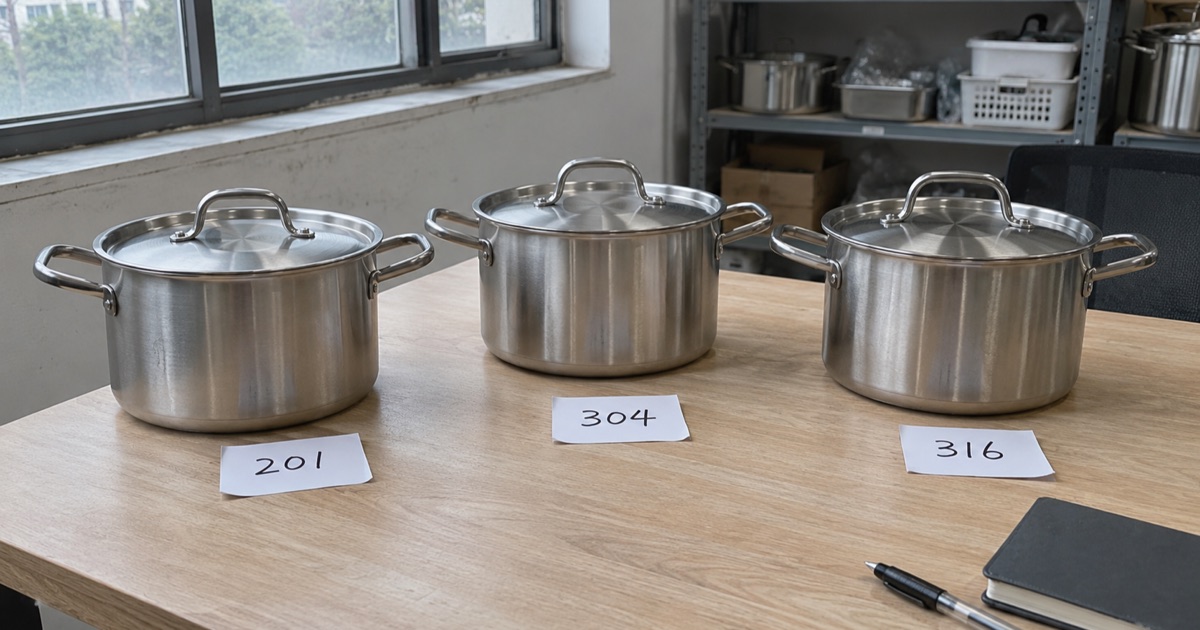
This comparison looks separately at alloy chemistry, service conditions and purchasing evidence. It is intended for importers who need a consistent product, including buyers comparing 304 vs 316 stainless steel cookware quotes. The practical questions are what the extra alloying contributes and which records show that the factory actually supplied it.
Key Takeaways
- 304 is a useful baseline for general-purpose cookware specifications.
- 316 contains 2-3% molybdenum in SSINA’s composition table; assess whether the intended exposure needs it.
- 201 requires application-specific review, not an automatic safety verdict.
- Verify alloy identity, finished-product testing and quote scope separately.
Chemical composition: what changes between the grades?
The clearest difference is alloy balance. In its Composition/Properties table, SSINA lists less nickel and more manganese for 201 than for 304. Both 316 variants add molybdenum; 316L has a lower carbon limit. The selected composition values below were checked on November 5, 2026.
| Grade / UNS | Chromium | Nickel | Manganese | Molybdenum | Carbon, max. |
|---|---|---|---|---|---|
| 201 / S20100 | 16-18 | 3.5-5.5 | 5.5-7.5 | Not specified | 0.15 |
| 304 / S30400 | 18-20 | 8-10.5 | 2 max. | Not specified | 0.08 |
| 316 / S31600 | 16-18 | 10-14 | 2 max. | 2-3 | 0.08 |
| 316L / S31603 | 16-18 | 10-14 | 2 max. | 2-3 | 0.03 |
These are selected limits, not a full purchase specification or a particular mill’s typical analysis. “Not specified” does not mean a guaranteed zero concentration. State the product standard and UNS designation in the order, then check the heat analysis against that specification. Other elements also matter.
A cookware assembly can contain several materials. The food-contact body, lid, rivets, handles and induction base need separate entries in the bill of materials. A 304 body with a deliberately specified magnetic outer base is a different proposition from an undisclosed substitution in the cooking surface.
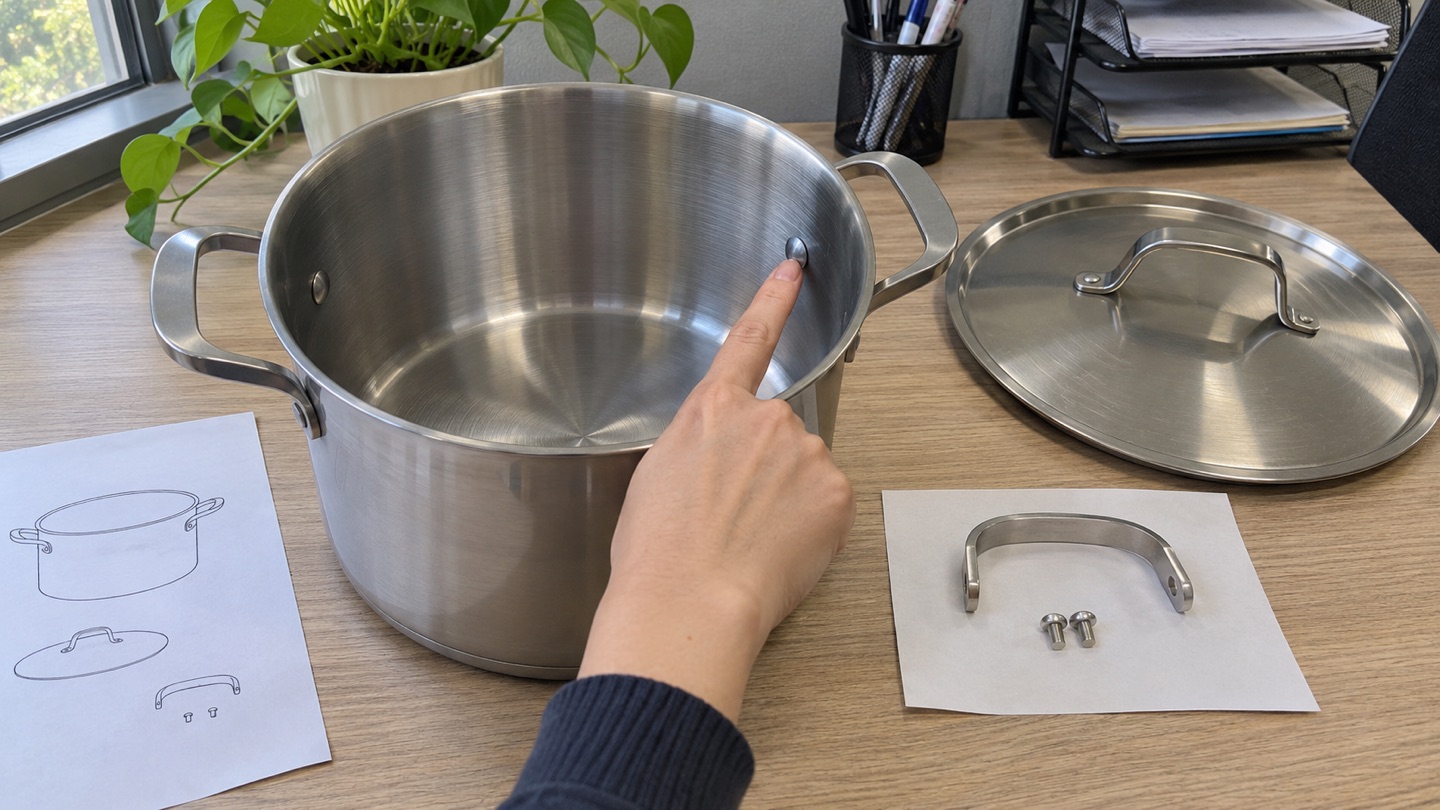
Labels such as 18/8 and 18/10 are shorthand for chromium and nickel content. They do not replace a complete material specification. Our 18/10 stainless steel guide explains the naming convention; here, the focus is on comparing grades and checking the material delivered.
In brief A cookware assembly can use different materials for its body, lid, handles, rivets and base. Record each component in the specification; a whole-product grade label does not describe every part.
201 vs 304 stainless steel: where does the trade-off matter?
If a supplier proposes 201 instead of 304, ask for evidence matched to the application. Lower nickel content is not a food-safety test. ATI’s 201 HP technical data lists cookware bodies and lids among its typical applications. This supports assessing a specified 201 product, but it does not establish that every 201 formulation performs the same way.
For a new general-purpose range, specifying 304 gives buyers a familiar reference for supplier comparisons. If a supplier proposes 201, ask which component uses it and why. Request the exact designation, representative samples and testing matched to the intended use. Do not accept “same appearance” as evidence of equivalent performance.
Nor should a buyer reject a sample solely because its manganese percentage exceeds that of 304. Bulk alloy composition and the quantity of an element released into food are different measurements. An assay of the steel cannot substitute for a release test on the article under appropriate conditions.
The EDQM guide, Metals and alloys used in food contact materials and articles, addresses specific release limits and testing procedures. Its second edition revised the treatment of several elements, including manganese. Ask the laboratory to identify the relevant destination-market requirements and the precise method used. A generic “food grade” statement leaves too much unanswered.
Do not write “201 always fails” into a specification. Define the acceptable result instead. The report should identify the tested item, laboratory, method, exposure conditions and outcome. Check that it represents the product being ordered, including its surface finish. A report for a different bowl or an unformed sheet is not automatically evidence for the proposed pot.
304 vs 316 stainless steel cookware: when does molybdenum help?
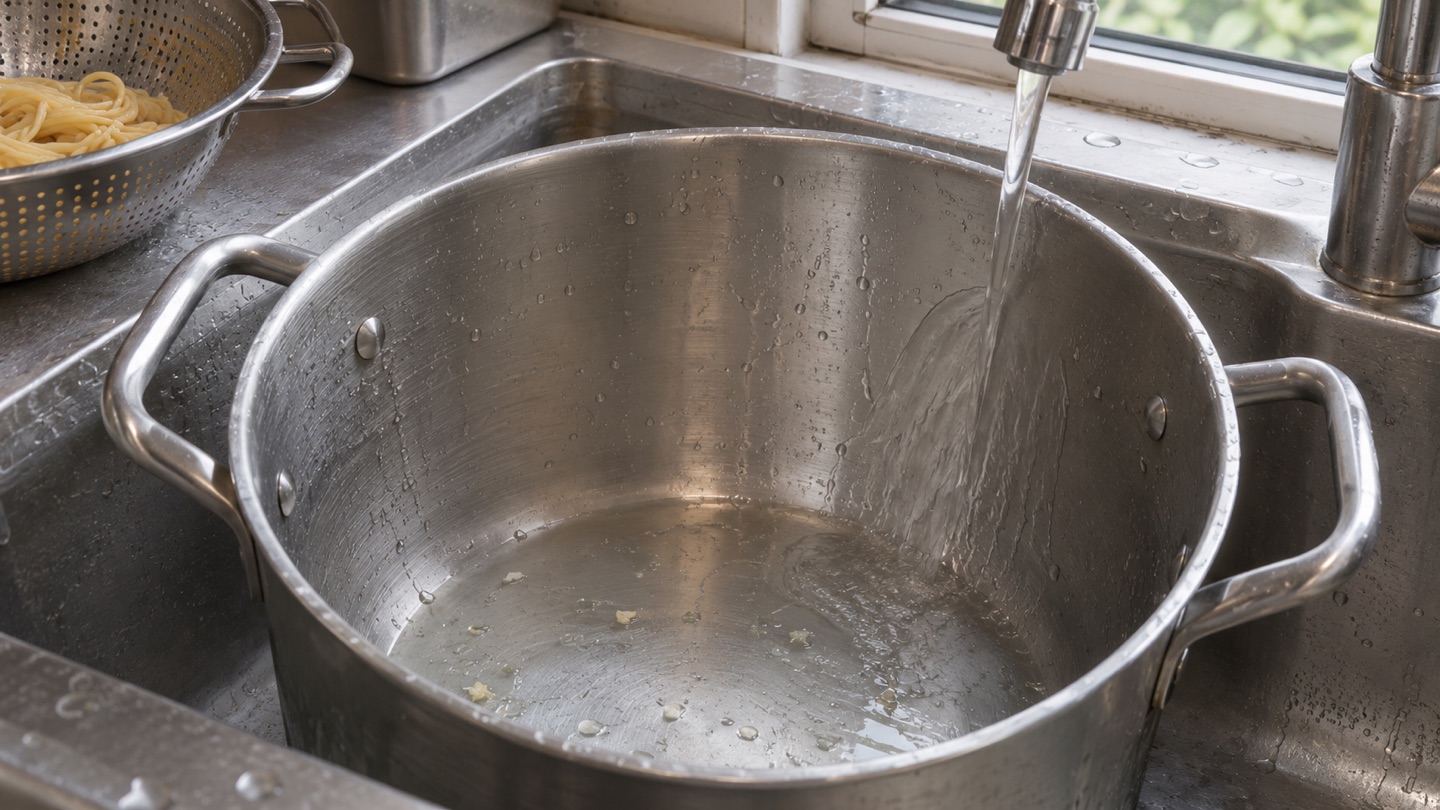
316 is worth considering where chloride exposure creates a corrosion concern. Outokumpu’s Austenitic stainless steel grades and properties explains how molybdenum additions contribute to corrosion resistance. That advantage matters under the relevant service conditions; it is not a guarantee that the pot cannot rust.
Consider the entire duty cycle. Does the vessel hold salty food after cooking? Can liquid remain around fasteners or seams? What cleaning chemicals will the customer use, and how thoroughly will staff rinse and dry the cookware? These questions give a materials specialist more useful information than the retail description “professional kitchen.”
304 can serve many ordinary cooking applications. A 316 proposal becomes more persuasive when the buyer can name the exposure it addresses. Even then, inspect fabrication and cleaning instructions. A more corrosion-resistant alloy does not remove deposits, eliminate crevices or correct a damaged surface.
The British Stainless Steel Association’s Stainless Steels for the Food Processing Industries discusses pitting, crevice corrosion and cleaning hazards. It advises avoiding hypochlorite or chloride cleaning solutions. Our dishwasher care article covers the maintenance side of the buying decision.
Does “surgical steel” identify a cookware grade?
Ask for the material designation. “Surgical steel” alone tells you neither the composition nor the product standard and acceptance criteria. A supplier quoting 316 should provide evidence for that grade. If the offer is for 316L, the evidence must also support the low-carbon requirement. The marketing phrase adds no measurable requirement to the purchase.
The L suffix concerns carbon control, which matters particularly in welded fabrication. SSINA’s explanation of intergranular corrosion describes the relationship between sensitization and low-carbon grades. That distinction is separate from non-stick performance, induction compatibility and cooking speed. Specify those properties independently.
What can salt-spray and food-contact reports actually prove?
Salt-spray exposure and food-contact release testing answer different questions. ASTM B117-26 describes a controlled corrosive environment, not a universal cookware pass mark. The ASTM standard’s public scope does not prescribe a product’s exposure duration or result interpretation, and cautions against predicting service performance from salt-spray results alone.
A claim such as “passed salt spray” needs a method, duration, sample condition and acceptance criteria to be useful. Establish whether the report covers the finished article or a coupon. Check the surfaces assessed and whether the agreed inspection included joints and edges. Photographs also need a clearly defined inspection context.
Food-contact documentation needs its own review. Confirm the destination market, intended foods, contact duration, temperature and repeated-use conditions with the testing laboratory. A corrosion photograph cannot establish the quantity of a metal released into food. Conversely, a release report does not certify the mechanical durability of handles.
| Evidence | Question answered | What it does not establish |
|---|---|---|
| Mill certificate + alloy check | Does the material match the ordered chemistry? | Finished cookware compliance |
| Defined corrosion test | How did the sample perform under the specified exposure? | A universal service life |
| Applicable food-contact test | Does the tested article meet the stated release criteria? | Every future batch or every use condition |
How should importers verify the supplied steel?
Use a traceable mill test certificate and an appropriate positive material identification method. Handheld XRF can identify alloying elements used to distinguish these grades, but it cannot verify the carbon difference between 316 and 316L. Thermo Fisher’s PMI Technologies comparison explains that limitation and alternative techniques.
An analyzer reading is only useful when you know what was measured. Record the component, measurement location and instrument method. For layered cookware, ask the testing provider how to isolate the intended layer. Testing the magnetic base and assigning its result to the inner cooking surface is a sampling error.
Use this sequence before shipment:
- Freeze the specification. Record the grade, product standard and material for each component, together with the agreed surface finish.
- Connect paperwork to material. Match heat or coil identifiers on the certificate to incoming stock and production records.
- Agree the sampling plan. Define the lots, components and measurement locations. A single demonstration sample is not a shipment inspection.
- Check the method’s limits. If the contract specifies low carbon, request testing that can measure carbon, together with supporting records. Ask the laboratory to choose a validated method suited to that requirement.
- Retain the evidence. Keep readings, photographs, reports, batch identifiers and an approved reference sample with the purchase order.
A magnet is not an alloy certificate. Forming history and multi-layer construction can affect what you observe. Consult the induction compatibility guide for cooktop questions, and use compositional evidence to establish the material identity.
In brief XRF can help identify alloying elements, but it cannot verify the carbon difference between 316 and 316L. Match the measurement location and test method to the component and requirement being checked.
How should buyers compare cookware quotations?
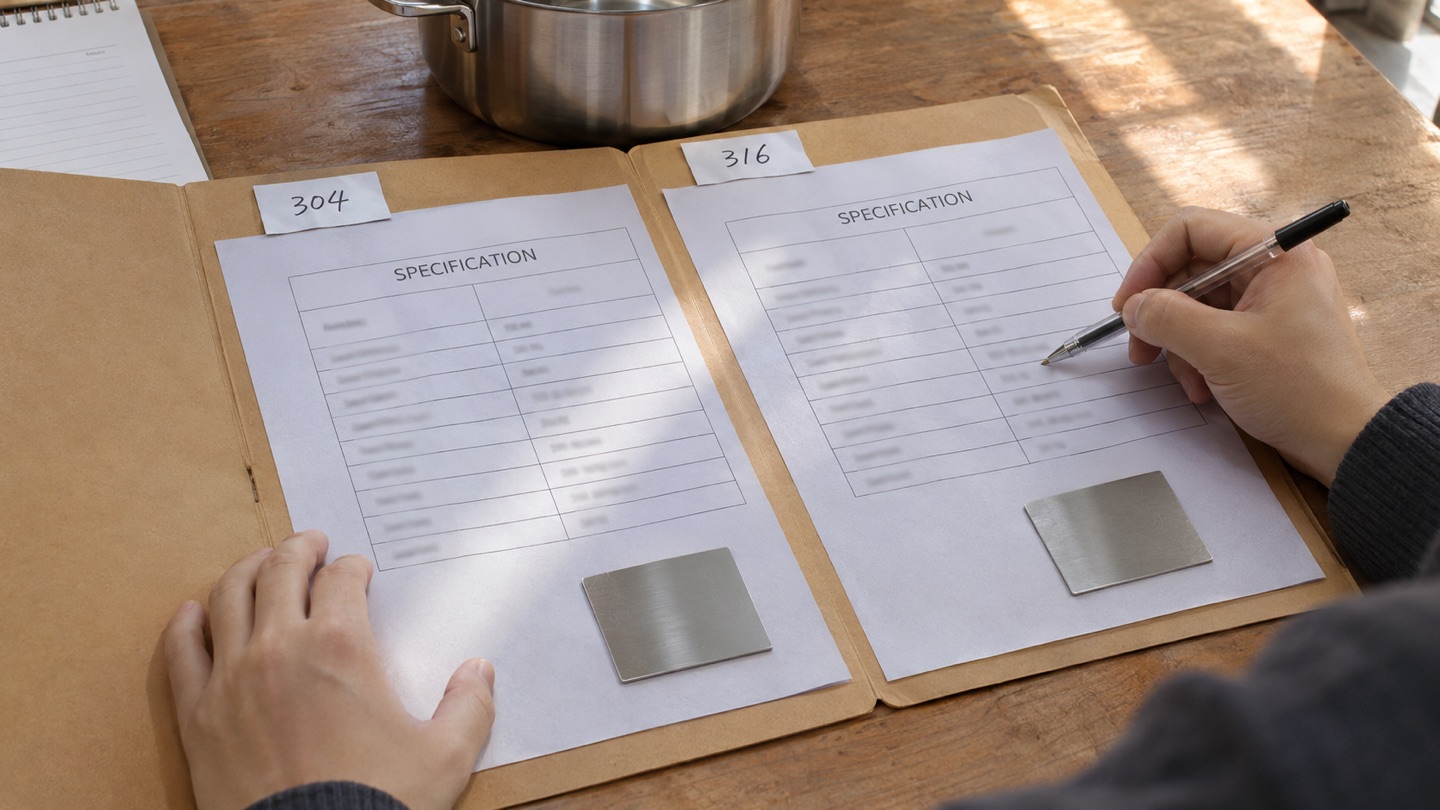
There is no reliable fixed percentage for converting a 304 cookware quote into a 316 quote. Alloy chemistry accounts for only part of the cost. Outokumpu’s alloy surcharge information shows why material pricing changes over time. Those figures are not a finished-cookware quotation or a Chinese factory’s FOB price.
Start with matched drawings and order conditions. If the 316 option also changes the base, packaging, polish or quantity, the quoted difference cannot be attributed entirely to steel grade. Ask the supplier to separate the changed material scope from other revisions. Keep quote dates and validity periods visible.
Our proposed comparison worksheet uses the following cost categories. It is a procurement method, not a claim about UFamcooks’ current prices:
| Quote item | Hold constant or record explicitly |
|---|---|
| Food-contact body | Geometry, finished thickness and grade |
| Other components | Lid, handles, rivets, base construction |
| Processing | Forming, joining and surface finish |
| Verification | Tests, inspection scope and document costs |
| Order conditions | Quantity, packaging and delivery schedule |
| Commercial basis | Currency, Incoterm, named place or port, validity |
A useful request is: “Please quote the same drawing with a 304 body and a 316 body. Identify all other changes required.” The reply should make clear whether the two options are equivalent. If the supplier cannot keep the construction identical, record the differences before choosing.
For a new range, test a representative sample against your real use conditions before negotiating annual volumes. A small apparent material saving can become an expensive specification dispute if the agreed acceptance criteria are missing. Equally, ordering 316 by habit adds cost without demonstrating a benefit when the service does not require it.
In brief Compare 304 and 316 quotations using the same drawing, construction and order conditions. Record any changes to the base, finish, packaging or quantity before attributing a price difference to the steel grade.
Frequently asked questions
Is 201 stainless steel cookware automatically unsafe?
No. Assess the finished article under its intended conditions. Require laboratory evidence for the destination market. A grade designation identifies chemistry; it does not grant regulatory approval.
Does 316 stainless steel cookware cook better than 304?
Not necessarily. Compare heating and handling with comparable samples. Base construction, dimensions and the heat source all affect the assessment. A higher grade number is not a score for cooking performance.
Can XRF prove that a pot is 316L?
No. Handheld XRF cannot measure carbon. Before accepting a low-carbon claim, ask the laboratory about suitable OES or LIBS analysis, the sample preparation required and how the results will be traced to the material.
Should a buyer choose 304 or 316 for a new cookware range?
Use 304 as the initial reference; investigate 316 when chloride exposure warrants it. Then qualify the proposed construction. Appearance, magnet attraction and “surgical steel” branding are insufficient selection criteria.
Prepare a material-specific cookware inquiry
Sourcing 304 vs 316 stainless steel cookware starts with a clear brief. Send your drawing, application, quantity and destination market. Identify any proposed 201 components separately.
Use the stainless steel cooking pot with lid as an initial product reference. Confirm the exact material and construction for your order in writing. Our OEM/ODM manufacturing page explains the broader project scope.
Request a material-specific cookware quote.
Prepared by Jason Gan, UFamcooks. This article compares published material data and proposes a buyer’s verification workflow; it does not report an in-house corrosion experiment. All linked technical sources were checked on November 5, 2026. Learn more about UFamcooks.
Material-specific inquiry
Request a comparable cookware quote
Send your drawing, application, quantity and destination market. Identify the material required for each component and any proposed 201 components.
Request a quote