
Stainless Steel Cookware Quality Grading Standards
Stainless steel cookware quality grading standards categorize cooking materials by alloy composition, corrosion resistance, and safety performance to guide purchasing decisions and protect end users. The four grades that matter most in cookware are 304, 316, 430, and 201, each defined by their chromium and nickel ratios. Regulatory bodies including India’s Bureau of Indian Standards and North America’s NSF International enforce these grades through mandatory testing, migration limits, and surface finish requirements. Knowing which grade you are buying, and what certification backs it, separates a pan that lasts a decade from one that corrodes in two years.
1. What are stainless steel cookware quality grading standards?
Stainless steel cookware quality grading standards are a set of composition and performance benchmarks that classify alloys by their suitability for food contact, heat exposure, and long-term durability. The grading system draws on designations from the American Iron and Steel Institute (AISI) and Society of Automotive Engineers (SAE), which assign numeric codes like 304, 316, and 430 to specific alloy formulas. These codes tell you exactly what percentage of chromium, nickel, and other elements are present. That composition directly determines how the pan performs on your stove and how long it survives daily use.
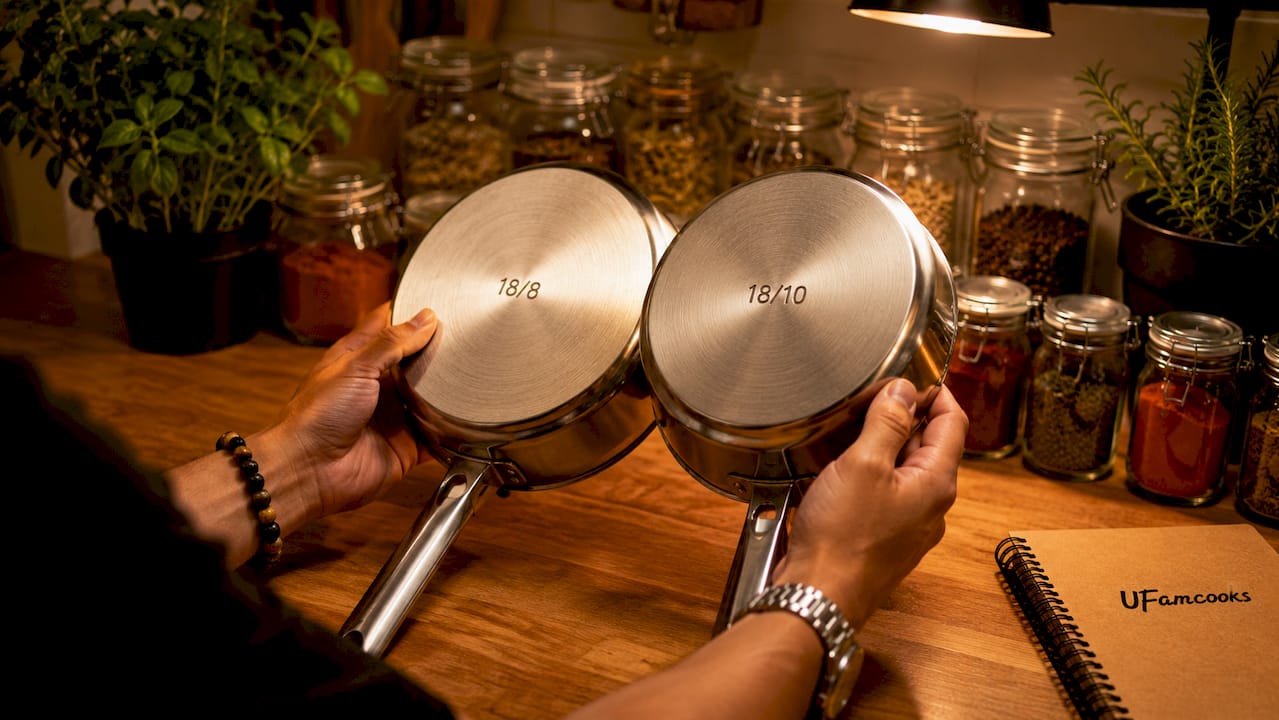
The industry also uses a parallel labeling system expressed as ratios such as 18/8 or 18/10. These fractions describe chromium-to-nickel percentages. 18/10 stainless steel means 18% chromium and 10% nickel, indicating premium corrosion resistance and durability. That extra 2% nickel over 18/8 increases surface hardness and luster, which is why premium cookware brands use it as a marketing signal.
2. What are the most common stainless steel grades in cookware?
304 stainless steel is the global industry standard for cooking surfaces, containing 18% chromium and 8–10% nickel. It resists rust, tolerates acidic foods, and handles repeated thermal cycling without warping. Most professional kitchen equipment from brands like All-Clad and Cuisinart uses 304 as the primary food-contact surface. It is the right choice for the vast majority of cooking environments.
316 stainless steel adds 2–3% molybdenum to the 304 formula. That addition significantly improves resistance to chloride corrosion, which matters when cooking with salt-heavy brines, seafood, or acidic sauces over long periods. The trade-off is a 20–30% price premium over 304. That premium is only justified in specific environments, not everyday home kitchens.
430 stainless steel is a ferritic grade with lower nickel content, which makes it magnetic. That magnetic property is exactly why manufacturers use it for induction-compatible cookware bases. Its corrosion resistance is lower than 304 or 316, so you will rarely see it used as a cooking surface. It appears as a bonded base layer in multi-ply pans designed for induction cooktops.
Grade 201 stainless steel is a budget alternative that substitutes manganese for some of the nickel in the alloy. It costs less to produce but delivers reduced corrosion resistance and a shorter service life. Budget cookware sold at discount retailers frequently uses 201 without clearly labeling it. Buyers who do not check the grade number or certification mark are the most likely to end up with 201 when they expected 304.
| Grade | Chromium | Nickel | Key Feature | Best Use |
|---|---|---|---|---|
| 304 (18/8, 18/10) | 18% | 8–10% | Balanced corrosion resistance | General cooking surfaces |
| 316 | 16–18% | 10–14% | Molybdenum for chloride resistance | Acidic or marine environments |
| 430 | 16–18% | Low/none | Magnetic, ferritic | Induction bases |
| 201 | 16–18% | 3.5–5.5% | Low cost | Budget items only |
3. How do international standards govern cookware quality?
Regulatory frameworks for stainless steel cookware quality ratings vary by region, but they share a common focus: controlling heavy metal migration, surface finish, and weld integrity. India’s IS 14756:2024 standard under BIS ISI certification mandates nickel migration limits of no more than 0.14 mg/dm² per week. That limit exists because nickel can leach into food during prolonged cooking, particularly with acidic ingredients. The certification became mandatory from October 2025, with full compliance required by 2026.
The same IS 14756:2024 standard also enforces surface finish requirements at 2B finish or better, and weld quality checks that include bend and tensile testing. Welds must be free from slag, porosity, and cracks. These requirements prevent contamination points where bacteria or corrosion can take hold. A pan that passes BIS ISI testing has been verified at the manufacturing level, not just at the material level.
In North America, NSF certification focuses on cleanable design and material safety, and is mandatory for commercial cookware alongside FDA compliance. Both 304 and 316 stainless steels qualify for NSF certification when manufactured correctly. NSF auditors inspect manufacturing facilities and test finished products for material composition, surface cleanability, and structural integrity. Commercial kitchens in the United States are required to use NSF-certified equipment, which is why the mark appears on professional-grade cookware sold by suppliers like Vollrath and Winco.
Key testing requirements across major standards include:
- Nickel and chromium migration testing under simulated cooking conditions with acidic solutions
- Surface roughness measurement to confirm 2B or mirror finish compliance
- Weld integrity checks including bend, tensile, and visual inspection
- Corrosion resistance testing using salt spray or acid immersion methods
- Dimensional and thickness verification to confirm material specifications match labeling
4. How do different grades affect cookware performance and durability?
The practical impact of cookware quality levels shows up most clearly over time, not on first use. A 304-grade pan used daily in a professional kitchen will maintain its surface integrity and resist pitting for well over a decade with proper care. A 201-grade pan in the same environment will show corrosion within two to three years, particularly around welds and rims where the alloy is thinnest.
316-grade cookware is the right call for specific scenarios. Coastal restaurant kitchens where salt air accelerates corrosion, fermentation operations using high-acid brines, and seafood processing environments all benefit from the molybdenum content in 316. For a home cook making pasta or sautéing vegetables, the price premium on 316 is not justified. Most residential and commercial cooking is adequately served by 304.
Here is a practical breakdown of each grade’s strengths and limitations:
- 304 (18/8 or 18/10): Excellent corrosion resistance, dishwasher safe, widely available, cost-effective for professional and home use. Minor susceptibility to chloride pitting in high-salt environments.
- 316: Superior chloride resistance, ideal for acidic or marine cooking. Higher cost and heavier weight. Overkill for standard cooking applications.
- 430: Magnetic for induction compatibility, lower cost. Not suitable as a primary cooking surface due to reduced corrosion resistance. Best as a bonded base layer.
- 201: Lowest cost, widely misrepresented as 304. Poor long-term durability, higher migration risk, not recommended for any serious cooking application.
5. How to read stainless steel cookware labels and ratings
Cookware labels carry more information than most buyers use. The 18/8 and 18/10 designations directly communicate nickel content, which is the primary driver of corrosion resistance and surface durability. 18/10 labeling signals premium quality and is the standard used by high-end cookware lines. 18/0 means no nickel, which corresponds to ferritic grades like 430 and signals induction compatibility but lower corrosion resistance.
Multi-ply construction describes bonded layers of stainless steel with aluminum or copper cores. A 3-ply pan has one core layer; a 5-ply pan has two. Higher ply count improves heat distribution and reduces hot spots, but it does not change the grade of the stainless steel used. A 5-ply pan built with 201-grade stainless still underperforms a 3-ply pan built with 304. Ply count and steel grade are separate quality dimensions.
Use this checklist before purchasing any stainless steel cookware:
- Confirm the grade number. Look for 304, 316, or 430 on the product spec sheet or packaging. Reject any product labeled only as “stainless steel.”
- Check the ratio label. 18/10 or 18/8 confirms 304-grade quality. 18/0 confirms ferritic grade.
- Verify certification marks. Look for BIS ISI (India), NSF (North America), or equivalent regional marks.
- Inspect weld points. Welds should be smooth, uniform, and free from visible pitting or discoloration.
- Assess surface finish. A 2B or mirror finish indicates proper manufacturing standards. Rough or uneven surfaces suggest lower-grade production.
- Evaluate ply construction. Confirm whether the interior food-contact layer is 304 or 316, regardless of ply count.
For a deeper look at how surface finish choices affect performance, the UFamcooks guide on custom stainless finishes covers the practical differences between 2B, brushed, and mirror finishes in production.
6. How do international cookware quality standards compare?
Stainless steel cookware quality grading standards differ meaningfully across regions, and those differences affect what you receive when sourcing internationally. India’s BIS ISI framework under IS 14756:2024 is among the most specific, with defined nickel migration limits, surface finish grades, and weld testing protocols. North America’s NSF system emphasizes cleanability and facility-level audits. European standards under EN 1600 and related directives focus on alloy composition and food-contact safety but allow broader composition ranges in some categories.
| Standard | Region | Key Focus | Migration Limits | Facility Audit |
|---|---|---|---|---|
| BIS ISI (IS 14756:2024) | India | Composition, finish, welds | 0.14 mg/dm²/week nickel | Yes |
| NSF International | North America | Cleanability, material safety | FDA-compliant thresholds | Yes |
| EN 1600 / EU Food Contact | Europe | Alloy composition, food safety | Varies by member state | Partial |
Buyers importing cookware from China or Southeast Asia should request third-party test reports confirming the grade and migration results. A certificate of conformity from the manufacturer is not sufficient on its own. Independent lab testing from SGS, Bureau Veritas, or Intertek provides verification that the product matches its labeled grade. For guidance on evaluating suppliers before placing large orders, the UFamcooks resource on vetting cookware manufacturers outlines the key checkpoints.
Key takeaways
The most reliable stainless steel cookware grade for most applications is 304, verified by 18/8 or 18/10 labeling and backed by NSF or BIS ISI certification.
| Point | Details |
|---|---|
| 304 is the standard | Grade 304 (18/8 or 18/10) covers most professional and home cooking needs reliably. |
| 316 for specific use cases | Reserve 316-grade for acidic, salty, or marine cooking environments where chloride corrosion is a real risk. |
| Certification matters | BIS ISI and NSF marks confirm composition, migration limits, and manufacturing quality beyond the label. |
| Ply count is separate from grade | Multi-ply construction improves heat distribution but does not upgrade the steel grade used. |
| Avoid unlabeled 201 | Budget cookware sold without a grade designation often uses 201 stainless, which corrodes faster and carries higher migration risk. |
Why I stopped trusting cookware labels at face value
I spent years assuming that any pan labeled “stainless steel” from a reputable retailer was 304 grade. That assumption cost me money and, more importantly, it cost me performance in the kitchen. The first time I had a line cook show me a two-year-old pan with visible pitting around the rivets, I pulled the spec sheet and found 201 stainless listed in the fine print. The retailer had marketed it as “professional grade.” It was not.
My honest position is this: 304 stainless steel handles everything a serious cook throws at it. I have never worked in a kitchen where 316 was genuinely necessary, and I have worked in coastal restaurants where salt air was a daily reality. The grade selection insight that resonates most with me is that the primary differentiator is intended application, not grade prestige. Chefs who insist on 316 for a standard sauté pan are paying a 20–30% premium for a benefit they will never use.
What I do insist on is certification. A BIS ISI or NSF mark tells me that an independent body has tested the product, audited the facility, and confirmed the migration limits. A brand name alone tells me nothing. The cookware industry has a long history of misleading labeling, and the only defense is knowing what the numbers mean and demanding proof. Maintenance matters too. Even 304-grade pans corrode prematurely when stored wet or cleaned with abrasive steel wool. The material quality and your care practices work together.
— Jason
Explore certified stainless steel cookware from UFamcooks
UFamcooks manufactures stainless steel cookware to international quality standards, with grade-verified materials and multi-stage quality control built into every production run. Whether you are sourcing for a commercial kitchen, a kitchenware brand, or a wholesale operation, UFamcooks offers OEM and ODM services with full customization from alloy selection to surface finish. Every product is traceable to its material grade and tested against the standards that matter in your target market. Browse the full range of quality stainless cookware to find options that match your grade, finish, and certification requirements. For manufacturing process details, the industrial cookware forging guide from Brass & Steel explains how production methods affect final product quality.
Browse the catalogFAQ
What does 18/10 mean on stainless steel cookware?
18/10 means the steel contains 18% chromium and 10% nickel. That ratio corresponds to 304-grade stainless steel and indicates premium corrosion resistance and surface durability.
Is 316 stainless steel worth the extra cost for cookware?
316 stainless steel commands a 20–30% price premium over 304 and is only justified for acidic, salty, or marine cooking environments. Standard home and commercial kitchens perform equally well with 304.
What certifications should I look for on stainless steel cookware?
Look for BIS ISI certification (India) or NSF International certification (North America). Both confirm that the cookware meets composition, migration, and manufacturing quality requirements.
What is the difference between 3-ply and 5-ply cookware?
Multi-ply construction refers to bonded layers of stainless steel and aluminum or copper cores. A 5-ply pan distributes heat more evenly than a 3-ply pan, but ply count does not determine the grade of stainless steel used in the cooking surface.
Why should I avoid grade 201 stainless steel cookware?
Grade 201 stainless steel has lower corrosion resistance and a shorter service life than 304 or 316. It is frequently used in budget cookware without clear labeling, and it carries a higher risk of metal migration during cooking.