
How to Negotiate OEM Cookware Pricing in 2026
Every week our export team in Jiangmen prices OEM cookware programs for buyers who are also collecting quotes from two or three other factories. I run product development and export sales at UFamcooks, so I see both sides of that spreadsheet. In 2026 the numbers move fast: LME nickel has already swung from a May high of $19,450 per metric ton to a July low of $16,065. This guide shows what actually sits inside a factory quote, how to line up competing offers fairly, and which negotiation moves change our price.
What goes into a Chinese factory’s OEM cookware quote?
Five blocks: stainless material, forming, surface finishing, packaging, and tooling. Material usually leads the sheet because stainless is priced off its alloy content. About two thirds of the stainless tonnage produced each year contains nickel (Nickel Institute), and 304, the classic 18/8 kitchen grade, sits squarely in that group.
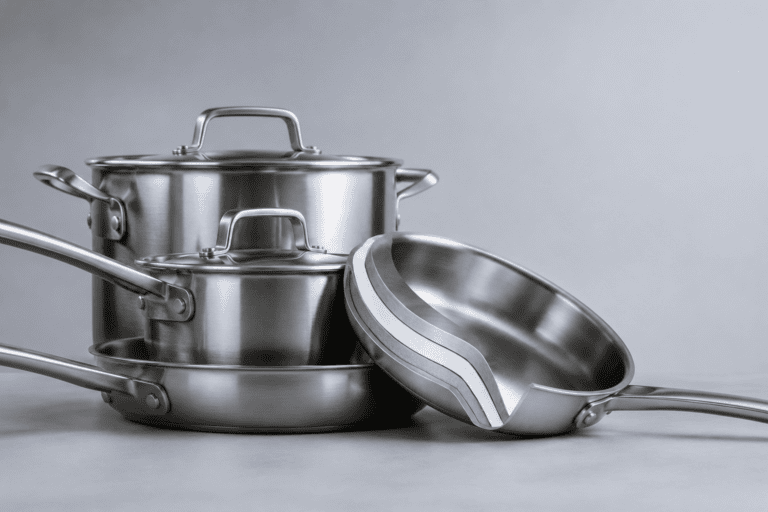
When our team prices a stockpot, we start from the blank: the flat disc of 304 or 430 that gets drawn into a body. Blank weight times sheet price sets the material line. The Nickel Institute notes that 300-series austenitic grades dominate demanding-formability products such as kitchen sinks, pots, and pans, which is exactly why cookware quotes track nickel so closely.
Forming comes next. A shallow fry pan may need one press stroke, while a tall stockpot needs several draws with annealing in between. Each extra draw adds machine time and scrap, and both are in your price whether the quote shows them or not. Deep drawing also thins the metal, so confirm wall thickness after forming, not the coil thickness.
Surface finishing is mostly labor. Mill sheet arrives in a dull 2B condition, and every step from there toward satin, brushed, or mirror adds polishing passes (the British Stainless Steel Association’s finish guide defines each stage). A mirror body with a satin interior costs more to make than plain satin throughout. We won’t quote you a universal percentage here; it depends on the shape and the buffing sequence.
Packaging and tooling round out the sheet. Bulk packing, color boxes, and mail-order cartons carry very different costs at scale. New shapes need new dies, and factories either amortize the die into the unit price or bill it separately. Always ask which one your quote does.
To make that concrete, here’s how a typical quote reads for a deep-drawn 304 stainless stockpot on our side. Material is the largest block and floats with the LME. Stamping, deep drawing, and welding come next, then surface finishing, which adds operations at every step from mill 2B toward a mirror polish. Packaging and tooling amortization close the sheet. The exact split varies by gauge, finish, and order size, which is one reason we quote tooling and the per-unit cost as separate lines: it lets buyers compare our numbers against other factories block by block.
| Quote block | What drives it | What to ask the factory |
|---|---|---|
| Material | Grade (304/430), blank weight, alloy-linked sheet price | Grade, plus wall and base thickness after forming, plus the LME reference date |
| Forming | Number of draws, annealing steps, scrap rate | The process route planned for your shape |
| Finishing | Polishing passes from mill 2B to the final finish | A named finish spec with signed acceptance samples |
| Packaging | Box type, print, master carton, container fill | An itemized packaging price per unit |
| Tooling | New dies for new shapes | Amortized or billed separately, and who owns the mold |
How do you compare OEM quotes from three factories?
Force every offer onto one spec sheet and one shipping basis first. Freight alone can flip a ranking: Drewry’s World Container Index showed Shanghai to Los Angeles at $6,482 per 40ft container and Shanghai to Rotterdam at $4,933 on July 9, 2026 (Drewry). An FOB quote leaves that freight with you, while a DDP quote buries it in the unit price, so convert every offer to one basis before you rank them.
What should the shared spec sheet pin down? For finished cookware, at minimum: steel grade, wall and base thickness after forming, base construction, the named surface finish, handle and rivet material, the packaging spec, and your inspection level. Two quotes that differ on any of these aren’t comparable yet.
Then fix the trade term. The ICC’s Incoterms 2020 framework defines 11 rules, from EXW through DDP, in force since January 1, 2020 (the US International Trade Administration keeps a plain-English summary). We quote most programs FOB Chinese port because it splits responsibility cleanly: we handle export clearance, you control ocean freight and import costs.
Two freight indices told the same story that week. Freightos put transpacific rates near $6,700 per FEU to the US West Coast and about $9,000 to the East Coast in its July 8, 2026 update. Different index, different basis, same conclusion: your delivery lane changes the real gap between factories more than a few cents of unit price does.
Finally, hold currency and validity constant, and record each quote’s LME reference date. Our RFQ checklist mirrors the one in our buyer’s guide to sourcing stainless steel kitchenware from China.
How does order volume move your unit price?
Mostly through tooling amortization, changeover time, and container fill rather than pure bargaining. Structured programs do move real money: McKinsey has documented a rapid procurement transformation that captured $30 million in run-rate savings, 20 percent of a two-year procurement target, within six weeks (McKinsey). The savings came from structure, and volume commitments carried much of the load.
Here’s how the mechanics look from the factory floor. Our MOQs run from 500 to 5,000 pieces per SKU depending on the process. Below those quantities, press changeovers and polishing-line setup eat the margin, so a small order carries the full setup cost in every unit. Past the MOQ, that fixed cost spreads thinner with each additional piece.
Volume bands beat exact quantities. Commit to a floor you’re sure of, then define tiers above it with pre-agreed prices, and let the factory share the upside when you clear a tier. Mixing SKUs to fill a 40ft container cuts per-unit freight too. We load more than 20 containers a month, so we routinely help buyers plan that fill.
Payment terms are the quiet lever. A larger deposit or shorter terms lowers our financing risk, and that’s worth real basis points on the quote. Trading a term you can afford for a price you want lands better than asking for a discount with nothing attached.
Want to see the conversation from the buyer’s chair? This short walkthrough on negotiating with Chinese suppliers covers tone and sequencing that match what we see across the table.
Nickel volatility: why your quote has an expiration date
Because the material under your quote repriced itself while you were comparing offers. LME nickel cash settlement ranged from a 2026 high of $19,450 per metric ton on May 6 to a low of $16,065 on July 6, and sat near $16,798 on July 13 (Westmetall, LME data).
That swing is why stainless mills publish monthly alloy surcharges. Aperam, the European producer, states that stainless selling prices depend on the market prices of the constituent alloying elements, particularly nickel. MEPS tracks the same effect across regional stainless prices. Your cookware quote inherits all of it through the sheet price.
So how long should a quote stay valid? Standard manufacturing quotations commonly run 30 days (see the quotation-validity clauses collected by Law Insider). For nickel-bearing stainless products, we and most of our peers shorten that to 7 to 15 days when the metal is moving. Whatever the window, compare quotes referenced to the same LME date, or you’re measuring market drift, not factory competitiveness.
A raw-material adjustment clause keeps both sides honest. Tie the sheet-price component to a published LME reference on a defined date, set a trigger band, and let the price move in either direction when the band breaks. Buyers sometimes read this as factory protection. It protects you too, because a factory locked into a loss will look for that margin somewhere you won’t enjoy.
US tariff stacking on stainless cookware in 2026
Stainless steel cookware entering the US under HTS 7323.93.00 carries a 2 percent MFN base duty (USITC), and China-origin goods add a 25 percent Section 301 duty reported under heading 9903.88.03 (CBP ruling N336921). More layers can stack on top, and those layers change.
The variable layers are the part that bites. CBP has published guidance implementing Section 232 duties of up to 50 percent on the steel content of listed derivative products, effective August 18, 2025 (CBP CSMS bulletin), and IEEPA-based reciprocal actions have come and gone by proclamation. Whether a given cookware line is covered on your entry date is a broker question. Verify the current stack with a licensed customs broker before you lock a landed-cost model.
This is also where Incoterms earn their keep. Under FOB you own the import duties and can manage classification directly. Under DDP the factory prices the duty risk into the quote, usually with a cushion you never see. For the mechanics of each layer, see our guide to how stainless steel import tariffs work in 2026.
A factory-side negotiation playbook
Since 2005 our team has quoted OEM programs for more than 1,000 brands across 30+ countries, and one pattern holds: prepared buyers get sharper first numbers. The frame that still works best is BATNA, from Fisher and Ury’s Getting to Yes. Know your best alternative before you open, and price your walk-away point.
- Send one spec pack to every factory. Reuse the five-block structure above so every quote answers the same question.
- Set three numbers before the first call: target price, fallback, and walk-away. The walk-away is your BATNA; without it you can’t say no with a straight face.
- Trade instead of squeezing. Offer a volume floor, a rolling forecast, a flexible ship window, or a larger deposit, and name the price you expect in return.
- Ask for itemized re-quotes. “What’s your best price?” earns a token cut. “Requote with mail-order packaging and a 3,000-piece floor” earns real engineering.
- Write the mechanics into the PO: LME reference date, adjustment trigger, FX basis, validity window, and surcharge rules, because anything agreed only in a call or a chat thread is hard to enforce once production starts.
| What moves our price | What doesn’t |
|---|---|
| A firm volume floor with tiered upside | A big annual forecast with no commitment attached |
| Mixed-SKU orders planned to fill a 40ft container | Splitting the same volume into many small, urgent orders |
| Simpler packaging or finish where your market allows it | Demanding a mirror finish at a satin price |
| A larger deposit or shorter payment terms | Quoting a competitor’s number without its spec sheet |
One more flag from our side of the table: price is one gate out of several. Audit the factory the way you audit the number; our guide to vetting stainless steel cookware manufacturers covers that half of the job.
Get a line-itemized OEM quote from our Jiangmen factory
UFamcooks runs a 10,000 m² stainless steel cookware factory in Jiangmen with 80+ staff, ISO 9001 certification, and LFGB and FDA test reports available on request. Send us your spec sheet and target quantities through our OEM and ODM manufacturing services page, and we’ll return a quote split into the five blocks above, with the LME reference date printed on it.
Browse the catalogFAQ
What MOQ should I expect for OEM stainless cookware?
Typical MOQs run 500 to 5,000 pieces per SKU, driven by press changeover and polishing-line setup rather than factory stubbornness. Simple spun or stamped items sit at the low end, while deep-drawn, multi-step products need larger runs to absorb setup. Ask how the MOQ was derived; the answer tells you which process the factory plans to use.
Who pays for tooling, and who owns the mold?
Both models exist. A factory can amortize the die into the unit price, which lowers your upfront cost but ties the mold to that factory, or bill tooling separately, which normally comes with a written agreement on ownership. Settle the arrangement in writing before the first purchase order, including what happens if the program ends early.
Should I ask for quotes in USD or RMB?
Ask every factory for the same currency, usually USD for export programs, and require the FX basis in writing. A mixed-currency comparison adds exchange-rate noise on top of genuine price differences. If you do accept RMB pricing, agree on a band within which the rate stays fixed, so neither side re-trades the deal after a currency move.
If LME nickel falls, does my open quote get cheaper automatically?
No. Factories buy sheet ahead of production, so a live quote reflects material already priced or committed. LME nickel fell from $19,450 in May 2026 to $16,065 in early July, but a drop like that reaches your unit price only through a requote or a contract clause tied to a defined LME reference date.