
The B2B Buyer’s Guide to Sourcing Stainless Steel Kitchenware from China
Sourcing stainless steel kitchenware from China is the process of selecting a qualified factory, agreeing on material grade and tolerances, placing an order above a minimum quantity, and verifying compliance before shipment. A complete sourcing run moves through seven decisions: vetting the factory, confirming MOQ, checking certifications, planning lead time, agreeing payment and inspection terms, choosing OEM or ODM, and structuring the RFQ price.
China exported 1.2 billion units of stainless steel household articles in 2024, worth $6.7 billion, out of total production of 1.8 billion units (IndexBox, 2024). Somewhere in that volume is the factory you’ll trust with your brand. This guide walks the seven decisions in order, written from the factory side, so the numbers match what a producer actually quotes: grades like 304, 316L, and 18/8; MOQ bands by product type; lead times in weeks; and the compliance rules that gate the EU and US markets. Where a topic needs depth, we link to a focused article, so you can vet a stainless steel cookware manufacturer without losing the thread.
Key Specs
- Common food-contact grades:
304(18/8 austenitic) for most kitchenware;316Lwhere chloride or acid exposure is high. - Typical MOQ in our production:
500–5,000 pcsper SKU; Alibaba.com’s B2B guidance marks500–1,000 unitsas a standard run. - Production lead time after sample sign-off:
30–60 daysfor standard orders; a new die adds15–30 daysin our tooling shop. - Door-to-door ocean transit, July 2026:
36.2 daysto the US West Coast,55.4to the East Coast,56.9to North Europe (Flexport). - Commercial safeguards: payment milestones written into the
PI; third-party pre-shipment inspection (PSI) before the balance payment; sampling per the agreedAQLplan. - Market-gating compliance:
LFGB(Germany),FDA(US food contact),ISO 9001(quality system),Reg (EC) 1935/2004(EU). No CE mark applies to plain stainless cookware.
How do you vet a stainless steel kitchenware factory?
Start by separating trading companies from producers, then verify the audit trail. In QIMA’s ethical audits, 25% of inspected factories earned a “Red” ranking in 2023, flagging urgent remediation, down from 27% in 2022 (QIMA Q1 2024 Barometer). Ask for the business license scope, in-house process list, and ISO 9001 certificate before sampling.
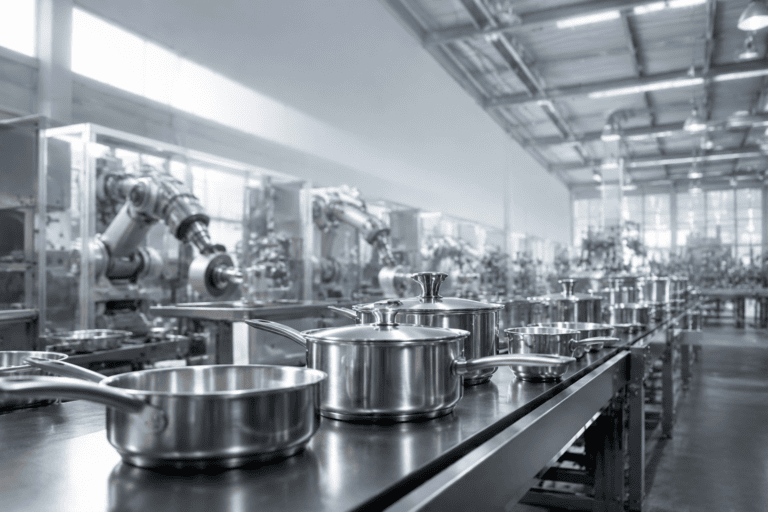
The fastest filter is a process question: which steps run in-house? A real producer answers with specifics: cold-rolling tolerance, deep-drawing, welding, polishing, passivation. A trader answers in generalities. We document our own line and inspection stations openly, because that’s the transparency test we’d want buyers to apply to everyone.
Platform badges don’t settle it either. Alibaba.com runs its Verified Supplier program precisely because a listing alone can’t confirm on-site production; verification requires a third-party audit of the premises (Alibaba.com Seller Central). Apply the same standard yourself and ask for a live video walkthrough of the line on your first call; a seller with no line of its own tends to keep postponing that request.
Third-party checks are becoming standard practice. US demand for inspections and audits ended 2025 up 9% year over year (QIMA Q1 2026 Barometer, 2026). The chart below shows what those audits keep finding, and why working hours and safety records deserve a line on your supplier scorecard.
Data point QIMA auditors found critical health and safety violations in 11% of audited factories in China in 2023, well below the 29% recorded in India (QIMA, 2024). Audit the specific factory you plan to use; country-level averages hide exactly the variance that matters at PO time.
For the full checklist, including document requests and red flags, see how to vet a stainless steel cookware manufacturer. To judge the parts you receive once samples arrive, read how to grade product quality.
What MOQ should you expect from a cookware manufacturer in China?
Expect 500 to 5,000 pieces per SKU; that’s the band we quote in our own production, set mainly by tooling cost and finish complexity. Alibaba.com’s own B2B guidance maps 500–1,000 units to a standard production run and 1,000+ to bulk manufacturing at the lowest unit cost (Alibaba.com, 2026). Simple stamped bowls sit low in the band; multi-part welded items sit high.
MOQ is an amortization tool, not an arbitrary wall. A mold or a custom polishing setup carries a fixed cost. Spread across 5,000 units, that cost disappears into the unit price; across 200 units, it doesn’t. New tooling pushes the floor up, and items running on existing dies pull it down.
Can you buy below the floor? Often, yes, if you move one of three levers: accept a finish we already run, group SKUs that share tooling, or commit part of your annual forecast to a scheduled release. We’ll open below our standard band for a committed release schedule, because predictable line load has real value to a factory.
For a full breakdown of MOQ tiers by customization depth, the seven cost drivers, and tactics for negotiating the floor down, see our detailed guide to MOQ at a stainless kitchenware factory.
Which certifications matter for stainless steel cookware?
Three frameworks gate most stainless cookware exports: Regulation (EC) No 1935/2004 plus Germany’s LFGB for the EU, FDA food-contact rules for the US, and ISO 9001 for the quality system behind them. Any material intended to touch food in the EU must comply with Regulation 1935/2004, which member states may extend with national law (Regulation (EC) No 1935/2004).
What is the difference between LFGB and FDA?
LFGB is Germany’s food and feed code and the benchmark most EU buyers request, because compliance is shown by migration testing on the finished article. Germany’s BfR recommendations describe the accepted technical route; they aren’t binding law, but they’re widely followed across EU member states (BfR). A buyer selling into both regions usually tests to LFGB first, then maps US conformity onto the same material.
The US works differently. The FDA doesn’t issue approval certificates for finished cookware; a food-contact material is lawful when each migrating component is covered under 21 CFR Parts 174–179, qualifies as GRAS, or holds an effective Food Contact Notification (FDA). So the accurate claim is “FDA-compliant,” and a supplier advertising “FDA approved” cookware deserves a second look.
Where ISO 9001 and RoHS fit
ISO 9001 specifies requirements for a quality management system: it certifies how an organization controls its processes, not the products themselves, and the certificates come from independent bodies rather than ISO itself (ISO). RoHS limits hazardous substances and applies when metal parts pair with electronic or coated components. Always check that certificate scopes name the legal entity quoting you.
Why no CE mark appears on stainless cookware
CE marking is reserved for product groups covered by EU harmonisation rules that specifically require it; where no such rules exist, affixing the mark is prohibited (Your Europe, European Commission). No harmonised CE rule covers plain, non-electrical stainless kitchenware. So a CE badge on a cookware listing is a compliance error, and worth raising with the supplier before you go further.
| Framework | Applies to | What it covers |
|---|---|---|
| LFGB | Germany; the benchmark most EU buyers request | Migration testing on the finished article |
| FDA (21 CFR) | United States | Food-contact compliance per component; no approval certificate exists for finished cookware |
| Reg (EC) No 1935/2004 | European Union | Framework rule for all food-contact materials |
| ISO 9001 | The factory’s quality system, any market | Process control at the named legal entity, certified by independent bodies |
| CE mark | Not applicable | No harmonised EU rule covers plain, non-electrical stainless kitchenware |
Compliance note Section 31(1) of the German Food and Feed Code (LFGB) prohibits food-contact articles from transferring substances to food in quantities that could endanger health or unacceptably alter its composition, odor, or taste (gesetze-im-internet.de). At EU level, Article 3 of Regulation (EC) No 1935/2004 sets the parallel requirement.
We produce in food-grade 304 and 316L, and third-party LFGB and FDA food-contact test reports travel with the order documentation, scoped to the products actually quoted. Ask for documents tied to your specific SKU rather than a generic certificate scan.
For the grade decisions underneath compliance, review material selection and the properties of 18/8 stainless steel.
How long are lead times for stainless kitchenware orders?
Plan on 30 to 60 days of production after sample sign-off for standard orders, before any freight. Alibaba.com’s B2B guidance draws the same bands: standard production in 15–30 days, bulk runs in 30–60, complex engineered products at 60+ (Alibaba.com, 2026). In our tooling shop, a new die adds another 15 to 30 days up front.
Lead time stacks in stages, and each stage has its own driver. Sampling depends on tooling status. Production depends on volume against current line load. Freight depends on lane and season. Buyers who plan against the full stack avoid the most common landed-date miss.
Shipping needs two clocks, and quotes often mix them. Port to port, a full container from China to the US runs roughly 14 to 42 days by lane; Shenzhen to Miami takes about 41 days via Suez or 35 via Panama (Freightos, 2026). Door to door, Flexport’s Ocean Timeliness Indicator showed 36.2 days to the US West Coast, 55.4 to the East Coast, and 56.9 to North Europe in early July 2026 (Flexport, 2026). Confirm which clock your forwarder is quoting before you promise a shelf date.
The most common avoidable delay we see sits on the buyer’s desk: sample approval. A sample that waits two weeks for sign-off pushes the whole schedule by two weeks, so plan to review and answer on the first sample within days rather than weeks.
Finish choice also moves the timeline, which is why early finish decisions help. See how we approach surface finishes.
Payment terms and pre-shipment inspection
Fix the commercial safeguards in writing before production starts. The proforma invoice (PI) should state each payment milestone and what releases it: the deposit that opens material purchase and tooling, and the balance that releases shipment. When the milestones live in the PI, neither side has to renegotiate them mid-run.
Booking a third-party pre-shipment inspection (PSI) before the balance payment is routine in export orders. The inspector visits the factory once production is complete and goods are packed, draws samples under the AQL plan agreed in the PI, and reports against your spec. Agree that AQL sampling standard up front, so both sides work to the same pass and fail criteria before the inspector arrives.
A legitimate factory treats this as normal workflow: it hosts the inspection agency on site, opens cartons for sampling, and holds shipment until the report clears. We accept buyer-appointed third-party inspection at our Jiangmen plant as standard practice. If a supplier resists an independent PSI, or wants the balance cleared before any inspection, fold that answer back into your Decision 01 vetting.
OEM vs ODM: match the model to design ownership
Choose OEM when you own the design and need a factory to build to it. Choose ODM when you adopt an existing factory design and put your brand on it. OEM buys full design control at the price of tooling cost and setup time; ODM trades exclusivity for speed, with sampling often inside two to three weeks.
When does OEM make sense?
OEM fits brands with a defined spec, proprietary geometry, or a patent to protect. You supply drawings and tolerances, and the factory tools to them. Settle mold ownership in writing before production starts, since you’ll typically own or co-own the dies, and expect a higher MOQ to amortize that tooling.
When is ODM the faster path?
ODM fits importers and private-label buyers who need a catalog quickly. You select from proven designs, apply your branding and packaging, and skip mold development entirely. MOQ and lead time both drop because the tooling already exists and the process has already run at volume.
| Factor | OEM | ODM |
|---|---|---|
| Mold ownership | Buyer typically owns or co-owns the dies; settle it in writing before production | Factory keeps its existing tooling; no new dies are cut |
| MOQ logic | Higher floor; new tooling cost has to amortize across the run | Lower floor; dies and process already run at volume |
| Development timeline | Longer; a new die adds 15–30 days before sampling starts | Shorter; sampling often lands inside two to three weeks |
| Design exclusivity | Full; the spec, geometry, and any patent stay with the buyer | Limited; you brand a proven design from the factory catalog |
Our own order book splits along one variable: who owns the design. Across 1,000+ brands shipped to buyers in 30+ countries, OEM clients arrive with drawings and leave owning molds, while ODM clients arrive with a market and adapt a line we already run. If you’re unsure, price both routes in the same RFQ and compare landed cost against calendar.
To weigh suppliers on customization depth, compare suppliers on tooling ownership, MOQ, and finish range.
RFQ pricing: how a factory builds your quote
A stainless kitchenware quote builds up from five blocks: material grade and gauge, tooling, finish, order volume, and trade terms. Steel dominates input cost on simple items, so grade and gauge move the price more than any other line. Volume then decides how far fixed costs dilute, and the Incoterm defines what’s inside the number.
A factory can only quote as precisely as the RFQ it receives. State seven inputs: grade (304 or 316L), gauge in mm, dimensions or capacity with tolerance, finish, quantity per SKU, target market for compliance testing, and Incoterm. What happens when an input is missing? We fill the gap with the safest assumption and price it in, and other factories handle missing inputs the same way.
Watch the gauge line hardest. Dropping from 0.8 mm to 0.6 mm shaves material cost, but it also changes weight, rigidity, and how the product feels in a shopper’s hand. Fix the gauge your market expects first, then negotiate volume from there.
Why source from UFamcooks
UFamcooks has built stainless steel kitchenware in Jiangmen, Guangdong since 2005: a 10,000 m² plant, a team of 80+, and 20+ containers leaving each month for buyers in 30+ countries and 1,000+ brands. We run OEM and ODM in food-grade 304 and 316L, send LFGB and FDA food-contact test reports with order documentation, and flex MOQ against tooling and release schedule. We publish the specs so you can check them before you commit.
Frequently asked questions
What is the minimum order quantity for custom stainless kitchenware?
Most factories set MOQ where tooling amortization starts to work. Our band runs 500 to 5,000 pieces per SKU, and Alibaba.com’s guidance treats 500–1,000 units as a standard production run. To buy under the floor, offer a scheduled annual release, pick a stock finish, or group SKUs onto shared dies.
Is 304 or 316L stainless steel better for cookware?
For most kitchenware, 304 (18/8) is the default food-contact grade. Step up to 316L when the product lives with chlorides or acids, think marine galleys, heavy brining, or commercial acid contact, because its added molybdenum resists pitting. Match the alloy to the end use instead of paying for resistance you won’t need.
How do I confirm a supplier is a real manufacturer rather than a trader?
Cross-check three documents before sampling: the business license, where production must appear in the registered scope, an ISO 9001 certificate naming the same legal entity, and a recent third-party audit report. Then schedule a real-time video walkthrough. Sellers without machines of their own tend to stall on all four requests.
Which rules apply when importing cookware into the EU and US?
EU-bound cookware must satisfy Regulation (EC) No 1935/2004, and Germany’s LFGB adds finished-article migration testing. US-bound products must be FDA-compliant under 21 CFR food-contact rules; the FDA doesn’t approve finished cookware. Plain stainless kitchenware carries no CE mark, since no harmonised EU rule mandates one.
What should a cookware RFQ include to get an accurate quote?
Give the factory everything that sets cost: alloy and wall thickness, dimensions with tolerances, surface treatment, volume per item, the market you’ll sell into, and the delivery term. Complete inputs remove guesswork, so pricing comes back tighter and faster. Gaps get filled with conservative assumptions, and the price rises to cover them.
Start your sourcing
Request a Quote with your grade, gauge, quantity, and target market.
We return a structured RFQ response: 304 / 316L food-grade stainless, OEM and ODM, flexible MOQ, LFGB and FDA test reports with your documentation. Factory direct from Jiangmen, Guangdong.
Request a Quote