
Why Custom Kitchenware Urgent Orders Work for Businesses
Urgent custom kitchenware orders are defined as time-sensitive production requests that use existing manufacturing infrastructure to deliver branded products in days rather than months.
Urgent custom kitchenware orders are defined as time-sensitive production requests that use existing manufacturing infrastructure to deliver branded products in days rather than months. This is the standard industry term for what buyers often call “rush orders” or “fast-track customization.” Understanding why custom kitchenware urgent orders work comes down to one core fact: manufacturers who maintain ODM mold libraries, buffer inventory, and AI-driven scheduling can compress lead times without cutting corners on quality. For restaurants, hotel groups, and kitchenware brands, that capability is the difference between capturing a seasonal opportunity and missing it entirely.
Urgent orders at a glance
- Minor ODM customization (logo, color, finish on an existing mold) cuts development time to
7–15 days, versus45–90 daysfor full OEM retooling. - Factories typically decline rush orders once utilization surpasses
95%capacity. - Businesses offering customized kitchenware see a
50%increase in customer retention;72%of consumers prefer personalized products. 61%of hospitality guests are willing to pay more for a personalized experience.- Buffer inventory agreements let production start the same day an order is confirmed.
- Batch matching and a pipeline of pre-approved base products protect brand consistency under urgency.
- AI-driven scheduling and ERP integration let manufacturers simulate rush-order impact within minutes.
What operational methods enable fast turnaround in urgent custom kitchenware orders?
Speed in custom production is not luck. It is the result of specific manufacturing decisions made long before a rush order arrives.
The fastest path to a finished product is minor ODM customization, which involves applying a logo, color change, or surface finish to an existing mold rather than building a new one. Minor customization via ODM reduces development time from months to just 7–15 days. That is a practical shortcut that bypasses the most time-consuming step in production: mold fabrication.
Beyond mold strategy, factories that handle urgent orders well share four operational traits:
- Buffer inventory agreements. Pre-negotiated stock of raw materials and semi-finished components means production can start the same day an order is confirmed. Priority restocking agreements and buffer inventory clauses, negotiated before emergencies arise, are the single most reliable way to secure rapid turnaround.
- Flexible production scheduling. Dedicated production slots reserved for rush orders prevent urgent jobs from disrupting regular runs. Without reserved capacity, urgent orders create chaos across the entire production floor.
- Dedicated project management. A single point of contact who tracks every stage from material sourcing to final inspection eliminates the communication delays that kill timelines.
- AI-driven scheduling and ERP integration. AI production scheduling allows manufacturers to analyze rush order impacts within minutes, running simulations to find alternative delivery options before committing to a deadline.
Pro Tip: Ask your manufacturer whether they maintain a standing buffer stock program before you ever place a rush order. If they cannot answer that question clearly, their “urgent” timeline is a guess, not a guarantee.
Quality does not get suspended under urgency. Factories that handle rush orders correctly apply the same multi-stage inspection protocols they use for standard runs, just on a compressed schedule. The difference is preparation, not shortcuts.
In brief Fast turnaround on urgent kitchenware orders comes from preparation, not shortcuts: minor ODM customization on existing molds cuts development time to 7–15 days versus 45–90 for full OEM retooling, and factories that execute well combine buffer inventory agreements, reserved production slots, dedicated project management, and AI-driven scheduling that simulates rush-order impact within minutes.
How does urgent ordering balance customization needs with consistent brand quality?
The central tension in urgent kitchenware orders is real: speed and maximum differentiation pull in opposite directions. Understanding where that line sits protects both your timeline and your brand.
The table below shows how the two primary customization models compare across the factors that matter most for urgent orders.
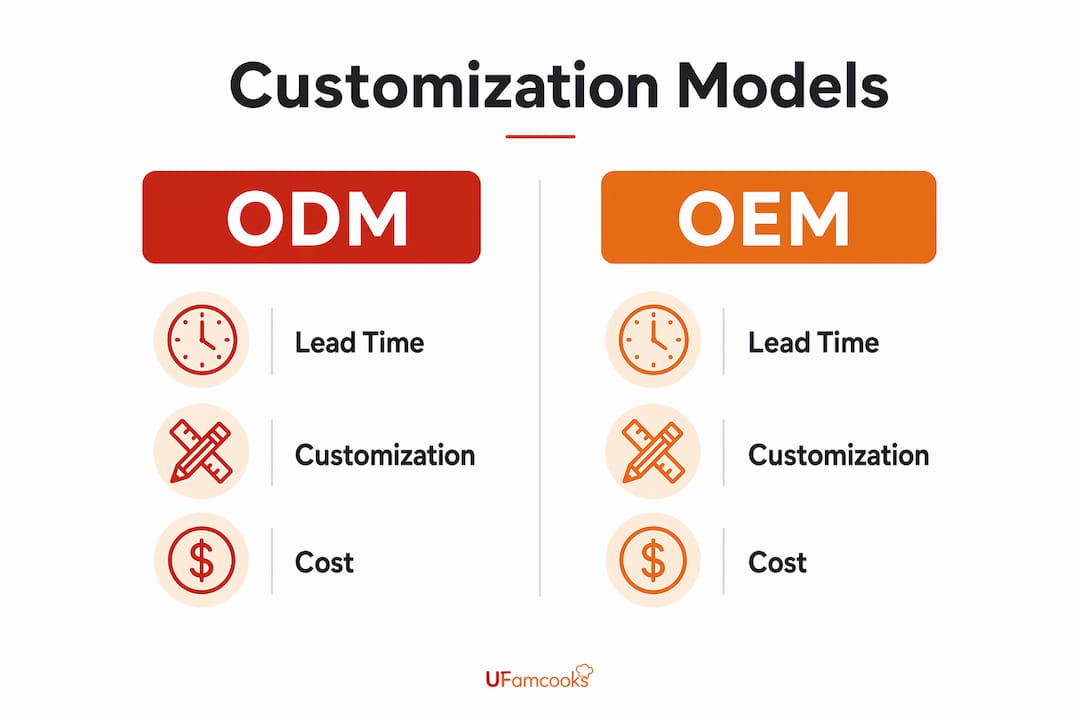
| Factor | ODM (minor customization) | OEM (full custom tooling) |
|---|---|---|
| Lead time | 7–15 days | 45–90 days |
| Mold requirement | Uses existing mold | Requires new mold fabrication |
| Brand differentiation | Logo, color, finish | Full geometry and specification |
| Best for urgent orders | Yes | No |
| Quality control complexity | Standard multi-stage | Extended validation required |
ODM minor customization is the correct choice for urgent orders in nearly every scenario. Full OEM retooling, which standard OEM/ODM production places at 4–8 weeks for standard runs and 45–90 days for full custom retooling, cannot meet a 15-day deadline without compromising structural integrity or skipping validation steps.
Maintaining brand consistency under urgency requires two additional practices. First, manufacturers must enforce batch matching, meaning every piece in a rush order uses the same steel grade, surface treatment, and finish specification as previous orders. Second, a pipeline of pre-approved base products allows rapid customization without requalifying materials from scratch. Multi-stage quality control protocols must remain active regardless of speed, because a product that ships fast but fails in service destroys the brand value the customization was meant to build.
Pro Tip: Before approving a rush order, request a material certification confirming the steel grade matches your previous batches. Batch drift is the most common quality failure in urgent production runs.
The strategic insight here is that stock solves urgency while customization protects consistency. Brands that maintain a library of pre-approved base products with their manufacturer can customize quickly without starting from zero every time.
What are the business benefits of using urgent custom kitchenware orders?
The commercial case for urgent custom kitchenware orders is grounded in measurable customer behavior, not theory.

Businesses providing customized kitchenware see a 50% increase in customer retention, with 72% of consumers preferring personalized products over generic alternatives. That retention premium compounds over time. A restaurant group that can deliver branded cookware for a new location opening in two weeks holds a real competitive advantage over one that needs three months.
The specific business benefits of urgent custom orders include:
- Last-minute event fulfillment. Hotels, catering companies, and restaurant chains regularly face openings, rebrands, or seasonal campaigns with compressed timelines. Urgent orders make those deadlines achievable without sacrificing branded presentation.
- Just-in-time production. Ordering against confirmed demand rather than forecasted demand reduces overstock risk. Businesses carry less inventory while still meeting client expectations on time.
- Competitive positioning through flexibility. The ability to say yes to a client’s urgent request is itself a differentiator. Competitors who cannot move fast lose the account, regardless of price.
- Higher willingness to pay in hospitality. Approximately 61% of hospitality guests are willing to pay more for a personalized experience. That premium flows directly to the brands and operators who can deliver customized tableware and cookware on demand.
- Faster market response. When a trend or seasonal opportunity appears, brands with urgent order capability can capitalize on it before the window closes.
The combination of retention gains, premium pricing, and reduced inventory burden makes urgent custom ordering a financially sound model, not just an operational convenience.
In brief Urgent custom kitchenware orders pay off commercially: customized kitchenware drives a 50% increase in customer retention (72% of consumers prefer personalized products), 61% of hospitality guests will pay more for a personalized experience, and the combination of retention gains, premium pricing, and just-in-time production makes urgent ordering financially sound rather than a mere convenience.
What limitations and best practices should businesses consider with urgent custom kitchenware orders?
Urgent orders have hard limits. Ignoring them leads to missed deadlines, quality failures, and damaged supplier relationships.
Respect factory capacity thresholds. Factories typically decline rush orders when utilization surpasses 95% capacity. At that level, physical machine time and worker safety cannot be stretched further without causing failures elsewhere in the production schedule. Pushing past this threshold does not accelerate delivery. It guarantees problems.
Know when to decline. Not every urgent request should be accepted. If a rush order requires full OEM retooling, a new material qualification, or a production run that conflicts with a larger committed order, the right answer is a clear no with an honest alternative timeline. Accepting an impossible deadline damages trust more than declining it.
Budget for the premium. Expedited production carries real costs: overtime labor, priority material sourcing, and dedicated project management all add to the unit price. Businesses that treat urgent order pricing as negotiable down to standard rates create incentives for manufacturers to cut corners.
Establish a rush order policy in advance. Define with your manufacturer what qualifies as a rush order, what the premium structure looks like, and what the minimum lead time is for different customization levels. Doing this before an emergency removes ambiguity when time is shortest.
Communicate specifications completely on day one. Incomplete briefs are the leading cause of urgent order delays. Every revision cycle adds days. Submit final artwork, steel grade requirements, finish specifications, and packaging details in a single complete brief at order confirmation.
Understanding and respecting factory capacity limits prevents unrealistic timelines and protects production quality during peak seasons. The businesses that get the best results from urgent orders are the ones that treat their manufacturer as a partner with real constraints, not a vendor to pressure.
Key Takeaways
Urgent custom kitchenware orders succeed because manufacturers combine ODM mold libraries, buffer inventory, and AI-driven scheduling to deliver branded products in 7–15 days without compromising quality control.
| Point | Details |
|---|---|
| ODM is the fastest path | Minor customization using existing molds cuts lead times to 7–15 days versus 45–90 days for full retooling. |
| Buffer inventory is non-negotiable | Pre-negotiated material stock allows production to start the same day an order is confirmed. |
| Quality control stays active | Multi-stage inspection protocols apply to urgent runs just as they do to standard production. |
| Capacity limits are real | Factories at 95% utilization cannot safely absorb rush orders without risking quality and schedule failures. |
| Customization drives retention | Businesses offering personalized kitchenware see a 50% increase in customer retention. |
What I’ve learned about urgent orders after years in custom kitchenware
The most common mistake I see businesses make is treating urgent orders as a test of a manufacturer’s willingness rather than a test of their preparation. A factory that says yes to every rush request without asking about specifications, capacity, or material availability is not a capable partner. It is a factory that will let you down at the worst possible moment.
The manufacturers worth working with are the ones who ask hard questions upfront. They want to know your steel grade, your finish spec, your packaging requirements, and your actual ship date before they commit. That discipline is what makes a 12-day turnaround possible, not enthusiasm.
Technology adoption matters more than most buyers realize. Manufacturers using AI-driven scheduling and real-time ERP systems can tell you within minutes whether a rush order is feasible and what the impact on your existing orders will be. That transparency is worth paying for. The alternative is a phone call three days before your deadline telling you the order is delayed.
My honest view is that the future of urgent custom kitchenware fulfillment belongs to manufacturers who invest in mold libraries, buffer stock programs, and digital production management. Businesses that build long-term relationships with those manufacturers, rather than shopping on price alone, will consistently outperform competitors when speed matters most.
— Jason
How UFamcooks handles urgent custom kitchenware orders
UFamcooks operates as a factory-direct stainless steel kitchenware manufacturer with full OEM and ODM manufacturing capabilities, including an established mold library that supports minor customization turnarounds. The factory-direct model eliminates middleman delays, which is a structural advantage when days matter. UFamcooks applies multi-stage quality control to every order, including urgent runs, so speed does not come at the cost of consistency. Kitchenware brands, wholesalers, and importers working with UFamcooks benefit from proactive delivery scheduling and a dedicated project management approach that keeps urgent orders on track from confirmation to shipment. Explore the full product range to see which base products are available for rapid customization.
FAQ
What is the fastest turnaround time for custom kitchenware?
Minor ODM customization, such as logo and color changes on existing molds, can be completed in 7–15 days. Full OEM retooling with new mold fabrication requires 45–90 days.
Why do urgent kitchenware orders sometimes fail?
Urgent orders fail most often when factories exceed 95% capacity utilization or when buyers submit incomplete specifications that require revision cycles. Both problems add days that a rush timeline cannot absorb.
Does urgent production compromise kitchenware quality?
Urgent orders succeed without compromising quality when manufacturers maintain multi-stage quality control protocols throughout the accelerated production run. Speed and quality are compatible when the factory is properly prepared.
What customization options work best for urgent orders?
ODM minor customization, covering logos, surface finishes, and color changes, is the correct choice for urgent timelines. Full structural or geometric changes require new tooling and cannot meet short deadlines safely.
How does hospitality benefit from urgent custom kitchenware?
61% of hospitality guests are willing to pay more for a personalized experience, making branded tableware and cookware a direct revenue driver. Urgent order capability lets hotels and restaurants deliver that personalization even under tight opening or rebrand schedules.
Recommended
- Material Selection in Custom Kitchenware: A Pro Guide
- Custom & OEM Stainless Steel Kitchenware: Manufacturing Guide
- UFamcooks – Excellent Kitchenware Manufacturer & Supplier
Have a deadline? Tell us the date
Send your spec and ship date — UFamcooks will confirm if it’s feasible.
Factory-direct OEM/ODM with an established mold library, multi-stage quality control on every order including rush runs, proactive delivery scheduling, and dedicated project management from confirmation to shipment.
Request a Rush Quote