
Custom & OEM Stainless Steel Kitchenware: The Complete Manufacturing Guide
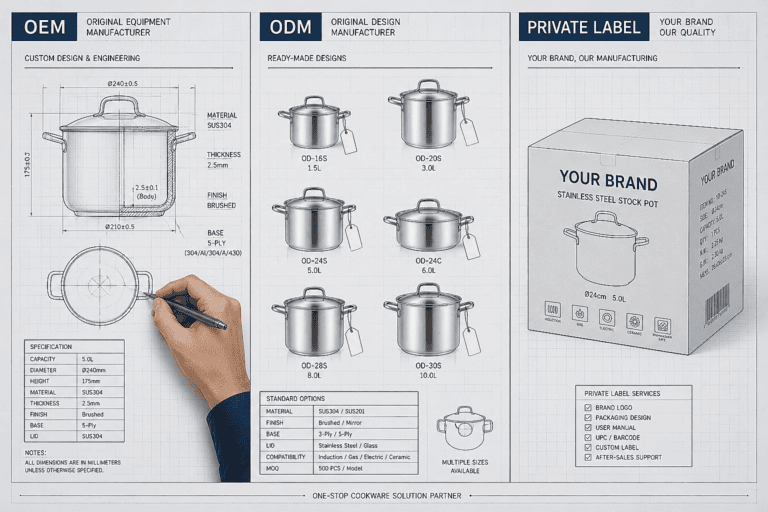
Custom stainless steel kitchenware manufacturing is the process of turning a brand’s design or concept into a production run: choosing a manufacturing model, locking the material grade and finish, cutting tooling, and setting packaging before the first unit ships. A complete custom program moves through six decisions: the OEM or ODM model, material and alloy, surface finish, tooling and molds, packaging and branding, and the custom RFQ.
This guide covers each customization decision in order. We write it as a factory, so the trade-offs reflect what a stainless kitchenware producer actually manages on a custom program: where tooling cost comes from, why grade is chosen before finish, and how packaging carries its own minimum order. Where a topic needs depth, we link to a focused article so you can move from concept to a production-ready spec without losing the thread. For the procurement side of a custom order, this guide pairs with our OEM/ODM manufacturing hub.
Key Specs
- Manufacturing models:
OEM(you own the design) ·ODM(factory design, your brand) ·private label(catalog product, your logo). - Food-contact grades:
304(18/8 austenitic) for most kitchenware;316Lwhere chloride or acid exposure is high. - Custom tooling typically adds
15–30 daysto the schedule and is amortized across order volume. - Typical MOQ band:
500–5,000 pcsper SKU, flexing with tooling, finish, and release schedule. - Customizable layers: grade and alloy, gauge, finish, dimensions and tolerance, packaging and branding.
OEM, ODM, or private label: which model fits your brand?
Choose OEM when you own the design and need a factory to build it; choose ODM when you brand an existing factory design as your own; choose private label when you want a catalog product carrying only your logo and packaging. OEM gives full design control at higher tooling cost and minimum order; ODM and private label cut time to market because the tooling already exists.
When does OEM make sense?
OEM fits brands with a defined product spec, proprietary geometry, or a patent to protect. You supply drawings and tolerances; the factory tools to them. Because new tooling carries a fixed cost, OEM usually means higher MOQ to amortize that setup, and a longer first run before samples are right. The upside is a product no competitor can order from the same catalog.
When is ODM or private label faster?
ODM and private label fit importers and retailers who need a catalog quickly without engineering a product from scratch. You select an existing design, apply branding and packaging, and skip mold development, so MOQ and lead time both drop. The trade-off is that the base design is shared, and differentiation lives in finish, packaging, and brand rather than in the form itself.
We run both OEM and ODM. If you arrive with drawings, we tool to your spec; if you arrive with a market and a brand, we adapt an existing line. For the dedicated commercial path, see our OEM / ODM manufacturing page.
In brief OEM manufacturing means the buyer owns the design and the factory tools to it, carrying higher MOQ and tooling cost but full control. ODM and private label mean adopting a factory’s existing design under the buyer’s brand, lowering MOQ and lead time because the tooling already exists; differentiation then shifts to finish, packaging, and branding.
Which stainless grade and alloy should a custom program specify?
Specify grade 304, also called 18/8, for general food-contact kitchenware, and 316L where chloride or acid exposure is high; move to a custom alloy only when a defined performance target justifies it. Grade is the first material decision because it sets corrosion resistance, formability, and cost before any finish or tooling choice is made.
The most common mistake on a custom brief is treating grade as a single checkbox. In practice, the right grade depends on the product’s environment: a dry-goods storage canister and a pan that meets simmering acidic sauces face very different corrosion loads. Fixing the application first, then matching the grade, avoids both under-spec failures and the cost of over-specifying 316L where 304 would serve.
For the full grade decision, including formability and weldability trade-offs, see our guide to material selection. When a standard grade will not meet a performance target, read how custom stainless steel alloy is engineered against a defined spec.
In brief Grade 304 (18/8) suits most food-contact kitchenware; 316L adds molybdenum for higher chloride and acid resistance and is specified where the application demands it. Grade is chosen before finish or tooling because it sets corrosion resistance, formability, and base cost. A custom alloy is justified only when a defined performance target exceeds what standard grades deliver.
How do you specify the surface finish?
Specify the finish early, because it affects tooling, cycle time, and unit cost, not just appearance. A brushed satin, a mirror polish, and a bead-blasted matte each demand different process steps and add different amounts of labor per unit. Finish is also functional: it changes cleanability, how visible fingerprints are, and how the surface ages in use.
Buyers often pick a finish from a photo and discover the cost only at quote stage. A mirror polish, for example, requires multiple progressive polishing passes and tight handling to avoid scratches, which raises both unit cost and reject rate. Choosing the finish at the spec stage, alongside grade and gauge, keeps it from becoming a late surprise that forces a redesign or a price renegotiation.
For the full range and how each option behaves over a product’s life, see how we approach selecting finishes for custom stainless kitchenware.
In brief Surface finish is a manufacturing decision, not only an aesthetic one: brushed, mirror, and matte finishes each require different process steps and add different labor per unit. Finish also drives cleanability, fingerprint visibility, and wear. Specifying it at the spec stage, with grade and gauge, prevents late cost surprises and reject-rate spikes.
What do tooling and molds cost, and who owns them?
Tooling is the fixed setup, the molds, dies, and fixtures, that a custom design requires before production can begin; its cost is amortized across order volume, and ownership should be agreed in writing before the first run. New tooling typically adds 15 to 30 days to the schedule and is the main reason a custom item carries a higher minimum order than a catalog one.
Why MOQ rises with custom tooling
A mold or a custom polishing setup carries a fixed cost regardless of how many units run on it. Spread across 5,000 units, that cost nearly disappears into the unit price; across 200 units, it dominates. That is why a factory quotes a higher MOQ when new tooling is involved and a lower one for items running on existing dies, and why combining SKUs that share tooling can bring the effective minimum down.
Who owns the molds?
Mold ownership is a commercial term, not a default, and it should be settled before production. Some programs have the buyer pay for and own the tooling outright; others share or amortize it into unit price with the factory retaining the physical mold. Neither is wrong, but leaving it unwritten creates friction later if you move volume or change suppliers. We set tooling ownership out in the quote so there is no ambiguity at reorder.
In brief Tooling is the fixed cost of molds, dies, and fixtures a custom design requires; it is amortized across order volume, so MOQ rises when new tooling is involved. New molds typically add 15 to 30 days to the schedule. Mold ownership is a commercial term that should be agreed in writing before the first run, not assumed.
How far can packaging and branding be customized?
Packaging and branding customization covers laser-etched or printed logos on the product, plus custom color boxes, inserts, manuals, and retail-ready or e-commerce-safe cartons. These layers are a separate program from the product itself, with their own minimum order and lead time, and they are often where a private-label buyer creates most of the visible differentiation.
The practical point buyers miss is that packaging MOQ and product MOQ do not have to match, and printed cartons usually carry their own setup cost for plates or print files. Planning branding alongside the product spec, rather than after sampling, keeps both timelines aligned and avoids a finished product waiting on boxes that were ordered too late. Where branding is etched onto the product, it also interacts with finish, so it belongs in the same conversation as the surface decision.
In brief Packaging and branding customization, laser-etched or printed logos, custom boxes, inserts, and retail-ready cartons, is a separate program from the product, carrying its own MOQ, setup cost, and lead time. For private-label buyers it is often the primary layer of visible differentiation, and it should be planned alongside the product spec rather than after sampling.
How do you structure a custom manufacturing RFQ?
A custom RFQ states the manufacturing model (OEM or ODM), grade and gauge, dimensions with tolerance, finish, packaging spec, quantity per SKU, target market for certification, and Incoterm. The more complete the brief, the tighter and faster the quote, because a factory builds less padding into a price when fewer variables are left open.
A vague custom RFQ invites a conservative quote or a long back-and-forth, since the factory has to guess at the missing variables or price for the worst case. The strongest briefs read like a spec sheet: each layer this guide covers, model, material, finish, tooling expectation, packaging, and volume, stated explicitly. That lets a producer quote against a real product rather than an idea, and it surfaces trade-offs early enough to adjust before tooling is cut.
For the wider procurement context around a custom order, including vetting, MOQ, certifications, and lead times, work through the B2B sourcing guide alongside this one.
In brief A complete custom kitchenware RFQ states the model (OEM or ODM), grade and gauge, dimensions with tolerance, finish, packaging spec, quantity per SKU, target certification market, and Incoterm. A precise, spec-sheet brief returns a tighter quote faster because the factory prices against a defined product rather than padding for open variables.
Why manufacture with UFamcooks
We are a stainless steel kitchenware factory in Jiangmen, Guangdong, running OEM and ODM production. We work in food-grade 304 and 316L, tool to buyer drawings or adapt existing designs, and customize finish, packaging, and branding. We set tooling ownership and MOQ out in the quote, hold certifications relevant to EU and US food contact, and can supply current certificates and third-party test reports on request. We publish specs, not slogans, so you can verify before you commit.
Frequently asked questions
What is the difference between OEM and ODM kitchenware manufacturing?
OEM means you own the design and the factory builds to your drawings and tolerances, with higher tooling cost and MOQ but full control. ODM means you brand an existing factory design as your own, which lowers MOQ and lead time because the tooling already exists. Private label is a form of ODM where you change only the logo and packaging.
Can I create a fully custom stainless steel product, or only modify existing designs?
Both paths are available. A fully custom (OEM) product is tooled from your drawings, which requires new molds and a higher minimum order to amortize that setup. Modifying an existing design (ODM) is faster and cheaper because the tooling exists; you customize grade, finish, packaging, and branding on a proven base. The right path depends on how much the form itself needs to be unique.
How much does custom tooling cost and who owns the molds?
Tooling is a fixed setup cost amortized across order volume, which is why it pushes MOQ up; the more units a mold runs, the less it adds per piece. Ownership is a commercial term to agree in writing before production: the buyer may own the tooling outright, or it may be shared or amortized with the factory retaining the physical mold. We state tooling ownership in the quote so reorders carry no ambiguity.
What is the MOQ for custom stainless steel kitchenware?
MOQ typically ranges from 500 to 5,000 pieces per SKU. Items on existing tooling sit at the low end; custom-molded or multi-part products sit higher because new tooling has to be amortized. MOQ can flex when you accept an existing finish, combine SKUs that share tooling, or commit to a release schedule rather than a single batch.
Can you customize packaging and branding for private label?
Yes. Branding options include laser-etched or printed logos on the product, plus custom color boxes, inserts, manuals, and retail-ready or e-commerce cartons. Packaging is a separate program with its own MOQ, setup cost, and lead time, so it is best planned alongside the product spec rather than after sampling to keep both timelines aligned.
Start your custom program
Request a Quote with your model, grade, finish, and packaging spec.
We return a structured RFQ response: OEM and ODM, 304 / 316L food-grade stainless, tooling ownership stated, flexible MOQ, certificates on request. Factory direct from Jiangmen, Guangdong.
Request a Quote