
How Stainless Steel Import Tariffs Work in 2026
Stainless steel import tariffs are federal duties calculated on the full customs value of imported goods, not just the metal content, under the Section 232 trade remedy framework. The April 2026 Presidential Proclamation restructured how stainless steel import tariffs work, replacing the old metal-content measurement approach with a classification-based system effective april 6, 2026. For importers, exporters, and trade professionals, this shift changes how you calculate landed costs, negotiate supplier contracts, and manage compliance across every product form from sheets and bars to fabricated kitchenware.
How stainless steel import tariffs work under Section 232
Section 232 tariffs are duties authorized under the Trade Expansion Act of 1962, applied when steel imports are deemed a threat to U.S. national security. The april 2026 Proclamation expanded and restructured these duties significantly. Rates now apply to the full customs value of the imported product, not just the embedded metal portion. That distinction matters enormously for mixed-component goods, where the old metal-content calculation would have produced a much lower duty base.
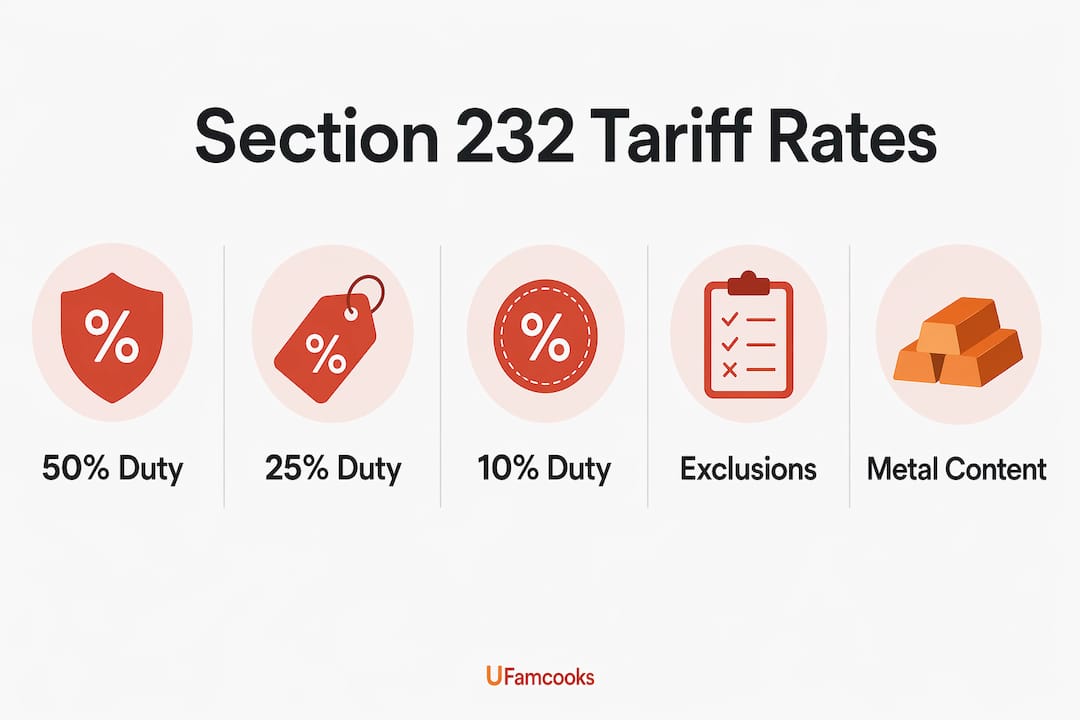
The tiered duty structure works as follows. Products made entirely or almost entirely of stainless steel carry a 50% duty. Derivative articles substantially made of steel carry 25%. Products manufactured abroad using qualifying U.S.-origin metals qualify for a reduced 10% rate. These rates apply based on product classification under Annex I-A and Annex I-B lists, which U.S. Customs and Border Protection (CBP) uses to sort imports into the correct duty tier.

The shift from metal-content measurement to classification-based tariffs simplifies the math but raises the stakes on accurate product classification. A misclassified entry can move a product from the 25% tier to the 50% tier, doubling the duty bill on a single shipment. That is not a rounding error. It is a compliance failure with real financial consequences.
How tariff classification and customs valuation determine your duty
HTSUS classification codes, customs value, and country of origin are the three inputs CBP uses to calculate every import duty. The Harmonized Tariff Schedule of the United States (HTSUS) assigns a 10-digit code to every product. That code determines which Section 232 annex list applies and, by extension, which duty rate the importer owes.
Customs value is typically the transaction value, meaning the price actually paid for the goods. CBP requires this figure to be declared on CBP Form 7501, the legal record for every import entry. The accuracy of Form 7501 in classification, value, and origin declarations is the foundation of compliance. Errors on this form create liability, not just administrative headaches.
Country of origin affects both the applicable tariff rate and whether additional trade remedies stack on top of Section 232. A stainless steel product from China, for example, may face Section 232 duties plus Section 301 tariffs simultaneously. A product from a country with a bilateral trade agreement may qualify for preferential treatment or exemptions, depending on current proclamation language.
- Verify the 10-digit HTSUS code before the purchase order is placed, not after the shipment arrives.
- Confirm country of origin documentation, including mill certificates and certificates of origin, before customs entry.
- Declare customs value based on the actual transaction price, including all charges payable as a condition of sale.
- Use a licensed customs broker to file CBP Form 7501 and review classification against current Annex I-A and I-B lists.
What are the tariff rates for different stainless steel products?
Stainless steel product forms map to different HTSUS subheadings, and those subheadings determine which Section 232 annex list applies. Sheets, bars, tubes, and fabricated goods each fall under distinct classifications. That means a kitchenware importer buying stainless steel mixing bowls faces a different tariff tier than an industrial buyer importing raw bar stock.
The metal-content threshold is the key dividing line. Products with 15% or less stainless steel content by value are excluded from Section 232 duties entirely. Products above that threshold fall into either the 50% or 25% tier based on whether they qualify as “entirely or almost entirely” steel or as derivative articles. Understanding how product composition affects duty is not optional. It is the core skill for any trade professional managing stainless steel imports.
| Product type | Duty rate | Basis |
|---|---|---|
| Entirely or almost entirely stainless steel | 50% | Full customs value |
| Derivative articles substantially made of steel | 25% | Full customs value |
| Made abroad with qualifying U.S.-origin metals | 10% | Full customs value |
| Products with 15% or less steel content by value | 0% (excluded) | Not applicable |
How do Anti-Dumping, Countervailing Duties, and Section 301 stack on top?
Trade remedy stacking is the single biggest source of surprise costs for stainless steel importers. Section 232 does not operate in isolation. Anti-Dumping (AD) duties, Countervailing Duties (CVD), and Section 301 tariffs can all apply to the same shipment simultaneously, depending on the product and country of origin.
AD duties address below-cost pricing by foreign producers. CVD duties offset foreign government subsidies. Both are administered by the U.S. Department of Commerce and the International Trade Commission (ITC). AD/CVD rates vary by exporter and producer identity, not just by country. An importer buying from a Chinese producer that was individually investigated may face a different cash deposit rate than one buying from a producer covered by the country-wide “all others” rate. That distinction can mean tens of thousands of dollars on a single container.
Section 301 tariffs apply specifically to Chinese-origin goods and were originally imposed in 2018. They remain in effect and layer on top of Section 232 for most stainless steel product categories from China. The combined exposure for a China-origin stainless steel product can exceed 100% of customs value when all three duty types stack.
- Check the Commerce Department’s AD/CVD order database before sourcing from any new supplier or country.
- Collect producer and exporter identity documentation early. Cash deposit rates are producer-specific, not just country-specific.
- Run a full trade remedy check against the specific 10-digit HTSUS code, not just the product category.
- For China-origin goods, calculate Section 232 plus Section 301 plus any applicable AD/CVD as separate line items in your landed-cost model.
How to manage compliance and landed costs as a stainless steel importer
Operational compliance for stainless steel imports is a continuous process, not a one-time setup. Procurement experts recommend updating landed-cost models and clarifying duty assumptions in supplier quotations every time regulations change. The april 2026 Section 232 revisions are exactly the kind of trigger that demands a full cost model review.
The practitioner workflow that works in practice looks like this:
- Match documents before entry. Align the purchase order, commercial invoice, packing list, and Mill Test Certificate with the intended HTSUS classification before the shipment reaches port. Discrepancies found at this stage are fixable. Discrepancies found during a CBP audit are not.
- Verify classification against current annex lists. Annex I-A and I-B product lists define which duty tier applies. Confirm the product’s classification against the current version of these lists, not the version from six months ago.
- Separate tariff costs from base material costs in supplier quotes. Distributors’ price quotes may or may not include duty risk. Ask explicitly. Build tariff exposure as a separate line item in every cost model.
- File Post Summary Corrections when needed. Post Summary Corrections (PSC) can be filed before entry liquidation to fix classification or value errors. Use this window. Waiting until liquidation closes the door on corrections without a formal protest.
- Coordinate across procurement, logistics, and customs brokers. Tariff liability is not just a customs problem. It affects purchase order pricing, inventory valuation, and margin forecasting. All three functions need to work from the same landed-cost assumptions.
For importers sourcing stainless steel kitchenware, the product grade and composition directly affect which HTSUS subheading applies and which duty tier the product falls into. Getting that classification right at the sourcing stage is far cheaper than correcting it after entry.
Key takeaways
Stainless steel import tariffs under the 2026 Section 232 framework apply tiered rates of 10%, 25%, or 50% on full customs value, determined entirely by product classification and metal-content thresholds.
| Point | Details |
|---|---|
| Full customs value is the duty base | Duties apply to the total declared value, not just the metal content of the product. |
| Classification drives the rate | The 10-digit HTSUS code and Annex I-A or I-B placement determine whether 50%, 25%, or 10% applies. |
| Trade remedies stack | Section 232, Section 301, AD, and CVD duties can all apply to the same shipment simultaneously. |
| PSC windows are a compliance tool | Post Summary Corrections allow importers to fix classification or value errors before entry liquidation. |
| Supplier quotes need duty clarity | Always confirm whether a supplier’s price includes or excludes tariff exposure before finalizing a purchase order. |
What I’ve learned about tariff compliance that most guides skip
The most expensive mistake I see importers make is treating tariff classification as a one-time task. They classify a product correctly at launch, then import the same SKU for two years without checking whether the annex lists or duty rates have changed. The april 2026 Section 232 revisions are a perfect example of why that approach fails. Products that were classified under the old metal-content framework needed reclassification under the new full-value system. Importers who caught that early renegotiated supplier prices before the new rates hit. Importers who missed it absorbed the cost increase after the fact.
The second thing most guides skip is the producer identity issue in AD/CVD cases. Trade professionals often focus on country of origin and forget that the cash deposit rate can vary dramatically based on which specific factory produced the goods. I have seen importers pay the country-wide “all others” rate for years when their specific supplier had a much lower individually investigated rate. That is recoverable money left on the table.
My practical advice: treat your landed-cost model as a living document. Review it every quarter. When a new proclamation drops, run your full SKU list against the updated annex lists within 30 days. The vetting of stainless steel manufacturers should include a tariff exposure review, not just quality and capacity checks. Suppliers who understand your tariff situation and can provide accurate documentation are worth more than suppliers who offer a slightly lower unit price but create compliance risk.
— Jason
How UFamcooks helps importers source stainless steel kitchenware with confidence
Tariff complexity does not have to mean sourcing complexity. UFamcooks manufactures stainless steel kitchenware directly from its factory, eliminating middleman markups and giving importers cleaner cost structures to work with when building landed-cost models. Every product is available with full OEM and ODM customization, from design to packaging, so you control the product specification and the documentation that supports your customs classification. UFamcooks provides Mill Test Certificates and detailed product specifications as standard, which are exactly the documents your customs broker needs to file an accurate CBP Form 7501. Browse the full stainless steel kitchenware catalog to find product forms that fit your tariff tier and margin targets.
Browse the catalogFAQ
What is the Section 232 duty rate on stainless steel in 2026?
The april 2026 Proclamation sets a 50% duty on products made entirely or almost entirely of stainless steel, 25% on derivative articles substantially made of steel, and 10% for products made abroad using qualifying U.S.-origin metals. All rates apply to full customs value.
What does “full customs value” mean for tariff calculation?
Full customs value is the total transaction price paid for the imported goods, including all charges payable as a condition of sale. Duties are calculated on this total figure, not just the value of the metal content within the product.
Can Section 232 and Anti-Dumping duties apply to the same shipment?
Yes. Section 232, AD/CVD, and Section 301 tariffs can all stack on the same shipment depending on the product’s HTSUS code and country of origin. China-origin stainless steel products frequently carry all three simultaneously, making combined duty exposure a critical calculation for any importer.
What is a Post Summary Correction and when should I use it?
A Post Summary Correction (PSC) is an amendment filed with CBP before an import entry is liquidated. Use it to fix errors in classification, declared value, or country of origin after a shipment has entered but before CBP finalizes the duty assessment.
How do I know if my stainless steel product qualifies for the 15% content exclusion?
Products with 15% or less stainless steel content by value are excluded from Section 232 duties. To qualify, you need a formal bill-of-materials analysis documenting the composition, which your customs broker can use to support the exclusion claim during entry or a CBP audit.