
How a Product Design Brief Works in Manufacturing
A product design brief is defined as a concise 1–2 page strategic document that captures a product’s core problem, target audience, and manufacturing constraints before any design work begins.
A product design brief is defined as a concise 1–2 page strategic document that captures a product’s core problem, target audience, and manufacturing constraints before any design work begins. Product managers and designers in manufacturing use it to align cross-functional teams on the “why” and “what” of a product, not the detailed “how.” The brief is distinct from a Product Requirements Document (PRD) or technical specification. It sits upstream of both, functioning as the first formal checkpoint where leadership approves the opportunity. Understanding how product design brief works in manufacturing is the difference between a focused development cycle and an expensive loop of revisions.
The design brief at a glance
- A brief is a concise
1–2 pagestrategic document — running longer crosses into PRD territory. - Eight core sections: project overview, brand background, target audience, goals, scope, constraints, timeline, budget range.
- Replace vague aspirations with measurable goals — e.g.
reduce unit cost by 10%or FDA food-contact compliance. - Keep the approval group lean:
3–5stakeholders (product lead, engineering lead, business lead). - Document sequence: design brief → PRD → technical specification; the brief sits upstream of both.
- Run a
30-minutebrief review with product, engineering, and business leads before any design work starts. - Treat the brief as a live document — update it when constraints change, not a static handoff artifact.
What are the essential components of a manufacturing design brief?
A well-structured design brief covers eight core sections: project overview, brand background, target audience, goals, scope, constraints, timeline, and budget range. Each section carries specific weight. Skipping even one creates ambiguity that compounds downstream.
Project overview and brand background set the context. Teams need to understand the business reason for the product before they can make good design decisions. A brief that opens with “we need a new pot” without explaining the brand position or market gap leaves engineers and designers guessing.

Target audience and user needs define who the product serves and what problem it solves for them. This section should describe the end user in behavioral terms, not just demographics. A kitchenware brand targeting professional home cooks has very different material and ergonomic requirements than one targeting budget-conscious families.
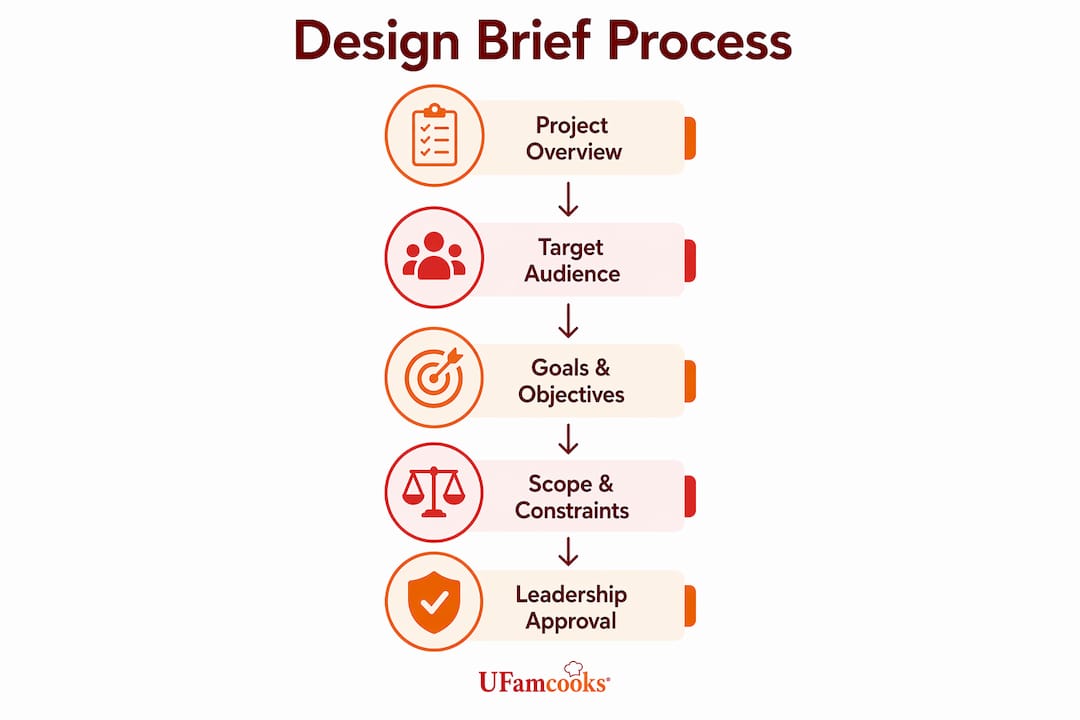
Goals and measurable success criteria are where most briefs fall short. Vague goals like “create a disruptive product” give teams nothing to work with. Precise, measurable outcomes like “reduce unit cost by 10%” or “meet FDA food-contact compliance standards” anchor decisions and reduce early-stage corrections.
The remaining sections cover:
- Scope inclusions and exclusions: List what the project covers and, critically, what it does not. Explicit exclusions prevent scope creep.
- Technical and manufacturing constraints: Specify materials, production volume, regulatory requirements, and cost ceilings. Production volume directly impacts which manufacturing processes are viable, such as injection molding versus die casting.
- Timeline and budget range: A budget range, not a fixed number, allows designers to make cost-informed decisions without locking in a figure prematurely.
Pro Tip: Never submit a brief that exceeds two pages. A brief that runs longer has crossed into PRD territory. If you cannot summarize the product’s intent, audience, and constraints in two pages, the strategy is not clear enough yet.
In brief A manufacturing design brief covers eight core sections — project overview, brand background, target audience, goals, scope, constraints, timeline, and budget range — each carrying specific weight so that skipping one creates ambiguity downstream. Goals should be measurable (e.g. “reduce unit cost by 10%” or FDA food-contact compliance), and the whole brief should stay within two pages before it drifts into PRD territory.
How does a design brief improve collaboration and reduce risk?
A product brief in manufacturing works as a shared reference point that replaces assumptions with documented agreements. Before any CAD file opens or tooling quote is requested, every stakeholder reads the same one-page summary of what the product is trying to accomplish.
“A great brief defines the problem space clearly in non-technical language, empowering innovation within manufacturing constraints. Focusing on user pain points and business opportunity instead of prescriptive solutions leads to more effective design outcomes.”
This matters because manufacturing teams and design teams often speak different languages. Engineers think in tolerances and material costs. Designers think in user experience and aesthetics. A brief written in plain language forces both groups to agree on the problem before either group proposes a solution.
The collaboration benefits are concrete:
- Prevents design by committee. When goals are vague, every stakeholder fills the gap with their own interpretation. A clear brief limits that drift.
- Enables early feasibility assessment. Manufacturing engineers can flag constraint conflicts before expensive prototyping begins.
- Reduces iteration loops. Failing to document manufacturing constraints early causes design-engineering tradeoffs later, leading to launch delays and cost overruns.
- Speeds up decision-making. Teams spend less time in alignment meetings when the brief already captures the agreed direction.
Limiting the approval group to three to five key stakeholders prevents decision paralysis and reduces costly development delays. Decision maker overload can delay design approval cycles significantly. Keeping the stakeholder group lean is not a shortcut. It is a discipline that protects the project’s momentum.
In brief A design brief reduces risk by replacing assumptions with documented agreements every stakeholder reads before any CAD file opens or tooling quote is requested. Written in plain language, it forces engineering and design to agree on the problem first — preventing design by committee, enabling early feasibility checks, and reducing the iteration loops that drive launch delays and cost overruns.
What are the common pitfalls when creating a product design brief?
The most common mistake product managers make is treating the brief like a PRD. The brief answers “what” and “why.” The PRD answers “how” in functional detail. Conflating the two produces a document that is too long to align leadership and too shallow to guide engineering.
- Writing a brief that is too long. A brief exceeding two pages has shifted into detailed requirements territory. Brevity forces clarity. Lengthy documents dilute focus and slow decision-making.
- Omitting a budget range. Providing a budget range allows cost-informed design decisions and prevents expensive revisions. Designers who do not know the cost ceiling will propose solutions the factory cannot produce at margin.
- Using unmeasurable goals. “Best in class” and “market leading” are not goals. They are aspirations. Replace them with metrics: target retail price, weight limit, compliance certification, or production cycle time.
- Ignoring explicit scope exclusions. Defining what is out of scope protects timelines and budgets in custom manufacturing projects. A brief that only lists inclusions invites teams to add features that were never approved.
- Locking the brief as a static document. The brief should evolve as new constraints emerge. Treat it as a live alignment tool, not a handoff artifact. When a material becomes unavailable or a compliance requirement changes, update the brief before the team discovers the conflict through a failed prototype.
Pro Tip: Schedule a 30-minute brief review with your product lead, engineering lead, and business lead before any design work starts. Three stakeholders in the room is enough. More than five and you will spend the meeting managing opinions instead of making decisions.
Material selection is one area where constraint documentation pays off immediately. Specifying stainless steel grade, surface finish requirements, and food-contact compliance in the brief prevents the engineering team from discovering incompatibilities after tooling is already ordered.
In brief The five most common brief pitfalls are treating the brief like a PRD, writing more than two pages, omitting a budget range, using unmeasurable goals, and locking it as a static document. Replacing aspirations with metrics (target retail price, weight limit, compliance certification, cycle time), listing explicit scope exclusions, and updating the brief when constraints change are the disciplines that prevent costly late-stage rework.
How does the design brief fit into the full product development process?
The product design brief is the first document in a staged development sequence. It precedes both the PRD and the technical specification. Each document serves a distinct purpose, and confusing their roles is a common source of process friction.
| Document | Primary audience | Core question answered | Stage |
|---|---|---|---|
| Product design brief | Leadership, product, design | What problem are we solving and why? | Pre-development |
| PRD | Product, engineering | What must the product do? | Development planning |
| Technical specification | Engineering, manufacturing | How will it be built? | Engineering execution |
The brief gains leadership approval on the opportunity, while the PRD and technical specs guide execution. This sequence matters because each document builds on the one before it. A weak brief produces a PRD full of assumptions. A PRD full of assumptions produces a technical spec that engineering has to rewrite after the first prototype fails.
The brief review meeting should include the product lead, engineering lead, and business lead. These three roles represent the three constraints every manufacturing product must balance: user value, technical feasibility, and commercial viability. Approval from all three before design begins is the checkpoint that prevents the most expensive mistakes.
Once the brief is approved, it does not disappear. Reference it at every major milestone. When the PRD is drafted, check it against the brief. When the first prototype is reviewed, verify it still solves the problem the brief defined. The brief is the anchor. Everything else is elaboration.
For teams working on OEM and ODM kitchenware projects, the brief also communicates the brand’s non-negotiables to the manufacturing partner before sampling begins. This saves weeks of back-and-forth on specifications that should have been settled at the strategy stage.
In brief The design brief is the first document in a staged sequence — brief → PRD → technical specification — answering “what problem and why” before the PRD’s “what must it do” and the spec’s “how will it be built.” Sign-off from the product, engineering, and business leads (user value, technical feasibility, commercial viability) before design begins is the checkpoint that prevents the most expensive mistakes.
Key Takeaways
A product design brief is the single most cost-effective document in manufacturing development because it forces alignment on goals, constraints, and scope before any money is spent on tooling or prototyping.
| Point | Details |
|---|---|
| Keep the brief to two pages | Longer briefs blur the line with PRDs and slow leadership approval. |
| Include measurable goals | Replace vague aspirations with specific metrics like cost targets or compliance certifications. |
| Document scope exclusions | Explicitly listing what is out of scope prevents budget overruns in custom manufacturing. |
| Limit approvers to three to five | Lean stakeholder groups make faster decisions and avoid costly feedback loops. |
| Treat the brief as a live document | Update it when constraints change rather than letting the team discover conflicts through failed prototypes. |
Why the brief is the most undervalued document in manufacturing
I have worked with product teams that spent months on detailed PRDs and technical specs, only to discover at the prototype stage that leadership never agreed on the core problem the product was solving. That is not an engineering failure. It is a brief failure.
The brief is consistently undervalued because it looks simple. Two pages feels like a small deliverable. Teams rush through it to get to the “real work” of design and engineering. That instinct is exactly backwards. Every hour spent sharpening the brief saves days of rework later.
The most effective briefs I have seen share one quality: they define what the product will not do as clearly as what it will. Explicit exclusions are not a sign of limited ambition. They are a sign of disciplined thinking. A brief that says “this product will not include a non-stick coating in version one” gives the engineering team permission to stop debating it and focus on what matters.
Scope creep is not a manufacturing problem. It is a communication problem. The brief is the fix.
I also believe the brief should never be a one-time handoff. The best teams I have observed treat it as a standing reference document, reviewed at every major gate. When a supplier changes a material or a compliance standard shifts, the brief gets updated first. That discipline keeps the whole team oriented to the same north star, even as the details evolve.
— Jason
How UFamcooks supports teams from brief to production
UFamcooks works directly with kitchenware brands, wholesalers, and importers who need a manufacturing partner that understands the brief stage, not just the production stage. When your design brief specifies stainless steel grade, surface finish, and compliance requirements, UFamcooks translates those constraints into manufacturable products through its OEM and ODM services. The factory direct model removes middleman costs and keeps communication direct throughout sampling and production. Teams that arrive with a clear brief get faster samples, fewer revision rounds, and more predictable delivery schedules. Explore UFamcooks’ full manufacturing capabilities and see how a well-written brief becomes a production-ready product.
FAQ
What is a product design brief in manufacturing?
A product design brief is a concise 1–2 page document that defines the product’s core problem, target audience, goals, and manufacturing constraints. It aligns teams before design or engineering work begins.
How is a design brief different from a PRD?
The brief answers “what” and “why” at a strategic level to gain leadership approval. The PRD follows with detailed functional requirements and user stories that guide engineering execution.
What should a manufacturing design brief always include?
Every brief should cover project overview, target audience, measurable goals, scope inclusions and exclusions, technical and manufacturing constraints, timeline, and a budget range.
How many stakeholders should approve a design brief?
Limiting approvers to three to five key stakeholders prevents decision paralysis. The core group should include the product lead, engineering lead, and business lead.
When should the design brief be updated?
The brief should be updated whenever a significant constraint changes, such as a material substitution, compliance requirement shift, or budget revision. Treat it as a live alignment document, not a static handoff.
Recommended
- OEM vs ODM vs Private Label Cookware: Which Fits Your Brand
- Custom & OEM Stainless Steel Kitchenware: Manufacturing Guide
- OEM / ODM Stainless Steel Kitchenware Manufacturing – Excellent Kitchenware Manufacturer & Supplier
- MOQ Explained: What to Expect from a Stainless Kitchenware Factory
From brief to production
Bring your design brief to UFamcooks and turn constraints into a production-ready product.
Factory-direct OEM and ODM: specify stainless steel grade, surface finish, and compliance requirements in your brief, and UFamcooks translates them into manufacturable products — direct communication through sampling and production, faster samples, and fewer revision rounds.
Request a Quote