
Stainless Steel Cookware Customization Options: 2026 Guide
Stainless steel cookware customization is defined as the process of specifying material grade, surface finish, certifications, ergonomic features, and packaging to meet exact market and compliance requirements. For manufacturers and retailers, getting these stainless steel cookware customization options right determines which markets you can legally sell into, what price point you can command, and how your product stands apart on the shelf. The two most critical starting decisions are material grade (304 vs. 316 stainless steel) and certification stack (FDA, NSF, LFGB). Tariffs and volatile raw material pricing affect final cost significantly, so locking in your spec early protects your margins.
1. What are the primary material grades for customizable cookware?
304 stainless steel is the baseline material for most custom cookware programs. It offers broad market acceptance, strong corrosion resistance, and a cost structure that works for private label and commercial buyers alike. The most cost-effective entry for private label brands is 304 stainless steel with NSF and FDA certification, because it captures the largest commercial segment at an acceptable price point.
316 stainless steel carries a 20–30% price premium over 304 and is suited for specialized environments like coastal kitchens and European export programs. The added molybdenum content in 316 resists chloride corrosion, which matters in high-humidity foodservice settings. That premium is justified when your target retail channel or geography demands it, but it adds real cost to every unit.

Sourcing stainless cookware overseas means navigating raw material price swings. 78% of manufacturers pass tariffs and cost increases directly to buyers, so your contracts should include cost-sharing clauses tied to commodity index benchmarks.
2. Which certifications are essential for different markets?
Certifications are not optional for commercial cookware. FDA and NSF certification are mandatory for US foodservice buyers, and NSF in particular signals that a product line is ready for commercial kitchen use. Retailers selling into US grocery and specialty channels also benefit from FDA compliance as a baseline consumer safety signal.
For European markets, the requirements shift. LFGB and GS marks are the standard compliance markers for food contact materials and electrical components in Germany and across the EU. Skipping these certifications blocks legal sale in major European retail chains.
“Multi-market flexible products using 304 stainless steel plus NSF and FDA certifications unlock the broadest commercial segment access.” — Alibaba Seller Blog, Stainless Steel Cookware Procurement Guide 2026
ISO 9001 certification on the supplier side indicates an active quality management system. This matters most when pricing is volatile, because a certified supplier has documented processes that reduce the risk of quality shortcuts under cost pressure. Always verify ISO 9001 status independently when vetting cookware manufacturers for a new program.
The certification combination you choose directly affects your landed cost and market access. A 304 stainless product with FDA and NSF covers the US market. Adding LFGB opens Europe. Adding ISO 9001 supplier verification reduces production risk across both.
3. What finishing options differentiate custom stainless cookware?
Surface finish is one of the most visible customization decisions a buyer makes. Mirror polish, brushed, and satin finishes each carry different trade-offs between aesthetics and practical durability. Mirror polish delivers a premium visual impression but shows fingerprints and scratches more readily. Brushed and satin finishes hide daily wear better and suit commercial environments where appearance must hold up over time.
| Finish Type | Scratch Resistance | Aesthetic Appeal | Best Market Fit |
|---|---|---|---|
| Mirror polish | Low | Very high | Premium retail, gift sets |
| Brushed | High | High | Commercial, everyday retail |
| Satin | Medium | High | Mid-range retail, hospitality |
| Matte | High | Moderate | Industrial, foodservice |
Engraving and laser marking add another layer of personalization. Retailers building private label programs use laser-etched logos and model numbers to reinforce brand identity at the point of use. Gift-focused cookware lines use engraving for personalized messages, which commands a higher retail price and reduces direct price comparison with commodity products.
4. How do ergonomic and accessory customizations improve competitiveness?
Handle design is the ergonomic variable that buyers feel most directly. The right handle material and shape affect perceived quality, safety, and usability across different cooking styles. Common options include:
- Stainless steel handles: Oven-safe, durable, and consistent with a full-metal aesthetic. They conduct heat, so they require oven mitts in high-temperature use.
- Silicone-wrapped handles: Add grip and heat insulation without changing the core metal construction. Popular in retail cookware sets targeting home cooks.
- Cast iron-style riveted handles: Signal durability and professional quality. Common in premium and restaurant-grade product lines.
- Stay-cool hollow handles: Reduce heat transfer through air insulation inside the handle tube. A strong selling point for direct-to-consumer brands.
Handle styles and lid options significantly impact ergonomics and user experience, which directly influences buyer preference at the retail level. Lid customization follows a similar logic. Glass lids let home cooks monitor food without lifting the lid, which is a feature that sells well in consumer channels. Stainless lids with venting holes suit commercial kitchens where durability outweighs visibility.
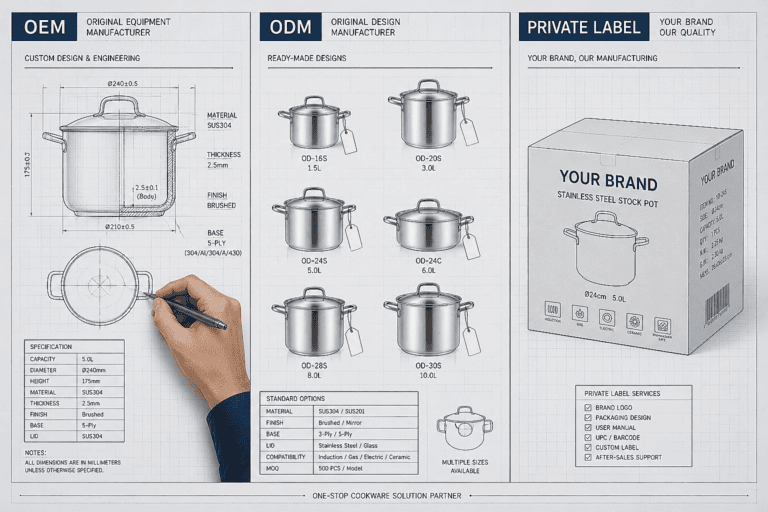
Cookware set configurations also require a decision. Selling individual pieces gives retailers flexibility to build their own sets and reduces minimum order complexity. Pre-configured sets (typically 5-piece, 7-piece, or 10-piece) simplify the purchase decision for end consumers and support higher average order values. Packaging customization, including branded boxes, inserts, and hang tags, completes the retail presentation and affects how the product is perceived before it is even opened.
5. Comparing customization packages by buyer profile
The right customization package depends on your market position, budget, and compliance requirements. The table below maps common buyer profiles to recommended configurations.
| Buyer Profile | Material Grade | Certification Stack | Finish | Design Priority |
|---|---|---|---|---|
| Entry-level private label | 304 | FDA + NSF | Brushed | Cost control |
| Premium retail brand | 304 or 316 | FDA + NSF + LFGB | Mirror or satin | Brand differentiation |
| US foodservice distributor | 304 | NSF mandatory | Brushed or matte | Durability |
| European importer | 316 | LFGB + GS + ISO 9001 | Brushed or satin | Compliance + aesthetics |
| Multi-market wholesaler | 304 | FDA + NSF + LFGB | Brushed | Broadest market access |
Entry-level commercial buyers get the most value from 304 stainless with NSF and FDA certification. This configuration covers the largest US commercial segment without the cost burden of 316 or multi-region certification stacks. Premium retail brands targeting European channels need to layer in LFGB and GS marks, which adds cost but opens significantly larger distribution opportunities.
The fastest growing kitchenware categories in 2026 include bakeware and modular cookware. Manufacturers building new programs should consider modular designs that allow consumers to mix and match pieces, because this format supports higher lifetime customer value and repeat purchases. Stainless steel cookware sourcing options that include modular configurations are increasingly available from factory-direct suppliers.
For buyers managing tariff exposure, cost-sharing contract clauses and fixed-price windows tied to commodity indexes reduce the risk of mid-production cost surprises. The B2B sourcing guide for stainless steel kitchenware from China covers supplier negotiation frameworks in detail.
Key takeaways
The most effective stainless steel cookware customization strategy pairs the right material grade with the correct certification stack, then layers in finishes and ergonomic features that match your target market.
| Point | Details |
|---|---|
| Material grade drives cost and market fit | 304 stainless suits most commercial programs; 316 is reserved for premium or coastal markets. |
| Certifications determine market access | FDA and NSF cover the US; LFGB and GS marks are required for European retail and foodservice. |
| Finish choice affects durability and brand perception | Brushed finishes hold up in commercial use; mirror polish commands a premium retail price. |
| Ergonomic features differentiate at the shelf | Handle material, lid type, and set configuration directly influence buyer preference and perceived value. |
| Supplier ISO 9001 status reduces production risk | A certified supplier maintains documented quality processes that protect consistency during cost volatility. |
What I have learned about cookware customization after years in B2B kitchenware
The conventional wisdom says to start with the lowest-cost configuration and upgrade later. I disagree. Retrofitting certifications after a product line launches is expensive and slow. Getting LFGB and NSF in place from the start costs more upfront, but it keeps your options open across multiple markets without a product redesign cycle.
The shift I have seen most clearly in recent years is buyers moving toward multi-market certified products from day one. A 304 stainless product with FDA, NSF, and LFGB is not just a compliance exercise. It is a commercial asset that gives your sales team flexibility to pursue US foodservice, European retail, and specialty channels simultaneously.
Modular cookware designs are the trend worth watching in 2026. Consumers want pieces that work together but can be purchased individually. Manufacturers who build modular compatibility into their OEM specs now will have a structural advantage as that category grows.
One more thing: transparent supplier communication is not a soft skill. It is a cost control mechanism. Suppliers who give you proactive delivery schedules and flag material cost changes early let you adjust your pricing and inventory before problems compound. That kind of relationship is worth more than a marginally lower unit price from a supplier who goes silent when things get complicated.
— Jason
Ufamcooks: factory-direct customization for serious buyers
Ufamcooks operates as a factory-direct manufacturer of stainless steel kitchenware, which means no middleman markup between your spec and your landed cost. Their OEM and ODM services cover the full range of custom stainless steel pots, pans, and bespoke cooking set options, from material grade selection through packaging design. Ufamcooks supports FDA, NSF, and LFGB certification requirements, and their multi-stage quality control process keeps production consistent across large and urgent orders. Retailers and wholesalers looking for personalized cookware designs with verified compliance can review the full product catalog to see available configurations and request a custom quote.
FAQ
What is the difference between 304 and 316 stainless steel for cookware?
304 stainless steel is the standard grade for most commercial and retail cookware, offering good corrosion resistance at a lower cost. 316 stainless carries a 20–30% price premium and adds molybdenum for superior resistance in high-humidity or coastal environments.
Which certifications do I need for US foodservice cookware?
NSF certification is mandatory for commercial US foodservice buyers, and FDA compliance is the baseline for food contact materials in the US retail market. Both should be confirmed before production begins.
How do I choose between mirror polish and brushed finishes?
Mirror polish suits premium retail and gift-focused product lines where visual impact drives purchase decisions. Brushed finishes are more practical for commercial and everyday retail use because they hide scratches and fingerprints better over time.
What is the best customization package for a multi-market wholesaler?
304 stainless steel with FDA, NSF, and LFGB certifications covers the broadest commercial segment across US and European markets. This configuration balances cost with compliance flexibility better than any single-market stack.
How does ISO 9001 certification affect supplier selection?
ISO 9001 on the supplier side confirms an active quality management system is in place. This reduces the risk of quality shortcuts during periods of raw material cost volatility, making it a key criterion when evaluating best stainless steel kitchenware import sources.
Recommended
- Selecting Finishes for Custom Stainless Kitchenware
- Vetting Stainless Steel Cookware Manufacturers: 2026 Guide
- Color Customization in Stainless Steel: A Manufacturer’s Guide
- Custom Stainless Steel Cookware Sets Catalog
Factory-direct customization
Specify material grade, finish, and certifications. No middleman markup.
OEM and ODM programs for 304 and 316L cookware with FDA, NSF, and LFGB support. Multi-stage quality control across large and urgent orders.