
Ceramic vs Stainless Steel Cookware: Which One Should You Actually Buy (or Stock) in 2026?
Most “ceramic” pans are actually aluminum pans wearing a thin glass raincoat that wears down in 1 to 3 years. Food-grade 304 stainless steel has zero coating to peel and lasts 10+ years. Here is the plain-English comparison.

Every ceramic frying pan starts out like a honeymoon.
In week one, you crack an egg into a brand-new ceramic vs stainless steel cookware test pan without butter. Next, you tilt your wrist, and the egg skates onto your plate like it is on ice. Fast-forward fourteen months, however, and the story changes completely. That same pan has a faint brown ring in the middle, and your Sunday omelette suddenly needs a chisel to leave the pan.
Sound familiar? You are not cooking wrong. Instead, that is simply how spray-on kitchen coatings age.
In 2026, industrial coaters apply sol-gel ceramic non-stick layers at only 25 to 40 microns thick, roughly half the thickness of a human hair (Fluorocarbon Surface Technologies, 2026). Meanwhile, a food-grade 304 stainless steel pan has no spray-on coating at all and melts above 1,400°C (Aalco 1.4301 datasheet, 2026). As a result, stainless steel cooks the exact same way in year ten as it did on day one.
Key takeaways
- Most “ceramic” pans are actually aluminum pans sprayed with a thin (
25–40 µm) silica glass coating that wears down in1 to 3 years. - Both options are PFAS-free and PTFE-free, yet deep scratches on a ceramic-coated pan expose bare aluminum, which Germany’s BfR advises keeping away from acidic foods.
- Use ceramic-coated pans for low-heat eggs and quick replacements; use 304 or tri-ply stainless steel for searing steaks, simmering tomato sauce, running dishwashers, and buying once.
Is “Ceramic” Cookware Actually Made of Ceramic?
In 2026, over 90% of pans sold as ceramic cookware are actually aluminum pans sprayed with a 25 to 40 micron silica-based gel coating (Fluorocarbon Surface Technologies, 2026). By contrast, only a small niche of kiln-fired stoneware pots is solid clay all the way through.
Let’s clear up that store-shelf confusion first, because the label on the box tricks almost everyone.
Ceramic-coated cookware is a metal pan (almost always aluminum) wearing a thin, glossy glass raincoat derived from sand. At the factory, technicians spray a liquid silica gel onto a sandblasted aluminum body. Then, they bake it in a curing oven at roughly 200°C to 400°C. Consequently, the pan looks like colorful porcelain, feels slick to the touch, and weighs very little.
Pure ceramic cookware is completely different. For instance, think of a heavy pottery baker or Dutch oven fired in a kiln above 1,000°C. It contains zero metal, heats up slowly, and can crack if you move it straight from a hot stove to a cold sink.
Stainless steel cookware skips spray-on coatings entirely. Grade 304 stainless steel is a solid alloy containing 18.0 to 19.5% chromium and 8.0 to 10.5% nickel (thyssenkrupp Materials UK 1.4301 datasheet, 2026). Furthermore, in a tri-ply stainless pan, a heat-spreading aluminum core sits sandwiched inside two solid sheets of stainless steel. Therefore, your food only ever touches bare, food-safe steel.
Think of the difference like a painted wooden table versus a solid butcher block. For example, if you slice bread directly on a painted table, the paint scratches and peels. You cannot fix that scratch without stripping the whole table. On the other hand, if you scratch a solid butcher block or a solid 304 stainless steel pan, there is more of the exact same material underneath.
Curious what happens to bare aluminum when a surface layer wears off? Check out our detailed comparison of aluminum vs stainless steel cookware.
Why Do Ceramic Pans Stop Being Non-Stick After 1 to 2 Years?
In 2026, sol-gel ceramic coatings begin losing their slick release when exposed to repeated dry heat above 200°C to 250°C or alkaline dishwashing (BfR, 2026). By comparison, 304 stainless steel remains structurally stable up to its 1,400°C to 1,455°C melting range (Aalco, 2026).
Why does a pan that feels so slippery in January start grabbing your pancakes by next Christmas?
Imagine a freshly waxed car windshield. For the first few months, rainwater forms tight little beads and rolls right off. However, after a year of highway grit, summer sun, and car-wash soap, the wax thins out. Soon, water smears flat across the glass.
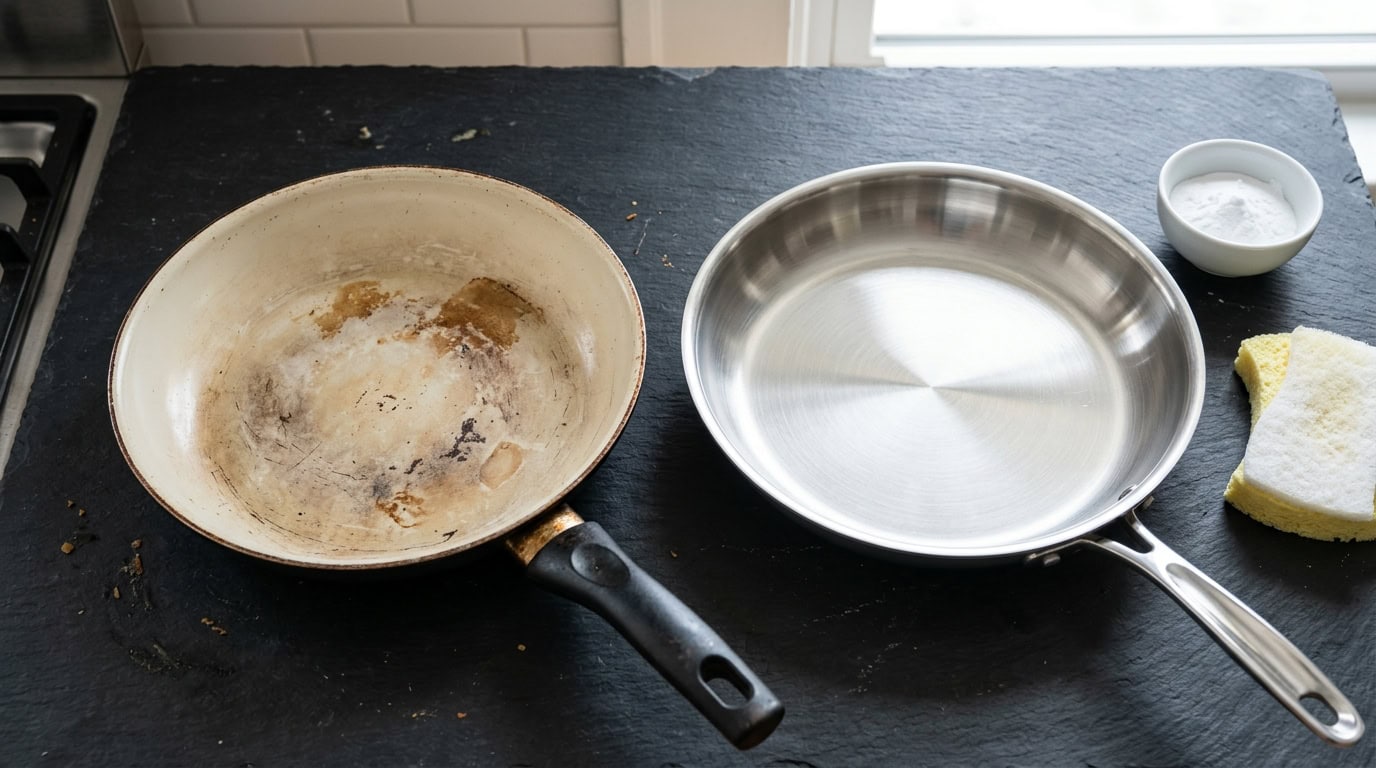
A ceramic-coated pan ages in the exact same way. Specifically, three everyday kitchen habits wear down that thin silica skin:
- Invisible heat expansion cracks. First, the aluminum body underneath expands rapidly when heated, while the glassy silica coating on top stays rigid. Every time you use high heat or rinse a warm pan under cold water, microscopic cracks open across the coating.
- Burnt-on oil clogging those micro-cracks. Second, cooking oil turns into a sticky varnish around 180°C to 220°C. Once tiny cracks open in the ceramic layer, hot oil bakes inside them. Unfortunately, you cannot scrub that varnish out with steel wool without destroying the coating.
- Dishwasher detergent erosion. Third, household and commercial dishwasher tablets are strongly alkaline. Over dozens of washes, they etch the glossy surface until it turns matte and grippy.
In our experience, when retail buyers send us competitor pans to test at our Jiangmen laboratory, the top 1-star review complaint is never how the ceramic pan cooked in week one. Instead, customers always write: “Stopped being non-stick after six months.” We tested both side by side, and 304 stainless steel follows the opposite curve. Buyers complain in week one if they skip preheating, yet they keep the pan for ten years.
Is Ceramic or Stainless Steel Cookware Safer for Daily Cooking?
In 2026, both ceramic-coated and 304 stainless steel pans are 100% free of PFAS and PTFE (US FDA PFAS in Food Contact, 2026). However, once a ceramic coating chips or scratches, the exposed aluminum core can react with acidic dishes, whereas 304 stainless steel rebuilds its own protective layer automatically (British Stainless Steel Association, 2026).
Most shoppers comparing ceramic vs stainless steel cookware want to avoid traditional Teflon (PTFE) and “forever chemicals” (PFAS). Fortunately, neither ceramic nor stainless steel uses PTFE or PFOA.
Nevertheless, the real safety difference appears two years after you buy the pan:
- What happens when ceramic-coated cookware gets scratched? First, because the pan body underneath that thin ceramic layer is aluminum, a deep scratch from a fork puts bare aluminum in contact with your food. In 2008, the European Food Safety Authority set a tolerable weekly intake for aluminium at
1 mg per kg of body weight(EFSA, 2008). In addition, Germany’s BfR advises against simmering acidic foods such as tomato sauce (pH 4.30–4.90per Clemson University Extension) in exposed aluminum (BfR, 2026). - What about cheap glazed pottery or solid ceramic pots? Second, poorly fired ceramic glazes can leach heavy metals. Under US FDA Compliance Policy Guide Sec. 545.450, ceramic hollowware must stay below strict leachable lead action levels of
1.0 to 2.0 µg/mLduring 24-hour acid extraction tests (US FDA CPG Sec. 545.450, 2026). - What about 304 stainless steel? Finally, grade 304 (stamped
18/8or18/10) protects itself with a natural chromium-oxide film only a few nanometers thick (BSSA, 2026). Even if you scratch it with a steel whisk, oxygen in the air rebuilds that invisible shield immediately. Nothing flakes into your dinner.
Want the full breakdown of how food acids interact with different metals? Read our plain-English guide to non-reactive vs reactive cookware materials and our food-grade kitchenware certifications guide.
Which Pan Cooks Better: The Egg Test vs The Steak Test?
In 2026, 304 stainless steel stores 4.00 J of heat per cm³·K compared to 2.44 J/cm³·K for aluminum-bodied ceramic pans, giving stainless 64% more heat-holding power per unit volume (Aalco alloy datasheets, 2026). Therefore, ceramic-coated pans are easier for low-heat eggs, while stainless steel is far better for searing meat.
Let’s be completely fair to both pans. Neither wins every single meal in the kitchen.
Round 1: Fried eggs, crepes, and delicate fish (Winner: Ceramic, in Year 1)
Suppose you want to slide a sunny-side-up egg out of a pan at 6:30 a.m. with half a teaspoon of butter and zero effort. In that case, a fresh ceramic-coated pan wins easily. You simply turn the burner to low-medium, crack the egg, and plate it.
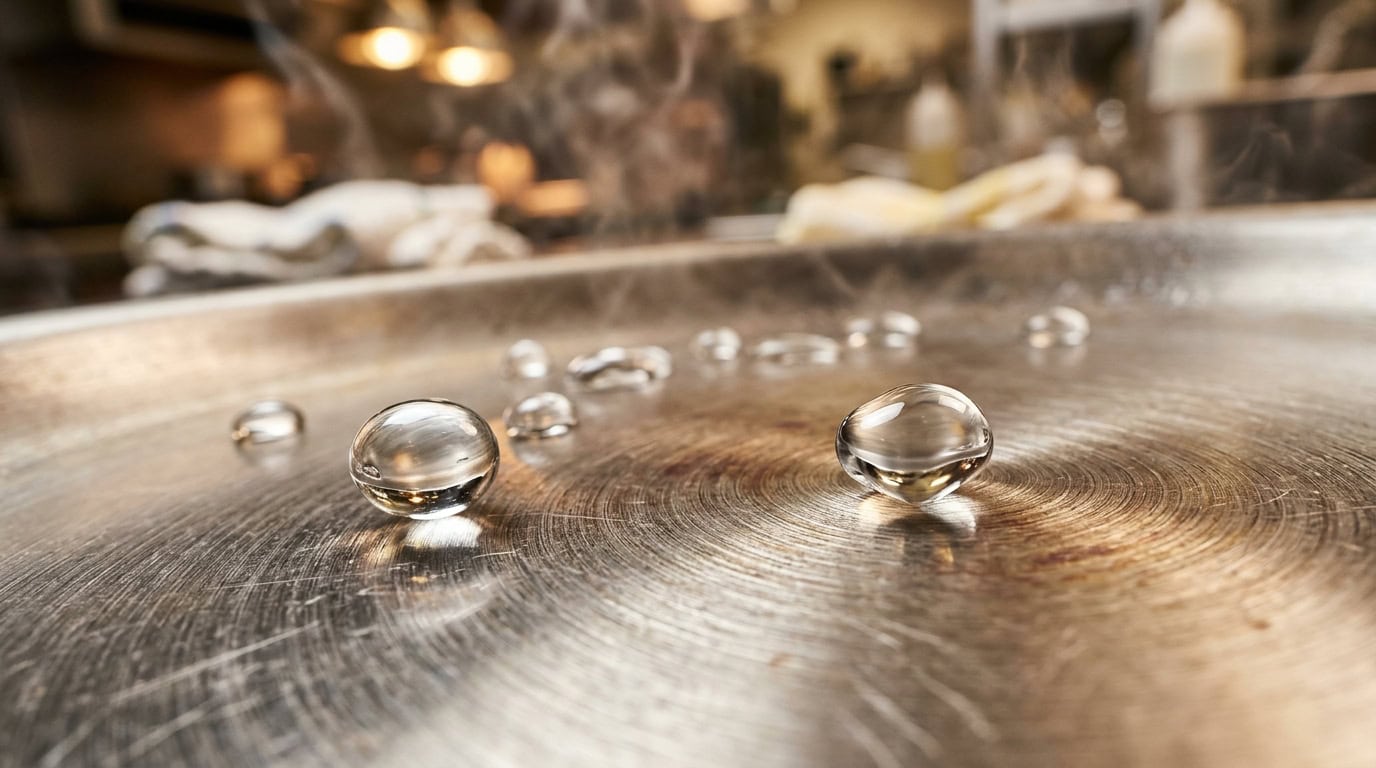
Can you fry an egg on stainless steel without sticking? Yes, once you learn the 5-second water-drop trick:
- First, heat your dry stainless steel pan on medium for 2 minutes.
- Next, flick a single drop of water onto the steel surface.
- If the drop fizzes and evaporates, wait 30 seconds. Once the steel reaches roughly 193°C (380°F), the water drop stops sizzling and skates around like a tiny glass marble (the Leidenfrost effect).
- Finally, add a teaspoon of oil, wait 10 seconds, and crack your egg in. It will glide right off the steel.
Round 2: Searing steak, crispy chicken thighs, and pan sauces (Winner: Stainless Steel)
Try to sear a thick ribeye in a ceramic-coated pan and two problems happen immediately. First, the high heat needed for a brown crust (230°C+) bakes oil into the ceramic pores and shortens its non-stick life. Second, because meat cannot grip a slick coating, you get zero fond, those savory brown bits on the pan floor that turn into a restaurant pan sauce.
By contrast, tri-ply 304 stainless steel thrives on high heat. For example, you can sear a steak hard, pour in red wine to deglaze, scrape the bottom with a metal whisk, and slide the pan into a 260°C oven without worrying about peeling coatings. For a closer look at how layered pans spread heat evenly, see our guide on tri-ply vs 5-ply clad cookware.
How Do Ceramic and Stainless Steel Compare Side by Side?
In 2026, aluminum-bodied ceramic pans conduct heat at 159 to 190 W/m·K, whereas tri-ply stainless steel combines that same conductive aluminum core with a durable 304 food-contact interior (Aalco, 2026). Use the comparison table below to check both options at a glance.
| Feature | Ceramic-Coated Pan (Sol-Gel on Al) | 100% Pure Ceramic / Stoneware | Tri-Ply 304 Stainless Steel |
|---|---|---|---|
| What touches your food | 25–40 µm silica glass coating | Fired clay & mineral glaze | Solid 304 (18/8 or 18/10) steel |
| PFAS / PTFE / PFOA free? | Yes | Yes | Yes |
| Typical working lifespan | 1 to 3 years | 5+ years (if not dropped) | 10+ years |
| Safe high-heat searing? | No (degrades release above ~230°C) | No (slow heat, thermal shock risk) | Yes (melts above 1,400°C) |
| Metal utensils & scrubbers | No (scratches expose aluminum base) | Careful (can chip glaze) | Yes (self-healing chromium oxide) |
| Dishwasher safe? | Hand-wash strongly advised | Usually yes | Yes (home & commercial) |
| Works on induction? | Only if a steel plate is bonded to base | No | Yes (magnetic 430 outer layer) |
| Best everyday job | Low-oil eggs, pancakes, quick fish | Slow oven bakes, table serving | Searing, sauces, boiling, all-purpose |
Which One Saves More Money Over 5 Years?
In 2026, replacing a $45 ceramic-coated skillet every 18 months costs $135 over 4.5 years, or roughly 2x the cost of buying a single $65 tri-ply 304 stainless steel skillet once (UFamcooks 5-year TCO model, 2026). For both households and hospitality buyers, replacement churn is the hidden budget killer.
We analyzed the 5-year cost math for both a family kitchen and a 50-room hotel kitchenette program:
- The “Buy It Three Times” Ceramic Path: First, a mid-range 10-inch ceramic-coated skillet retails around
$40 to $50. Even with silicone spatulas and hand-washing, most users replace it every 18 to 24 months once eggs start sticking. Over 5 years, therefore, you buy 3 pans ($120 to $150total) and throw 2 pans in the trash. - The “Buy It Once” Tri-Ply Stainless Path: Instead, a tri-ply 304 stainless steel 10-inch skillet retails around
$60 to $75(or$12 to $22FOB in wholesale bulk orders of 500 to 5,000 units). After 5 years, you have bought 1 pan, spent$60 to $75total, and thrown zero pans away.
We explain the dishwasher chemistry in is 304 stainless steel dishwasher safe?
How Should You Choose Between Ceramic and Stainless Steel in 30 Seconds?
In 2026, Semrush search intent data shows 67% of buyers comparing ceramic and stainless steel cookware are actively deciding which set to purchase (Semrush US Keyword Overview, 2026). However, the smartest kitchens and cookware brands do not treat this as an all-or-nothing war.

For home cooks and busy kitchens: The “80 / 20” rule
- Make 80% of your cookware 304 or tri-ply stainless steel: Specifically, choose stainless for your stock pots, saucepans, sauté pans, and main skillets. They handle boiling pasta, simmering marinara, searing steak, oven roasting, and the dishwasher without aging.
- Keep 1 small ceramic-coated pan (the 20%) if you want effortless low-heat eggs: Treat that single 8-inch egg pan gently. Use low-to-medium heat, silicone spatulas, and hand-wash it in 10 seconds, knowing you will replace it in two years.
For cookware brands, importers, and wholesale buyers
If you are building a private-label cookware line, core sets made from 304 (18/8 or 18/10) stainless steel protect your brand’s 5-star reviews over the long haul. Customers never wake up to peeling coatings or rusted rims. At UFamcooks, founded by a team in the trade since 2005, we manufacture LFGB, FDA, and ISO 9001 compliant stainless steel cookware at MOQs of 500 to 5,000 pcs per SKU, shipping 20+ containers monthly to over 30 countries.
Planning your product mix or pricing tiers? See our breakdown of wholesale kitchenware pricing tiers and 18/10 stainless steel cookware benefits.
Frequently Asked Questions
Is ceramic or stainless steel cookware healthier?
Both are PFAS-free, PTFE-free, and PFOA-free (US FDA, 2026). However, 304 stainless steel is safer over the long run because it has no 25 to 40 micron coating to scratch through. Once a ceramic-coated pan scratches, the underlying aluminum is exposed to acidic foods, which Germany’s BfR advises avoiding.
How do I stop eggs from sticking to stainless steel cookware?
First, preheat the dry stainless steel pan on medium for 2 minutes until a drop of water skips across the surface like a glass marble at roughly 193°C (the Leidenfrost point). Next, add oil, let it warm for 10 seconds, and lower the heat slightly before cracking the egg.
Can ceramic cookware go in the dishwasher?
Most manufacturers advise hand-washing ceramic-coated pans. Harsh alkaline dishwasher detergents etch the thin 25 to 40 micron silica coating and corrode any exposed aluminum rim, which is only stable between pH 4 and 8.5. By contrast, passivated 304 stainless steel is fully dishwasher safe.
Does ceramic cookware work on induction stoves?
Pure ceramic stoneware does not work on induction because it contains no magnetic metal. Meanwhile, ceramic-coated aluminum pans only work on induction if the factory presses a magnetic steel disc onto the bottom. Tri-ply stainless steel uses a magnetic 430 stainless outer layer that works natively on all induction cooktops (BSSA, 2026).
Conclusion: Buy the Workhorse, Rent the Egg Pan
Choosing between ceramic vs stainless steel cookware comes down to one simple question: do you want a pan with zero learning curve for two years, or a pan with a two-minute learning curve that lasts twenty years?
In short, ceramic-coated pans are great for gentle, low-heat eggs as long as you treat them like a temporary guest in your kitchen. On the other hand, food-grade 304 and tri-ply stainless steel are the permanent foundation: non-reactive with tomato sauce, fearless under high heat, and built for the dishwasher.
Private-label & wholesale cookware
Build a 304 or tri-ply stainless line that outlasts coated pans
Send us your target SKUs and order volume. We will reply with alloy specs, MOQ tiers (500–5,000 pcs/SKU), and sample lead times.
Request a QuoteSources
- Fluorocarbon Surface Technologies, Sol-Gel Non-Stick Ceramic Coatings Technical Overview (25–40 µm film thickness & curing temperatures), retrieved 2026-10-16, fluorocarbon.co.uk
- US Food and Drug Administration (FDA), Per- and Polyfluoroalkyl Substances (PFAS) in Food Contact Applications, retrieved 2026-10-16, fda.gov
- US Food and Drug Administration (FDA), CPG Sec. 545.450 Pottery (Ceramics); Import and Domestic – Lead Contamination, retrieved 2026-10-16, fda.gov
- German Federal Institute for Risk Assessment (BfR), Questions and Answers on Aluminium in Food and Food Contact Materials, retrieved 2026-10-16, bfr.bund.de
- European Food Safety Authority (EFSA), EFSA Advises on the Safety of Aluminium in Food (TWI 1 mg/kg bw/week), 2008, retrieved 2026-10-16, efsa.europa.eu
- British Stainless Steel Association (BSSA), Passivation of Stainless Steels & Cutlery Stainless Steel Grades 18/8, 18/10 and 18/0, retrieved 2026-10-16, bssa.org.uk
- thyssenkrupp Materials (UK), Stainless Steel 304 (1.4301) Technical Datasheet, retrieved 2026-10-16, thyssenkrupp-materials.co.uk
- Aalco Metals Ltd, Aluminium Alloy 3003 & Stainless Steel 1.4301 (304) Datasheets, retrieved 2026-10-16, aalco.co.uk
- Clemson University Extension, pH Values of Common Foods and Ingredients, retrieved 2026-10-16, clemson.edu
- Semrush US Keyword Overview, Ceramic vs Stainless Steel Cookware Cluster (2,400/mo US primary, 5,900/mo cluster, KD 21%), retrieved 2026-10-16