

Why Product Reliability Affects Wholesaler Reputation
Product reliability is the single strongest operational signal that establishes or destroys a wholesaler’s reputation with retail buyers.
Product reliability is the single strongest operational signal that establishes or destroys a wholesaler’s reputation with retail buyers. Commercial buyers evaluate suppliers strictly by delivery outcomes, which means when a production batch fails, the wholesaler absorbs the direct fallout. The resulting damage cascades rapidly through the business:
Reliability benchmarks at a glance
- Defect rate threshold:
< 1.5%for commercial metalware and cookware - Return rate ceiling:
< 2.0%for hardgoods distribution - OTIF delivery standard:
95%–98%for Tier-1 retail accounts - Post-sale warranty target:
< 5 claimsper 1,000 units sold - Sampling convention:
ANSI/ASQ Z1.4 (ISO 2859-1)Level II AQL - Incident resolution window:
< 5 business daysfrom notice to closure - UFamcooks factory-direct lines:
304and316L, MOQ500–5,000 pcs/SKU
- Lost buyer trust and cancellation of repeat orders: A single inconsistent shipment can dismantle a commercial reorder relationship built over several years.
- Escalating operational and regulatory expenses: Returns, retailer chargebacks, warranty replacements, and CPSC regulatory recall liabilities all originate from reliability breakdowns.
- Commercial penalty fines and lost retail shelf space: Major retailers enforce strict financial penalties for non-conforming goods and will delist SKUs, or terminate the entire vendor contract, following recurring delivery issues.
Wholesale sourcing managers should maintain a rolling 30-day reliability dashboard. Reviewing defect rates, customer return rates, and on-time-in-full (OTIF) metrics over 90-day intervals provides immediate visibility into operational risk before buyer relationships degrade.
What product reliability actually means in a wholesale context
Product reliability in wholesale represents repeatable performance across successive production cycles, ensuring every container matches the approved physical specification. It extends beyond basic bench testing to measure whether goods function identically across every batch, delivery window, and reorder volume.
In brief Product reliability in wholesale requires dimensional consistency across production lots, expected duty-cycle durability, and documented AQL failure rates prior to container dispatch.
From an engineering and procurement standpoint, reliability rests on three foundational pillars: lot-to-lot dimensional consistency, expected duty-cycle lifespan under commercial or domestic conditions, and verified statistical failure rates measured before and after container release.
Procurement directors and sourcing professionals evaluate several core indicators:
MTBF and MTTF. Mean Time Between Failures (applicable to repairable equipment) and Mean Time To Failure (for non-repairable hardware) quantify operational lifespan before mechanical breakdown. Department store buyers and commercial procurement teams routinely review these figures when auditing newly proposed cookware lines or kitchenware SKUs.
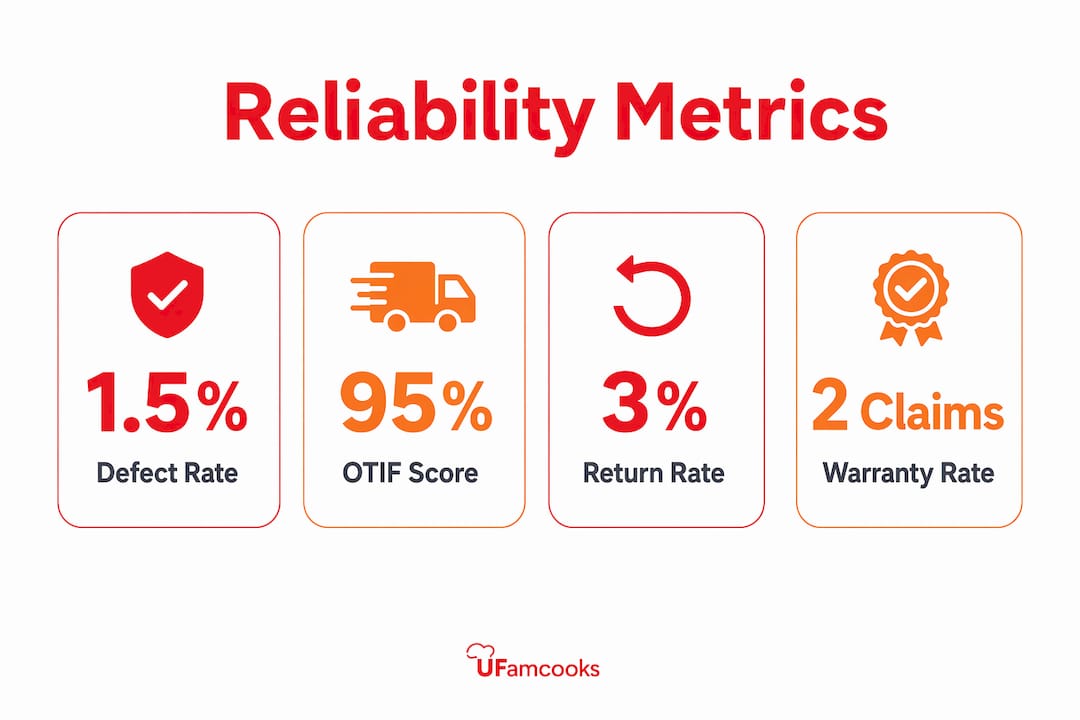
Defect rate. The percentage of units in a production lot failing quality control inspection. Calculated as: (defective units ÷ total units inspected) × 100. Even a modest 2% defect rate across a 5,000-unit cookware consignment results in 100 substandard units entering commercial retail channels.
OTIF (On-Time In-Full). The proportion of purchase orders delivered complete and strictly within the designated shipping window. Low OTIF ratings signal chronic supply instability to enterprise buyers, even when individual units meet aesthetic standards.
Return rate. Defective or returned merchandise expressed as a percentage of total units sold. In modern omnichannel and e-commerce distribution, elevated return rates trigger automatic algorithmic ranking penalties on platforms such as Amazon and Walmart Marketplace well before merchant teams conduct formal vendor reviews.
Warranty claim rate. Formal warranty claims submitted per 1,000 units sold in the field. This metric directly connects factory metallurgical integrity and weld quality to actual post-sale remediation costs.
Administrative packaging consistency functions as a vital companion to physical product tolerances. Identical master carton dimensions, verified barcode scannability, structural transit integrity, and lot-traceable inspection certificates establish predictable warehouse receiving for retail partners.
How product reliability translates directly into your reputation
Product reliability directly determines buyer retention because commercial satisfaction serves as the operational bridge to long-term account loyalty. Sourcing consistency validates buyer trust, whereas unexpected product failures expose retail partners to commercial losses they will not tolerate.
In brief Commercial retailers judge wholesalers by physical delivery performance; persistent defects trigger automated marketplace ranking penalties and permanent delisting from vendor rosters.
The progression from product inconsistency to reputational damage follows a predictable pattern:
- Cumulative order history establishes commercial credibility. Receiving three consecutive conforming shipments builds baseline confidence, yet a single substandard lot following months of good deliveries triggers immediate vendor review flags.
- Customer returns and quality complaints generate permanent records. Published reviews, retailer vendor scorecards, and chargeback ledgers remain permanent entries in enterprise procurement systems. Empirical research indexed by MDPI on quality signals and brand trust demonstrates that product consistency correlates directly with account longevity and favorable supplier evaluations.
- Supply unpredictability leads to immediate account substitution. Merchandising teams facing delivery shortfalls or packaging defects replace unpredictable vendors with proven competitors to protect scheduled retail promotions.
- Crisis response speed dictates whether buyer relationships survive. Transparent technical communication and rapid containment preserve buyer trust during quality incidents, whereas delayed acknowledgments accelerate delisting decisions.
Consider a standard distribution scenario: a distributor delivers a reorder of stainless steel stock pots where the exterior satin polish on batch two deviates noticeably from batch one. The retailer’s receiving dock halts unloading, logs photo evidence, and escalates the variance to the category manager. Rather than opening extensive debates, the retail buyer issues a return authorization and logs a formal vendor infraction. In another case, master cartons arrive with unreadable GS1 barcodes on 15% of the freight. Distribution center scanners reject the pallets, goods remain stranded on receiving docks, and the distributor receives non-compliance chargebacks alongside delivery delay fines. In both instances, administrative or surface variances inflicted substantial reputational damage.

Pro Tip: Treat master carton dimensional stability, barcode clarity, and batch documentation as decisive operational differentiators. A retail partner whose automated distribution centers process your freight without inspection delays will renew contracts without price friction, whereas repeated documentation errors invite immediate competitor displacement.
Operational and financial impacts: what you actually lose when reliability slips
Reliability deficits erode company financial performance long before manifesting as canceled supply agreements. Financial damage settles across multiple operating centers, inflating overhead and depressing gross margins:
In brief Unresolved defects generate compound losses through reverse freight, warehouse restocking labor, chargeback fines, and margin markdowns that far exceed upstream inspection investments.
- Reverse logistics and freight handling expenses: Outbound freight, return transport, warehouse sorting labor, and scrap processing fees quickly multiply when non-conforming goods are returned. On a 5,000-piece cookware consignment with a 3% defect rate, warehouse crews must inspect and handle 150 compromised units prior to resolving penalty claims.
- Warranty replacements and customer service overhead: Direct manufacturing costs for replacement pieces, accompanied by administrative handling time across customer support and technical teams.
- Retailer non-compliance chargebacks: Big-box and regional retail chains enforce strict penalty matrices for delivery delays, label discrepancies, or pallet damage under binding vendor agreements.
- Distressed inventory markdowns: Retail accounts unable to retail compromised units enforce margin markdowns, subtracting the financial shortfall directly from pending invoices.
- Customer support workload inflation: Repetitive defect claims divert internal staff toward reactive dispute resolution and away from new commercial accounts.
Cost illustration: Assuming a 2% defect rate across a 10,000-unit production order where each non-conforming unit demands $8 in replacement, freight, and administrative expense, the wholesaler incurs $1,600 in direct losses per batch. Implementing an upstream pre-shipment AQL inspection protocol at $0.50 per sample unit represents a predictable investment that completely eliminates recurring claim exposure and reputational harm.
Commercial retailers hold wholesale suppliers strictly accountable for all manufacturing discrepancies. When a subcontracted factory compromises raw material standards, retail merchants issue score penalties directly against the distributor of record. This structural reality makes rigorous supplier vetting and verified contractual SLAs fundamental requirements for wholesale stability.
Which metrics must wholesalers track to connect reliability to reputation?
Wholesale businesses maintain supplier credibility by monitoring clear quality benchmarks across their active catalog. Tracking empirical data reveals defect trends before retail accounts experience receiving dock friction.
In brief Sourcing scorecards should monitor defect rates, return percentages, OTIF timelines, and warranty frequencies by individual SKU rather than blended catalog averages.
| Quality Metric | Calculation Method | Target Industry Benchmark | Verification Source |
|---|---|---|---|
| Defect Rate | (Defective units ÷ Total inspected) × 100 | Under 1.5% for metalware and cookware | In-factory AQL inspection logs, receiving records |
| Return Rate | (Units returned ÷ Units delivered) × 100 | Under 2.0% for commercial hardgoods | Retailer vendor reports, portal claim data |
| OTIF Delivery | (Orders on-time and complete ÷ Total orders) × 100 | 95% to 98% for Tier-1 retail contracts | Carrier bills of lading, receiving receipts |
| Warranty Claims | (Claims filed ÷ Total units sold) × 1,000 | Under 5 claims per 1,000 units | After-sales CRM data, distributor warranty logs |
| Buyer Satisfaction | Structured vendor evaluation score or buyer CSAT | NPS ≥ 35 / CSAT ≥ 88% | Periodic buyer surveys, ASQ quality resources |
| Incident Resolution | Business days from dispute filing to signed closure | Under 5 business days | Quality incident tickets, corrective action logs |
Operational data inputs required to populate a wholesale reliability scorecard include:
- Pre-shipment inspection sheets and AQL 1.5 sampling reports prepared by accredited inspection bodies
- Customer return manifests and root-cause reports supplied by retail buyers
- Feedback and review summaries from major e-commerce sales channels
- Quarterly vendor scorecard evaluations issued by department store groups and institutional accounts
- Accredited metallurgical test certificates and mill verification sheets

Pro Tip: When presenting quality scorecards during annual buyer reviews, isolate two key views: defect rate broken down by individual SKU, and 12-month trailing OTIF performance. Sourcing directors prioritize SKU-specific consistency over blended catalog averages.
How can wholesalers prevent reliability failures before goods reach buyers?
Preventing reliability failures requires institutional controls positioned upstream at the manufacturing source rather than downstream at destination warehouses.
In brief Upstream preventative controls include ISO 9001 factory audits, pre-shipment AQL 1.5 inspections, 200–500 unit pilot runs, and contractual sample retention.
1. Vet manufacturing partners thoroughly before contracting
Demand documented factory audit reports, valid ISO 9001:2015 quality management certifications, and mill test certificates before committing production deposits. A production partner unable to furnish transparent compliance documentation introduces unacceptable quality variance into your supply chain. Implementing a structured cookware manufacturer vetting guide ensures systematic evaluation across all sourcing teams.
2. Mandate pre-shipment AQL inspection for every container
Never rely on supplier self-declarations. Enforce ANSI/ASQ Z1.4 (ISO 2859-1) Level II AQL sampling at the manufacturing floor before goods are loaded into sea containers. Establish written pass and fail criteria covering dimensional tolerances, weld bead finishing, rivet shear strength, and surface polish before production commencement.
3. Validate newly engineered SKUs with pilot production runs
Avoid scaling new product designs directly into high-volume manufacturing. Commissioning a controlled pilot batch of 200 to 500 units allows engineering teams to identify tool wear, dimensional drift, and packaging weaknesses before thousands of units enter transit. Require signed golden sample sign-offs prior to authorizing volume production.
4. Standardize technical specifications and master sample controls
Maintain signed engineering drawings, material grade specifications, and approved packaging proofs for every catalog item. Cross-reference barcode symbology and outer carton labeling against destination distribution center compliance manuals.
5. Subject master cartons to transit packaging testing
Conduct ASTM D4169 and ISTA 1A carton drop tests, edge crush testing (ECT), and moisture barrier evaluations. Verifying wholesale packaging integrity prevents crushed cartons and concealed merchandise damage at destination receiving docks.
6. Formalize defect thresholds and sample retention within supplier contracts
Incorporate explicit defect rate thresholds, clear financial remedies for non-conformance, and mandatory 12-month lot sample retention within master supply agreements. Retained production samples serve as conclusive baseline evidence whenever quality disputes arise.
Essential receiving dock inspection checklist:
- Verify carton quantities against shipping manifests, immediately flagging physical shortages
- Examine outer carton condition for crush damage, perforated tape, or moisture exposure
- Scan 10% of master carton and retail package barcodes against purchase order records
- Draw random AQL sample units to verify dimensions, weight, and polish against the master spec
- Photograph all damaged or out-of-spec merchandise prior to pallet movement
When reliability fails at scale: recalls, legal risk, and crisis response
Systemic product defects, metallurgical contamination, or structural handle failures require immediate, disciplined execution. Operations teams must act in sequence: quarantine inventory lots immediately, secure production inspection logs and retained sample units, notify retail accounts in writing within 24 hours, and engage regulatory counsel before issuing formal statements.
In brief Substantial product defects trigger statutory CPSC Section 15(b) reporting obligations; granular lot-level tracking isolates affected shipments and averts market-wide recalls.
In the United States, consumer product safety compliance falls under the jurisdiction of the Consumer Product Safety Commission (CPSC). Under Section 15(b) of the Consumer Product Safety Act (15 U.S.C. § 2064(b)), distributors and importers must immediately notify the commission if a product contains a defect that could create a substantial product hazard. For food preparation vessels and food-contact wares, the FDA safety recall protocols govern contamination and public safety alerts. Implementing granular, lot-level traceability across every container allows distributors to isolate specific manufacturing runs rather than initiating costly, market-wide recalls. As detailed in retail industry analyses on how supplier failures disrupt retail supply chains, lack of lot-level tracking transforms localized defects into company-wide commercial disasters.
Distributors must recognize that product liability exposure under U.S. and European law extends throughout the commercial distribution hierarchy. Wholesalers and importers can be named as primary defendants in commercial litigation involving defective goods, regardless of factory origin. Comprehensive supplier indemnification agreements, verified factory certificates, and robust commercial liability coverage represent foundational business safeguards.
How a reliable manufacturing partner protects your reputation
A wholesaler’s commercial reputation remains fundamentally tethered to the operational discipline of its manufacturing base. Factory-direct manufacturing partners that maintain structured quality control systems furnish distributors with verifiable compliance proof that satisfies enterprise retail audits.
In brief Reliable factory partners furnish mill test certificates for AISI 304/316L, structural weld pull inspections, and ASTM/ISTA packaging test reports with every container.
Core production practices that directly protect wholesale metrics include:
- Certified raw material verification: Providing lot-specific mill test reports for AISI 304 and 316L stainless steel ensures raw coil composition strictly matches declared specifications, preventing premature surface corrosion or post-sale pitting.
- Automated and manual weld inspections: Conducting rigorous pull testing and microscopic weld seam examination prevents handle detachment accidents, eliminating major product liability exposures.
- Packaging drop and transit testing: Subjecting finished cartons to standardized drop and vibration testing guarantees goods withstand multi-modal shipping without cosmetic scuffing.
- Documented certificates of conformance: Delivering traceable quality certificates alongside container manifests provides the physical compliance documentation required by commercial retail buyers.
- Disciplined production scheduling: Predictable production staging ensures steady container dispatches, supporting distributor OTIF compliance.
Key technical inquiries for prospective cookware manufacturing partners:
- Can your quality team provide lot-specific mill test reports and AQL inspection sheets from recent production runs?
- What is your verified defect rate by product category, and which sampling standard governs container sign-offs?
- What structural transit tests are performed on master cartons, and are test records available for review?
- What documented corrective action procedure is enforced when an in-process batch fails dimensional checks?
- Do you retain production baseline samples from each shipped container for 12 months?
The speed, detail, and documentation transparency accompanying a manufacturer’s answers provide the truest measure of their production reliability.
The part most wholesalers get wrong about reliability
Many wholesale businesses treat product reliability purely as a receiving dock inspection task. In reality, reliability is an upstream systems discipline that begins at factory qualification and raw material procurement.
In brief Treating reliability as an upstream engineering system rather than a receiving dock checkpoint eliminates systemic packaging, tooling, and metallurgical errors before freight departs.
Relying exclusively on receiving dock inspection creates severe operational bottlenecks. By the time compromised merchandise reaches a domestic warehouse, freight expenses have been incurred, retail fulfillment deadlines are compromised, and the business faces costly rework or delayed shipments. Neither outcome preserves wholesale profitability.
High-performing wholesale distributors invest heavily upstream: executing comprehensive on-site factory audits, locking down signed engineering tolerances, and enforcing pilot batch approvals before full container releases. Addressing dimensional consistency, metallurgical purity, and packaging integrity at the manufacturing source eliminates the root causes of field failures.
Furthermore, distributors frequently overlook administrative reliability. Precise pallet counts, verified carton labeling, and synchronized compliance documentation represent vital operational elements of customer satisfaction. Retail distribution centers that encounter recurring receiving errors will inevitably source alternatives.
For operations teams seeking immediate risk reduction within the next 30 to 60 days, conduct a focused root-cause audit: review defect and return records across your top three volume SKUs over the preceding six months, mapping each variance to its origin. Correcting upstream packaging or tool wear issues permanently stabilizes commercial reputation.
Key Takeaways
Reliable product delivery represents the core operational foundation of wholesale reputation. Systematic tracking of defect rates, return volumes, and OTIF timelines prevents delivery disruptions and protects retail placement.
| Operational Area | Core Requirement |
|---|---|
| Establish Baselines | Monitor defect rate, customer return rate, and OTIF scores across 90-day rolling cycles. |
| Pilot Verification | Validate new SKUs with 200 to 500 unit pilot runs against written engineering criteria before full production. |
| Documentation Retention | Maintain lot-specific mill certificates, AQL inspection records, and physical samples for at least 12 months. |
| Incident Communication | Provide structured, factual status reports to retail partners every 48 hours during delivery investigations. |
| Factory Direct Partnership | Partner with verified manufacturers providing multi-stage QC, 304/316L material certifications, and lot-level traceability. |
How reliability reads from a factory floor
“In wholesale kitchenware distribution, quality reliability is an administrative and engineering discipline, not a marketing promise. When raw material certificates, weld pull tests, and barcode accuracy are verified before container loading, retail buyer relationships remain rock-solid.”
— Jason Gan, Production & Quality Director at UFamcooks
Factory-direct reliability from UFamcooks
For wholesale distributors and retail brand owners, protecting market reputation requires full visibility into the manufacturing source. Operating from Jiangmen, China, UFamcooks bridges the accountability gap as a direct stainless steel kitchenware manufacturer, providing importers and brand partners direct access to OEM and ODM manufacturing services supported by multi-stage quality control, lot-traceable documentation, and disciplined production scheduling.
Every commercial production run includes lot-specific metallurgical certificates, weld integrity documentation, and packaging drop test reports, providing the exact compliance documentation required during institutional retail vendor audits. Operating without trading intermediary markups, UFamcooks manufactures premium stainless steel cookware collections engineered for private label programs and custom brand specifications. Sourcing teams are invited to request sample evaluations or factory inspection records to verify our technical standards directly.
FAQ
Why does product reliability matter so much to wholesalers?
Commercial retailers hold wholesale suppliers fully accountable for physical product quality regardless of underlying manufacturing origin. A single defective lot triggers compliance fines, damaged vendor scorecards, and potential contract cancellation.
How does product quality affect brand reputation for a wholesaler?
Consistent product performance generates favorable retail reviews, low return rates, and reliable reorder volume. Conversely, recurring defects create permanent negative records in vendor scorecards and e-commerce platform algorithms.
Why are reliable suppliers so important to a wholesaler’s business?
Retail buyers do not distinguish between factory errors and distributor failures. Upstream manufacturing shortcuts translate directly into domestic chargebacks, customer returns, and commercial delisting risks.
What metrics should wholesalers track to monitor reliability?
Wholesale sourcing managers should monitor defect rates, customer return rates, OTIF shipping scores, and post-sale warranty claims per SKU across 90-day rolling periods.
How can a wholesaler rebuild reputation after a product failure?
Provide transparent status updates to affected commercial buyers every 48 hours, preserve complete inspection and shipping documentation, and implement a verified corrective action plan at the manufacturing facility.
Recommended
- Packaging Integrity in Wholesale: What Brands Must Know
- MOQ Explained: What to Expect from a Stainless Kitchenware Factory
- Why Stainless Steel Weld Quality Matters | UFamcooks
- Why Stainless Steel Grade Matters for Kitchenware Brands
Factory-direct reliability
Protect your wholesale reputation with documented factory quality
UFamcooks manufactures commercial stainless steel cookware in Jiangmen, China, providing wholesale distributors with lot-specific AISI 304/316L mill test certificates, weld inspection records, and pre-shipment AQL sampling on every production run. Inquire today for OEM specifications or sample audits.
Request a quote