
Factory Direct Sourcing Explained: A Procurement Guide
Factory direct sourcing means purchasing products and direct materials directly from the manufacturing plant without trading companies, commission brokers, or commercial middlemen.
Factory direct sourcing means purchasing products and direct materials directly from the manufacturing plant without trading companies, commission brokers, or commercial middlemen. This model operates most effectively when your order volume is substantial, product specifications are stable, and your team maintains the internal bandwidth to manage factory relationships, quality control, and international logistics. When those operational conditions align, bypassing intermediaries delivers a 15% to 30% unit cost advantage at commercial scale. When those internal capabilities are absent, an established sourcing agency or hybrid procurement model provides far greater financial protection.
PROCUREMENT BENCHMARKS & SOURCING METRICS
- Landed cost advantage:
15%–30% unit margin improvementover trading intermediary quotes at volume. - Production run minimums:
1,000–3,000 units per SKUon automated deep-draw stamping lines. - Quality assurance protocol:
ISO 2859-1 (ANSI/ASQ Z1.4)AQL 0 Critical / AQL 1.5 Major / AQL 2.5 Minor. - First-order delivery window:
14–24 weeks totalfrom drawing lock to destination warehouse delivery. - Commercial payment structure:
30% milestone depositwith70% balance against original Bill of Lading. - Contractual risk mitigation:
Binding NNN agreementsand exclusive buyer tooling ownership clauses. - Category feasibility threshold:
2,000+ units annual spendper SKU to offset internal logistics overhead.
What does factory direct sourcing actually mean operationally?
In brief Direct sourcing establishes legal, commercial, and engineering contracts straight with the manufacturing facility, eliminating intermediary markups and information delays.
Direct sourcing is an operational procurement strategy where a buying organization issues purchase orders, transfers payments, and executes commercial supply contracts directly with the entity that owns the physical tooling and assembly lines. In functional terms, your procurement team holds direct title to the goods, coordinates directly with plant engineers, and manages export documentation without third-party markup or information asymmetry.
The operational benefit extends beyond base pricing. Sourcing direct connects your engineering team directly to the factory floor. Your quality assurance team defines the inspection gates and critical-to-quality dimensions. Your procurement director negotiates milestone payment structures directly with factory ownership rather than dealing with an intermediary sales agent. This communication compression eliminates translation errors during tooling changes and Bill of Materials (BOM) revisions.
Direct materials versus indirect procurement: Strategic direct sourcing refers specifically to materials, components, and finished products that enter your revenue-generating inventory and directly influence production scheduling and product liability. Indirect sourcing covers operational consumables and facilities support that do not touch the finished product. This analysis focuses strictly on direct materials.
Primary factory engagement structures:
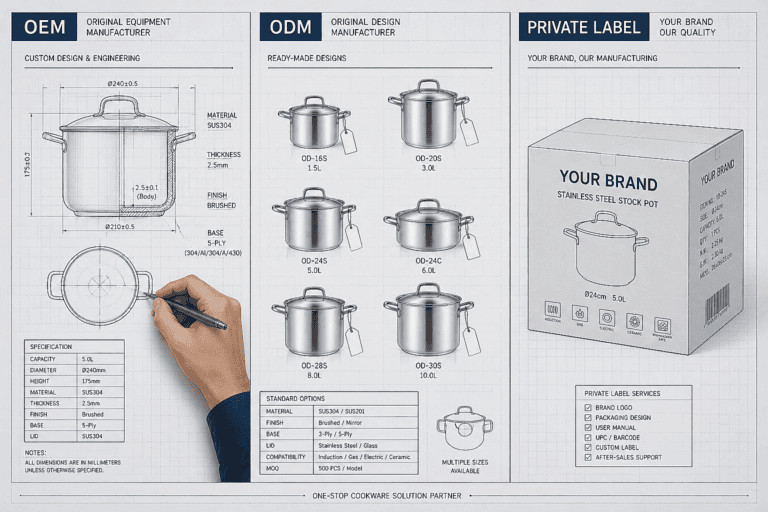
- OEM (Original Equipment Manufacturer): The factory manufactures goods strictly according to your proprietary CAD models, tooling dies, and material specifications. Your company retains full intellectual property ownership. Working directly with the factory gives you complete BOM visibility and enables rapid engineering change orders.
- ODM (Original Design Manufacturer): The manufacturing plant develops catalog designs that buyers customize through branding, surface finish adjustments, or minor dimensional tweaks. Going direct allows you to negotiate exclusive territorial rights or tooling modifications that agents often decline to pursue for modest accounts.
- Private Label Supply: The factory produces its standard catalog items packaged in your custom branded retail boxes. Direct sourcing remains valuable here for securing volume tier pricing, negotiating flexible MOQs, and enforcing packaging durability standards.
Determining which structure matches your portfolio is the foundation of your program. The OEM vs. ODM vs. private label guide breaks down the legal, tooling, and lead time implications of each option.
What benefits do procurement teams actually gain from going direct?
In brief Beyond 15% to 30% gross margin improvements, direct factory sourcing delivers direct access to die tooling engineers and real-time production scheduling visibility.
Procurement teams capture gross margin expansion of 15% to 30%, direct engineering access for accelerated tooling modifications, and unfiltered visibility into factory capacity. While base unit cost savings receive the primary focus, direct communication and production transparency deliver equally significant operational value over extended contract cycles.
Unit cost reduction: Eliminating the intermediary margin is the initial financial benefit. Commercial trading entities and broker agencies typically add a 10% to 25% markup to the factory gate price, often scaling higher for customized or low-volume goods. Across multiple container loads and continuous replenishment cycles, that markup compounds into substantial operational expenditure.
Direct engineering and tooling collaboration: Establishing direct contact with factory tooling engineers accelerates sample iterations and drawing approvals. You can audit die construction, inspect material mill certificates, and authorize alloy upgrades without waiting for an external broker to relay technical drawings or add markup to modification fees.

Unfiltered production scheduling visibility: Direct relationships provide real-time updates regarding raw material lead times, deep-draw press maintenance schedules, and holiday factory shutdowns. Trading agents often conceal scheduling delays until shipment dates pass, leaving procurement teams unable to adjust distribution logistics.
Accumulated strategic advantage: As purchase volumes grow, your team gathers supplier intelligence regarding plant capacity, actual labor rates, and primary steel coil sources. That operational insight strengthens your position during contract renewals and protects gross margins when raw metal commodities fluctuate.
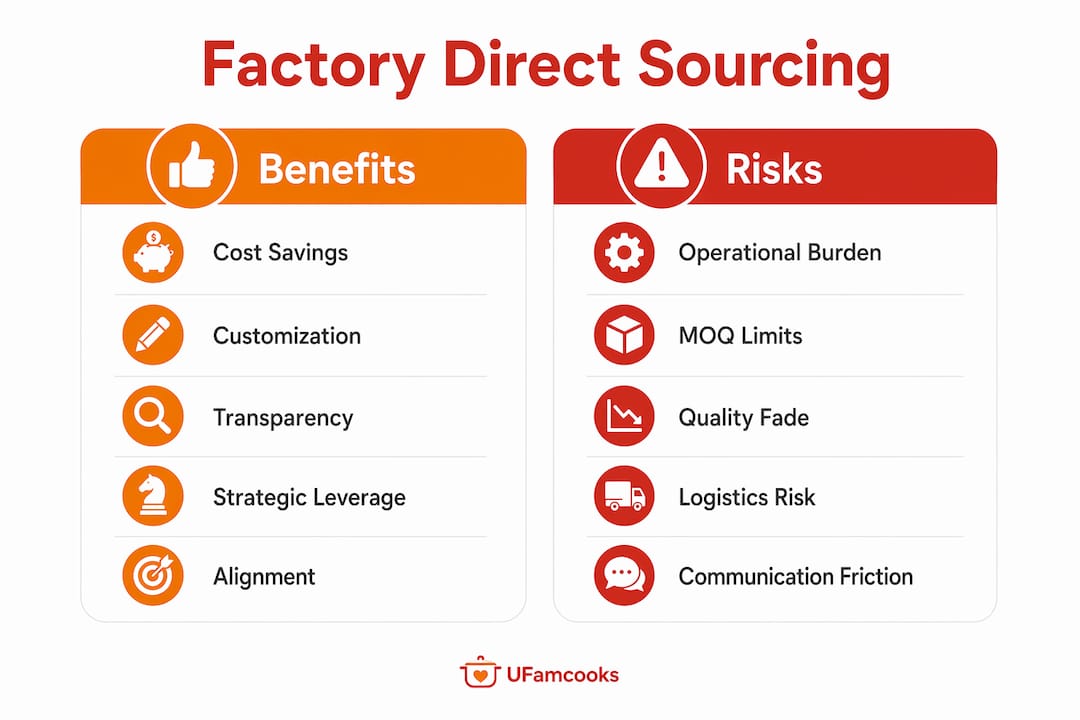
Internal cross-functional alignment: Finance prioritizes lower cost of goods sold and predictable cash flows. Operations values on-time shipping and reliable replenishment cycles. Product design requires precise tolerance execution. A well-managed direct sourcing program satisfies all three requirements once initial supplier qualification is complete.
What are the real risks and limits of factory direct sourcing?
In brief Direct buyers assume full operational responsibility for factory minimum order quantities, batch quality verification, and international freight coordination.
Direct sourcing transfers supplier oversight, international logistics coordination, and quality control enforcement directly onto your internal procurement staff. While landed cost savings are substantial, direct buyers take on full exposure to minimum order quantities, manufacturing deviations, and international trade compliance.

Rigid minimum order quantities (MOQs): Automated manufacturing facilities enforce strict run minimums to justify tooling setups and coil slitting operations. For exploratory programs or initial market tests, factory MOQs of 1,000 to 3,000 units per SKU can tie up working capital in excess stock. Direct sourcing is designed for predictable replenishment and established product lines rather than experimental micro-batches.
Quality fade between batches: The variance between an initial pre-production sample and mass container output represents a primary risk point in direct relationships. Without an intermediary managing daily plant inspections, your team must establish written Quality Hold Points. Factories may drift from drawing tolerances over time unless third-party audits verify dimensions before container loading.
Logistics coordination and LCL risks: Managing ocean freight directly requires handling container booking, customs documentation, and marine insurance. Less-than-container-load (LCL) shipments carry higher risk of transit damage and cargo handling fees compared to consolidated full container loads (FCL).
Communication barriers and cultural norms: Time-zone gaps and technical terminology nuances introduce operational friction during contract negotiations. Without clear written specifications and bilingual drawings, technical requirements can be misinterpreted on the shop floor.
Factory allocation and priority: During peak production quarters (such as pre-holiday manufacturing periods), large manufacturing plants prioritize their highest-volume accounts. A new direct buyer with modest annual volume may encounter pushed completion dates unless formal delivery penalty clauses are written into the contract.
Pro Tip: When managing remote production without a local office, establish structured milestone photo inspections (post-blanking, post-deep draw, pre-passivation, and final packaging) tied directly to staged milestone payments. While this does not replace a physical third-party inspection, it prevents production drift before goods reach the loading dock.
Operational red flags during factory vetting:
- The vendor claims direct factory status but cannot provide original ISO or BSCI audit certificates matching its corporate business license.
- Initial sample quality is high, but the supplier cannot provide a written in-process Quality Control plan or list its testing equipment.
- The supplier demands 100% upfront wire payment without standard commercial milestones (such as 30% deposit and 70% against Bill of Lading).
- All technical engineering queries are answered by junior sales clerks rather than dedicated production engineers.
Factory direct vs. sourcing company vs. hybrid: which fits your situation?
In brief Factory direct suits high-volume recurring orders; sourcing agencies mitigate market entry risks; hybrid models provide the safest transition pathway.
Choosing between factory direct, sourcing agencies, or a hybrid arrangement depends on annual spend volume, specification stability, and internal engineering bandwidth. Experienced corporate buyers deploy all three procurement strategies across their product categories based on portfolio maturity.
| Operational Dimension | Factory Direct | Sourcing Agency / Broker | Hybrid Procurement Model |
|---|---|---|---|
| Optimal Application | High-volume, repeat orders with locked engineering prints | New geographic markets, pilot orders, complex assemblies | Initial pilot phase managed by agency, transitioning to direct |
| Landed Cost Profile | Lowest unit cost; buyer absorbs internal coordination overhead | Agency markup (10%–25%); external management included | Higher initial pilot costs; direct savings on subsequent runs |
| MOQ Requirements | Direct factory run minimums apply (typically 1,000+ units) | Agency may consolidate orders across buyers for lower minimums | Agency manages pilot MOQ; direct volume takes over at scale |
| Quality Governance | Full buyer control; buyer specifies AQL inspection standards | Agency provides inspection layer; buyer has indirect visibility | Agency establishes baseline inspection; buyer assumes ownership |
| Production Lead Time | Faster once tooling is stable; requires longer initial setup | Faster initial supplier onboarding; agency coordinates locally | Balanced; agency accelerates launch, direct optimizes long term |
| Operational Exposure | Higher initial diligence requirement; lower ongoing friction | Lower initial risk; reduced transparency over true factory costs | Balanced; agency mitigates market entry risk, direct preserves margin |
Practical deployment scenarios:
A hospitality distributor placing recurring quarterly orders of 2,500 units per SKU on established stainless stockpots represents an ideal direct sourcing candidate. Specifications are finalized, tooling is amortized, and margin gains compound with each container shipment.
Conversely, a cookware startup launching a novel nonstick concept in an unfamiliar overseas manufacturing hub benefits from engaging a regional sourcing agency for initial runs. The on-ground presence, language fluency, and local auditing capabilities justify the agency fee during the initial validation period.
The hybrid model offers the most reliable transition path for expanding brands: retain a specialized sourcing agency to manage tooling fabrication and initial trial batches, capture transparent factory contacts and BOM costs in the initial agreement, and then transition repeat replenishment orders to direct factory management once the line is stable.
When does factory direct sourcing actually deliver the highest return?
In brief Direct procurement yields maximum financial return on core 80/20 revenue categories characterized by mature CAD prints, repeat replenishment, and high volume.
Direct sourcing delivers peak financial return when applied to core revenue-generating product lines characterized by high annual purchase volume, mature tooling, and predictable demand cycles. Academic research and procurement practice confirm that direct engagement yields maximum value when applied strategically to core categories rather than fragmented across every catalog item.
The standard Pareto principle applies across manufacturing portfolios. Identify the top 20% of your SKUs that generate 80% of your procurement spend and maintain stable engineering specifications. Those components represent prime candidates for direct factory engagement. The remaining low-volume catalog items, custom accessories, and short-lifecycle products are more efficiently managed through trading intermediaries.
Infrastructure requirements for scaling direct sourcing: Scaling direct procurement across multiple factory partners requires systematic supplier intelligence systems. Enterprise procurement teams implement structured supplier discovery, automated performance dashboards, and digital quality auditing to manage administrative overhead. Without dedicated supplier management workflows, direct procurement programs often experience declining efficiency beyond 8 to 10 active factory relationships.
Pro Tip: Before transitioning a category to direct sourcing, perform a comprehensive Total Cost of Ownership (TCO) calculation. Include internal administrative labor, third-party inspection fees, marine insurance, and customs broker charges alongside the factory gate quotation. Factoring in these operational expenses provides a realistic picture of your true landed margins.
Procurement directors often underestimate the organizational capabilities required to sustain direct sourcing. Successful direct programs require disciplined contract negotiation, rigorous quality control protocols, and continuous supplier performance evaluation to achieve long-term cost benefits.
How to source factory-direct: a 7-step process
In brief A structured seven-step framework spanning category spec lock, on-site auditing, milestone-tied contracts, and pre-shipment inspections guarantees program success.
Executing a successful factory direct sourcing program follows a structured seven-stage framework, moving from technical requirements definition to sustained supplier performance management:
-
Define technical specifications and category volume. Finalize your 2D engineering drawings, GD&T tolerance limits, alloy grade requirements, annual volume forecasts, and acceptable MOQ thresholds before initiating supplier outreach. Detailed specifications prevent ambiguous quotations and misaligned samples.
-
Supplier discovery and legal verification. Screen candidate manufacturers through verified trade associations, international expos, and industry referrals. Confirm that each candidate is an actual manufacturer by verifying on-site machinery ownership, export business licenses, and certified quality management audits.
-
Structured RFQs and pre-production sampling. Issue a comprehensive RFQ containing your technical drawings, target order quantities, packaging specifications, and milestone payment expectations. Request functional pre-production samples simultaneously, evaluating incoming pieces against objective engineering benchmarks.
-
Factory audits and technical capability checks. Conduct an on-site manufacturing audit or commission an accredited third-party inspection agency to inspect plant capacity, stamping presses, in-process annealing furnaces, and laboratory testing facilities. Review the UFamcooks vetting guide for manufacturers for structured auditing checklists.
-
Commercial terms and contract execution. Establish terms covering tooling ownership, intellectual property protections, milestone payments (such as 30% deposit with 70% against original Bill of Lading), agreed production lead times, and defined financial penalties for unexcused shipment delays.
-
Pre-shipment inspection and logistics execution. Prior to container dispatch, dispatch an independent quality inspector to conduct a final Pre-Shipment Inspection (PSI) adhering to ISO 2859-1 (AQL) standards. Verify export customs declarations, bill of lading documentation, and marine transit insurance.
-
Post-production review and ongoing refinement. Following initial warehouse receipt, document any tolerance discrepancies, transit packaging damage, or schedule variances. Incorporate these operational findings into subsequent production orders and annual contract reviews.
Standard production control checklist:
- Approved physical Golden Reference Samples retained by both buyer and factory quality labs.
- BOM specifications and alloy chemistries formally signed by factory engineering heads.
- Mandatory Quality Hold Points embedded within purchase order terms.
- Pre-shipment inspection scheduled prior to final packaging and container loading.
- Payment release triggers linked directly to documented quality verification milestones.
- Tooling and die ownership rights explicitly established in the master supply contract.
- Direct communication channels established with plant engineering staff rather than sales clerks.
Key contractual protections to include:
- Tooling Rights: “All dedicated tooling, dies, and molds engineered for this production order remain the exclusive property of [Buyer] and may not be utilized for third-party manufacturing without prior written consent.”
- Quality Conformance: “Shipped inventory failing to meet the retained physical Golden Reference Sample criteria (Sample ID #[X]) or exceeding agreed AQL tolerance limits shall be rectified or replaced at the sole expense of the manufacturer.”
- Proprietary Design Protection: “The manufacturer agrees not to duplicate, market, display, or distribute proprietary designs, tooling geometries, or technical documentation provided by [Buyer] to any third party.”
Managing quality, IP, and supplier risk when you buy direct
In brief Protect product programs through physical Golden Reference Samples, binding NNN agreements, tooling ownership clauses, and independent ISO 2859-1 PSI audits.
Managing quality and intellectual property directly requires establishing structured quality checkpoints that intermediaries typically manage behind the scenes. Building these governance frameworks internally is a core requirement of an effective direct sourcing program.
Multi-stage quality control framework:
- Golden Reference Samples: retain signed, dated production reference units at both corporate headquarters and the factory testing laboratory.
- In-process photographic verification: require high-resolution photographs at defined milestones (such as blanking, deep drawing, and handle riveting) prior to milestone payments.
- Independent Pre-Shipment Inspection (PSI): engage accredited third-party inspectors to evaluate lots against ISO 2859-1 sampling plans (AQL 0 for critical safety, AQL 1.5 for functional performance, AQL 2.5 for cosmetic appearance).
- Production lot retention: archive representative production samples from each ocean container for a full warranty cycle.
Intellectual property safeguards: Execute a binding Non-Disclosure and Non-Use Agreement (NNN) before transferring CAD files, die schematics, or proprietary specifications. Establish legal tooling ownership in the initial contract prior to tool fabrication. For unique product geometries, pursue design patents in the manufacturing country prior to tooling release. The UFamcooks review of design IP in manufacturing details standard clauses for safeguarding proprietary tooling.
Commercial risk mitigations:
- Milestone-based payment terms tied strictly to verified production stages rather than calendar schedules.
- Documented audit rights granting your representatives access to production lines with 48 hours notice.
- Quality retention holdbacks (typically 5% to 10% of final balance) released following port-of-entry inspection.
Pro Tip: Channel all technical and tolerance discussions directly to factory production engineers rather than commercial sales reps. Establish this requirement in your initial project brief. Direct engineering communication prevents translation errors during tooling modifications and keeps production schedules on track.
What do costs, MOQs, and timelines actually look like?
In brief Budget 14 to 24 weeks for initial orders to cover tooling fabrication, sample approvals, mass production runs, and trans-ocean container shipping.
Evaluating the complete cost structure and lead time requirements before launching a direct sourcing program prevents budget variances and inventory stockouts during commercial rollout.
| Procurement Element | Standard Industry Benchmark | Operational Considerations |
|---|---|---|
| Factory Gate Unit Price | Baseline manufacturer quotation | Ex-Works (EXW) or Free on Board (FOB) origin port; excludes freight and tariffs |
| Tooling and Die Investment | $1,500–$8,000+ per custom die set | One-time capital expense; ensure exclusive ownership is locked in contract |
| Pre-Production Sampling | $300–$800 per functional prototype set | Often credited against first volume purchase order upon approval |
| Third-Party PSI Inspection | $280–$350 per inspector-day | Standard budget: 1 to 2 inspector-days per 40-foot container load |
| Ocean Freight and Drayage | Variable based on market container index | FCL shipments achieve significantly lower per-unit freight costs than LCL |
| Customs Tariffs and Duties | Determined by HTS code and trade origin | Confirm precise tariff classification before issuing purchase orders |
| Destination Port Drayage | $350–$750 per container transfer | Terminal handling, chassis fees, and local delivery to regional warehouse |
| Sample Review and Approval | 2–4 weeks | Includes transit time, laboratory performance tests, and dimensional review |
| Tooling Fabrication Lead Time | 4–7 weeks | Following formal 2D/3D drawing sign-off and deposit transfer |
| Mass Production Lead Time | 5–8 weeks | Dependent on plant capacity and raw stainless coil delivery cycles |
| Ocean Transit (Asia to US/EU) | 3–5 weeks | Port-to-port ocean voyage; budget additional time for customs release |
| Total First-Order Lead Time | 14–24 weeks | From initial engineering freeze to arrival at destination warehouse |
Minimum Order Quantity (MOQ) dynamics: Large manufacturing plants operating high-speed stamping presses enforce MOQs of 1,000 to 3,000 units per item to optimize coil slit widths and press setup times. Specialized medium-scale factories may accept initial trial batches of 500 units, though unit costs will reflect shorter machine runs. SKU rationalization, consolidating volume across fewer core models, is the most practical method for meeting factory minimums. The UFamcooks breakdown of MOQ expectations from a kitchenware factory explores these trade-offs in detail.
A standard first-order lead time of 14 to 24 weeks requires early planning. Align your inventory planning and sales commitments with this realistic window rather than relying on production cycle quotes alone.
How do you choose between factory direct, a sourcing company, or a hybrid?
In brief Evaluate categories across annual spend volume, drawing stability, internal auditing bandwidth, and regional market familiarity before committing.
Selecting the right procurement model requires evaluating four core criteria: order volume, specification stability, internal team capabilities, and regional market familiarity. Conduct this review for each product category prior to contract execution.
Select Factory Direct Sourcing when:
- Annual projected volume per SKU easily satisfies factory production minimums without creating excess inventory.
- Product drawings and material specifications are finalized and unlikely to shift during the next 12 months.
- Your company maintains dedicated staff to manage vendor communication, third-party inspection, and logistics.
- The manufacturing partner has completed comprehensive quality and social compliance audits.
- The product category represents a core, high-spend component of your revenue base.
Select a Sourcing Agency or Broker when:
- Entering an unfamiliar overseas manufacturing market for the first time.
- Order quantities remain below standard factory production minimums.
- Your team lacks language fluency or on-ground auditing resources in the manufacturing region.
- The product is in early development with design changes anticipated across initial batches.
- You need immediate access to pre-qualified factory networks without a 6 to 12 month diligence cycle.
Select a Hybrid Model when:
- Validating a new production partner before committing to high-volume purchase agreements.
- Transitioning an established agency-managed product line to direct internal management.
- Requiring on-ground agency support for initial tooling while training internal staff on category logistics.
Category evaluation criteria:
- What is the projected annual procurement spend and volume for this category?
- Are product drawings and material specifications locked for the coming year?
- Does your internal team possess the bandwidth to oversee daily quality and shipping logistics?
- Has the production facility passed on-site quality and ethical compliance audits?
- What is the total cost of ownership under each model when internal labor is accounted for?
Recommended phased implementation: Work with an experienced sourcing agency to oversee tooling fabrication and initial trial batches. Ensure the initial agreement provides transparent factory contacts and true manufacturing costs. Once production quality stabilizes, transition recurring purchase orders to direct factory management. This phased transition captures long-term margin benefits while minimizing early production risks.
Maintaining a supply diversification strategy is essential throughout this process. Relying on a single manufacturing facility concentrates risk, making it prudent to maintain secondary pre-qualified suppliers for critical product lines.
Key Takeaways
In brief Direct factory procurement delivers substantial financial and operational returns when backed by internal quality management and disciplined change control.
Factory direct sourcing delivers significant margin and operational benefits for high-volume, stable product categories when supported by internal quality management and logistics capabilities.
| Strategic Principle | Operational Application |
|---|---|
| Conditional Cost Savings | The 15% to 30% unit cost advantage requires internal management of quality control and logistics to realize net savings. |
| MOQ Management | Direct sourcing is designed for volume replenishment; use SKU rationalization to meet factory production minimums. |
| Phased Hybrid Transition | Mitigate initial risk by using an agency for tooling and pilot runs before transitioning mature lines to direct reorders. |
| Structured Quality Control | Implement physical Golden Reference Samples, in-process inspection milestones, and third-party PSI audits as non-negotiable standards. |
| Direct Factory Partnership | Partner directly with established manufacturers offering integrated engineering, tooling, and certified quality management under one roof. |
A procurement strategist’s perspective
“Direct sourcing is not merely a cost-cutting tactic; it is an organizational capability build. The buyers who win are those who turn factory engineers into technical partners before volume scales.”
— Jason Gan, Founder & Lead Engineer
In brief Direct sourcing is an organizational capability rather than a transactional tactic. Start with hybrid validation before transitioning mature volume lines.
Industry discussions around factory direct sourcing often present an oversimplified choice: go direct to maximize margins, or use an agency for convenience. In practice, the critical question is identifying when a product category has matured enough for direct sourcing and whether your internal team is equipped to manage it.
The procurement teams achieving the highest returns on direct sourcing rarely bypassed intermediaries immediately. Instead, they leveraged specialized sourcing partners to audit initial factories, establish baseline quality standards, and oversee early trial runs. Once production stabilized, they transitioned ongoing replenishment to direct factory management. That disciplined progression minimizes operational risk while capturing long-term cost benefits.
Procurement leaders must recognize the operational capabilities required for successful direct sourcing. Direct procurement at scale is not merely a cost-reduction measure; it requires systematic supplier management, direct engineering communication, and disciplined contract oversight. Organizations that implement direct sourcing without these capabilities often encounter quality deviations, shipping delays, and higher overall costs.
For kitchenware brands and commercial distributors, UFamcooks’ factory direct model provides an effective benchmark. By integrating OEM and ODM engineering with multi-stage quality control directly on the plant floor, buyers gain transparent factory pricing alongside the technical support typically provided by external agents. This integrated structure allows brands to transition to direct sourcing without having to build a dedicated overseas quality office from the ground up.
A phased lifecycle approach remains the most effective strategy: validate production partners through hybrid arrangements, establish clear engineering benchmarks, and move to direct sourcing on high-volume product lines once specifications are locked.
UFamcooks: factory direct manufacturing without the middleman markup
In brief UFamcooks combines OEM/ODM cookware engineering, automated deep-draw stamping, and multi-stage ISO 9001 quality assurance directly within Jiangmen.
For kitchenware brands, commercial wholesalers, and hospitality distributors ready to transition to factory direct sourcing, UFamcooks offers an integrated manufacturing model that eliminates intermediary markups while providing the engineering and quality support buyers require.
UFamcooks manufactures high-grade stainless steel cookware to custom OEM and ODM specifications, providing complete customization across alloy selection, vessel forming, and retail packaging. Our quality assurance framework incorporates in-process inspections, independent pre-shipment audits, and physical Golden Reference Sample archiving directly into the factory workflow. Clear production scheduling ensures lead times and shipping milestones are communicated transparently throughout the manufacturing cycle.
For buyers evaluating manufacturing capabilities and product ranges, our dedicated OEM/ODM manufacturing service page details our plant equipment, tooling options, and direct supply workflows. When you are ready to review technical drawings and minimum order quantities for your product line, our engineering team is available to assist.
FAQ
How does direct sourcing work?
Direct sourcing involves contracting, issuing purchase orders, and communicating directly with the manufacturing facility rather than through trading companies or commission agents. The buyer manages design specifications, quality assurance protocols, and ocean logistics directly with factory management.
What is a factory direct supplier?
A factory direct supplier is the actual manufacturing entity that owns the physical production machinery, tooling dies, and fabrication lines, rather than an intermediary broker. Validating direct manufacturer status requires auditing business licenses, equipment ownership records, and on-site production lines.
What are the 7 steps of sourcing?
The standard strategic sourcing process consists of seven phases: category definition and spec lock, supplier discovery and validation, RFQ issuance and sample evaluation, factory capability auditing, commercial contract negotiation, pre-shipment inspection with logistics execution, and post-production performance review.
What are the three types of sourcing?
The three primary sourcing structures are factory direct procurement (direct contracting with the manufacturer), indirect procurement via trading agencies or brokers, and hybrid procurement (using an agency for initial tooling and pilot runs before transitioning to direct management). Enterprise buyers utilize all three across different product categories.
When should you use a sourcing company instead of going direct?
Engage a sourcing agency when expanding into unfamiliar geographic regions, when initial order quantities fall below factory production minimums, or when your internal team lacks on-ground auditing and language capabilities. The agency fee provides valuable risk mitigation during market entry.
Recommended Procurement Guides
DIRECT MANUFACTURING INQUIRY
Cut Intermediary Markups with Direct Factory Engineering
UFamcooks operates 6 automated stamping and forming lines across 10,000+ m² in Jiangmen’s manufacturing cluster. We provide direct DFM reviews, P20/H13 tooling fabrication, 3-ply and 5-ply cladding, and certified testing under ISO 9001.
Request Factory Direct Quote