How Custom Stainless Steel Alloy Works for Engineers
June 3, 2026
Custom stainless steel alloying is the practice of precisely engineering a metal’s chemical composition and heat treatment sequence to produce targeted mechanical and corrosion performance. Unlike standard grades such as 304 or 316, custom alloys like Custom 450 and Custom 455 are designed from the ground up to hit specific yield strength, hardness, and corrosion resistance thresholds. Understanding how custom stainless steel alloy works means understanding two inseparable levers: composition control and thermal processing. Get either one wrong, and the microstructure you need never forms.
How custom stainless steel alloy works at the metallurgical level
The foundation of every custom stainless steel alloy is chromium. At concentrations above roughly 10.5% by weight, chromium reacts with oxygen to form a thin, self-repairing Cr₂O₃ passive film on the steel’s surface. That film is what separates stainless steel from ordinary carbon steel in corrosive environments. Without it, no amount of heat treatment produces a corrosion-resistant part.
Beyond chromium, the properties of stainless steel alloys are shaped by a second tier of alloying elements. Nickel stabilizes the austenitic phase and improves toughness. Molybdenum raises pitting resistance in chloride environments. Carbon content is kept deliberately low in precipitation-hardening (PH) grades to preserve weldability and prevent carbide precipitation during heat treatment. The term “precipitation hardening” refers to the process of forming fine intermetallic particles inside the metal matrix during a controlled aging cycle, and it is the core mechanism behind the strength of alloys like Custom 450 and Custom 455.

The custom alloy manufacturing process follows a defined sequence. Steel is melted in an electric arc furnace, then refined through argon oxygen decarburization (AOD) or vacuum oxygen decarburization (VOD) to hit precise chemistry targets. Vacuum arc remelting (VAR) is added for the highest-cleanliness grades. After forming, the alloy undergoes solution annealing at 1000 to 1100 °C with rapid cooling to dissolve carbides and homogenize the microstructure. The part is then soft, machinable, and ready for aging.
Aging is where the real engineering happens. During aging, elements like titanium (Ti), niobium (Nb), and copper (Cu) precipitate out of the martensitic matrix as fine intermetallic compounds. These particles block dislocation movement, which is the atomic-scale mechanism behind increased hardness and yield strength. The aging temperature and time determine the size and density of those precipitates, which in turn control the final property balance.
- Solution annealing dissolves alloying elements into a uniform solid solution and sets the starting microstructure.
- Quenching locks that solution in place by cooling too fast for precipitation to occur spontaneously.
- Aging (e.g., H900 at 482 °C) triggers controlled precipitation of strengthening intermetallics at low temperature.
- Annealed condition describes the soft, solution-treated state used for machining and forming.
- Aged condition describes the final hardened state after the aging cycle is complete.
Pro Tip: Machine PH stainless steel parts in the annealed condition whenever possible. The dimensional change during aging is only about 0.001 in/in contraction, meaning tight tolerances set before aging survive the heat treatment cycle with minimal correction.
Custom 450 vs. Custom 455: which alloy fits your application?
These two alloys represent the clearest illustration of how composition choices translate into different performance profiles. Both are martensitic PH grades, but their chemistry and resulting properties diverge in ways that matter for real applications.
| Property | Custom 450 (UNS S45000) | Custom 455 (UNS S45500) |
|---|---|---|
| Yield strength (annealed) | 690 MPa guaranteed | Lower; optimized for aged condition |
| Yield strength (aged) | 1200+ MPa (single aging step) | 1600+ MPa at H900 (482 °C) |
| Primary strengthening elements | Ti, Cu | Ti, Nb, Cu |
| Corrosion resistance | 304-level | Slightly lower than 450 in aggressive media |
| Machinability | Excellent in annealed state | Excellent in annealed state |
| Weldability | Good; post-weld aging recommended | Good; post-weld aging recommended |
| Typical applications | Aerospace fasteners, medical instruments | High-stress structural parts, springs, shafting |
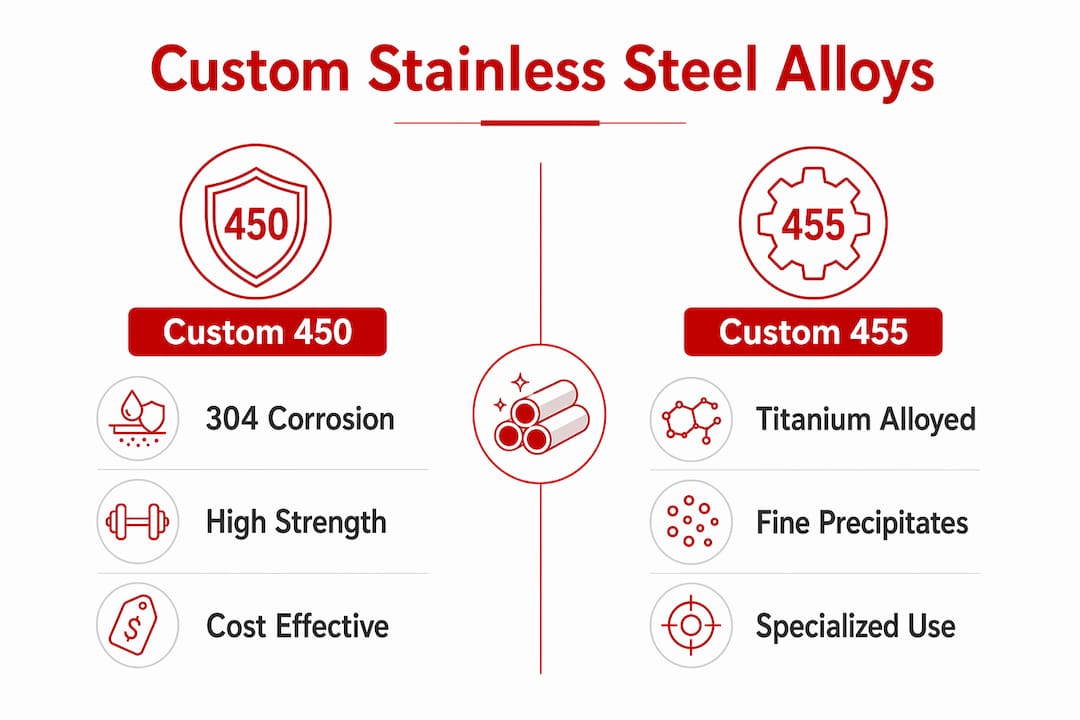
Custom 450 is the pragmatic choice when you need 304-level corrosion resistance combined with strength well above standard austenitic grades. Its post-weld aging is not mandatory in the annealed state but is strongly recommended when maximum strength in the heat-affected zone is required. That flexibility makes it attractive for fabricated assemblies where welding is unavoidable.
Custom 455 is the specialist. Its titanium, niobium, and copper combination produces intermetallic precipitates so fine and uniformly distributed that the alloy reaches over 1600 MPa yield strength after a single 482 °C aging cycle. The dimensional change during that cycle is negligible, which is why precision aerospace and defense components are routinely made from it. The trade-off is slightly reduced corrosion resistance compared to Custom 450, which matters in medical sterilization environments where repeated autoclave exposure is the norm.
Pro Tip: When specifying Custom 455 for medical devices, verify the sterilization protocol with your materials engineer. Repeated steam autoclave cycles can challenge the alloy’s passive film in ways that dry-heat or chemical sterilization does not.
How grain boundaries affect corrosion and mechanical behavior
The passive Cr₂O₃ film that protects stainless steel is not uniform across the entire surface. Chromium oxidation initiates preferentially at grain boundaries because atomic diffusion is faster along those boundaries than through the bulk crystal lattice. This means grain boundaries are both the first line of defense and the first point of vulnerability.
In practice, this creates a predictable sequence of corrosion events that engineers need to account for:
- Passive film formation begins at grain boundaries under oxidizing conditions, producing island-like Cr₂O₃ structures that eventually coalesce into a continuous film.
- Selective oxidation can deplete chromium locally at grain boundaries, reducing the protective capacity of the film in those zones.
- Pit initiation occurs when chloride ions penetrate the film at its weakest points, typically at grain boundary intersections or inclusion sites.
- Pit propagation is sustained by chloride accumulation and restricted oxygen transport inside the pit cavity, creating an aggressive local chemistry that the bulk environment does not reflect.
- Stress corrosion cracking (SCC) can develop when pit growth transitions to crack propagation under applied or residual stress, a failure mode that surprises engineers who assume stainless steel is immune to cracking.
The practical implication is that grain size and texture are not just mechanical variables. Finer grain sizes increase the total grain boundary area, which accelerates initial passive film formation but also creates more potential initiation sites for localized attack. Heat treatment parameters directly influence grain size: higher solution annealing temperatures coarsen grains, while lower temperatures or shorter hold times produce finer microstructures. Choosing the right annealing condition is therefore a corrosion engineering decision, not just a strength decision.
Microstructure-aware inspection strategies follow from this understanding. Ultrasonic testing and eddy current methods that are calibrated for grain texture give more reliable defect detection in PH stainless steels than generic protocols designed for austenitic grades. Advanced corrosion models now incorporate grain boundary texture and local chloride chemistry as inputs to predict pit-to-crack transitions before they occur in service.
Applications and how to choose the right stainless steel alloy
The benefits of custom stainless steel are most visible in applications where standard grades hit a performance ceiling. Four sectors drive the majority of demand for PH grades.
- Medical devices: Surgical instruments, bone screws, and implant components require both high strength and reliable corrosion resistance in saline and sterilization environments. Custom 450 is the common choice here because its 304-level corrosion resistance survives repeated autoclave cycles.
- Aerospace and defense: Fasteners, shafting, and structural brackets need maximum strength at minimum weight. Custom 455 dominates this space because its 1600+ MPa yield strength after aging exceeds what most austenitic or ferritic grades can achieve.
- Tooling and precision components: Springs, valve stems, and actuator parts benefit from the near-zero distortion aging of Custom 455, which allows final machining before heat treatment without sacrificing dimensional accuracy.
- Chemical processing: Equipment exposed to chloride-containing process streams requires careful alloy selection. Custom 450 with its molybdenum content handles moderate chloride concentrations, but highly aggressive environments may require a duplex or super-austenitic grade instead.
When selecting a custom stainless steel alloy, evaluate these properties in sequence. Start with the corrosion environment: identify the specific corrosive agents, temperature, and exposure time. Then set the minimum mechanical requirements: yield strength, hardness, and fatigue life. Only after those two filters are applied should you consider machinability and weldability, because compromising on the first two to gain manufacturing convenience typically produces field failures.
The most common pitfall in machining PH stainless steels is attempting to machine in the aged condition. Work hardening rates in the aged martensitic matrix are high, tool wear accelerates, and dimensional control suffers. The correct sequence is always: machine soft, then age. Welding introduces a separate challenge: the heat-affected zone reverts toward the annealed condition, creating a strength gradient in the joint. Post-weld aging restores uniformity, and skipping it is the leading cause of premature weld joint failures in PH stainless fabrications.
Key takeaways
Custom stainless steel alloys work by combining controlled chemistry, precipitation hardening, and grain-level microstructure management to achieve strength and corrosion performance that standard grades cannot reach.
| Point | Details |
|---|---|
| Composition drives performance | Chromium, Ti, Nb, and Cu additions each target specific mechanical or corrosion properties. |
| Heat treatment is non-negotiable | Aging temperature and time determine precipitate size, strength, and dimensional stability. |
| Custom 450 vs. Custom 455 | Custom 450 prioritizes corrosion resistance; Custom 455 prioritizes ultra-high strength. |
| Grain boundaries are the weak link | Chromium depletion at grain boundaries is the primary initiation site for pitting and SCC. |
| Machine soft, age last | Machining in the annealed condition before aging preserves tolerances and extends tool life. |
What working with PH stainless steels taught me about alloy design
Most engineers I encounter treat alloy selection as a catalog exercise: find the grade that meets the minimum spec, order it, and move on. That approach works until it doesn’t, and when it fails, it fails expensively. The real lesson I’ve taken from years of working with precipitation-hardened stainless steels is that the heat treatment sequence is as much a part of the design as the composition itself.
The rise of computational thermodynamics and genetic algorithms for alloy design is changing this, and not a moment too soon. Designed alloys achieving 1365 MPa yield strength and 1539 MPa tensile strength through optimized phase fractions represent what happens when you stop guessing at composition and start computing it. The development time and cost reductions are real, and they make custom alloy design accessible to mid-size manufacturers who previously had to accept whatever standard grades offered.
The uncomfortable truth about stainless steel is that the “stainless” label creates false confidence. Chloride-induced pitting that transitions to stress corrosion cracking is a well-documented failure mode, and it catches engineers off guard precisely because they assumed the material was immune. Grain boundary control, inspection protocols calibrated to the actual microstructure, and honest corrosion environment assessment are not optional refinements. They are the difference between a part that lasts and one that fails at 60% of its design life.
My practical advice: never skip post-weld aging on a structural PH stainless assembly, and always verify your inspection method is sensitive to the grain texture of the specific alloy you are using. Those two habits alone eliminate the majority of field failures I have seen.
— Jason
Explore Ufamcooks’ custom stainless steel product line
Ufamcooks manufactures stainless steel kitchenware directly from the factory, which means the alloy selection, forming, and quality control happen under one roof without the markup of a middleman. For kitchenware brands, wholesalers, and importers who need consistent corrosion resistance and precise forming tolerances, that matters. Browse the full range of custom stainless steel products to see OEM and ODM options across cookware, storage, and mixing categories. If you need food-safe corrosion resistance in a specific form factor, the stainless steel food storage containers line demonstrates what controlled alloy selection and multi-stage quality control produce at scale. Request a quote directly to discuss composition requirements and production timelines.
ЧАСТО ЗАДАВАЕМЫЕ ВОПРОСЫ
What is stainless steel alloying?
Stainless steel alloying is the process of adding controlled amounts of elements such as chromium, nickel, molybdenum, titanium, and niobium to iron to produce a metal with targeted corrosion resistance, strength, and toughness. The minimum chromium content required to form a protective Cr₂O₃ passive film is approximately 10.5% by weight.
How does precipitation hardening work in custom alloys?
Precipitation hardening works by dissolving strengthening elements into the metal matrix during solution annealing, then aging the alloy at a lower temperature to form fine intermetallic precipitates that block dislocation movement. Custom 455 reaches over 1600 MPa yield strength through this mechanism after a single 482 °C aging cycle.
What is the difference between Custom 450 and Custom 455?
Custom 450 offers 304-level corrosion resistance with yield strength up to 1200+ MPa after aging, making it the preferred choice for medical and chemical applications. Custom 455 sacrifices some corrosion resistance to achieve 1600+ MPa yield strength, which suits aerospace and high-stress structural components.
Can stainless steel corrode despite its passive film?
Yes. Localized pitting in chloride environments can penetrate the passive film and, under stress, transition to stress corrosion cracking. The passive film is self-repairing under normal conditions but is not immune to aggressive occluded chemistry inside a pit.
When should you machine a PH stainless steel part?
Always machine PH stainless steel in the annealed (soft) condition before the aging cycle. The dimensional contraction during aging is only about 0.001 in/in, so tolerances set before aging remain accurate after hardening, and tool wear is dramatically lower in the softer annealed state.