Vetting Stainless Steel Cookware Manufacturers: 2026 Guide
Vetting stainless steel cookware manufacturers is the process of systematically confirming a factory’s material authenticity, production capabilities, certifications, and quality control systems before committing to a sourcing relationship.
Vetting stainless steel cookware manufacturers is the process of systematically confirming a factory’s material authenticity, production capabilities, certifications, and quality control systems before committing to a sourcing relationship. For kitchenware brands, professional chefs, and wholesale buyers, skipping this process means risking counterfeit material grades, failed compliance audits, and product recalls that destroy brand equity. The standard industry term for this process is supplier qualification, and it covers everything from ISO 9001 certification verification to on-site factory audits. A manufacturer quoting 304-grade stainless steel at suspiciously low prices is a red flag, not a bargain. This guide gives you the exact criteria and practical steps to separate reputable cookware suppliers from those who will cost you far more than they save.
Vetting at a glance
- Supplier qualification means confirming material grade, capability, certifications, and QC before you order.
- Certifications to verify:
ISO 9001,FDA(US),LFGB(EU), andNSF/ANSI 51for foodservice. - Verify certificates directly with accredited labs —
SGS,TUV Rheinland,Intertek. - Confirm
304-grade steel (not201) with an MTR plus XRF analysis; visual and magnet tests are unreliable. - Tell a factory from a trader: business-license scope plus a virtual tour; direct factories avoid a
10–30%markup. - Established manufacturers: MOQ around
1,000units/SKU, lead times40–60 days. - A reputable factory runs three QC stages —
IQC,IPQC,OQC— with documented criteria.
What certifications qualify a reputable stainless steel cookware manufacturer?
Certifications are the first filter in any stainless steel manufacturer vetting process, but they are only useful if you verify them correctly. A certificate pinned to a supplier’s Alibaba profile means nothing unless you confirm it is current, product-specific, and issued by an accredited third-party laboratory.
The certifications that matter most depend on your target market:
- ISO 9001 covers quality management systems and confirms the factory operates with documented processes, not ad hoc production decisions. It does not guarantee food safety on its own.
- FDA compliance (United States) and LFGB certification (European Union) confirm that materials and coatings meet food contact safety standards. If you sell in both markets, you need both.
- NSF/ANSI 51 is the standard for commercial foodservice equipment and is required by many restaurant supply chains and institutional buyers in North America.
- BSCI (Business Social Compliance Initiative) or SMETA (Sedex Members Ethical Trade Audit) cover ethical manufacturing practices, labor conditions, and environmental standards. Retailers like Walmart and Costco require these before onboarding suppliers.
Certificates must be current, relevant to the specific product line, and verified directly with accredited labs to avoid fraud. Outdated or generic certificates do not guarantee product safety or compliance. The accredited labs to use for independent verification are SGS, TUV Rheinland, and Intertek. Each of these organizations maintains a public database where you can cross-check certificate numbers against their records.
Pro Tip: Ask the manufacturer for the certificate number and the issuing lab’s contact, then call the lab directly to confirm validity. Any supplier who resists this request is telling you something important.
How to confirm material quality and construction capabilities
Material fraud is the single most costly mistake buyers make when sourcing stainless steel cookware. The two most common grades used in cookware are 304 and 201 stainless steel, and they look identical to the naked eye.
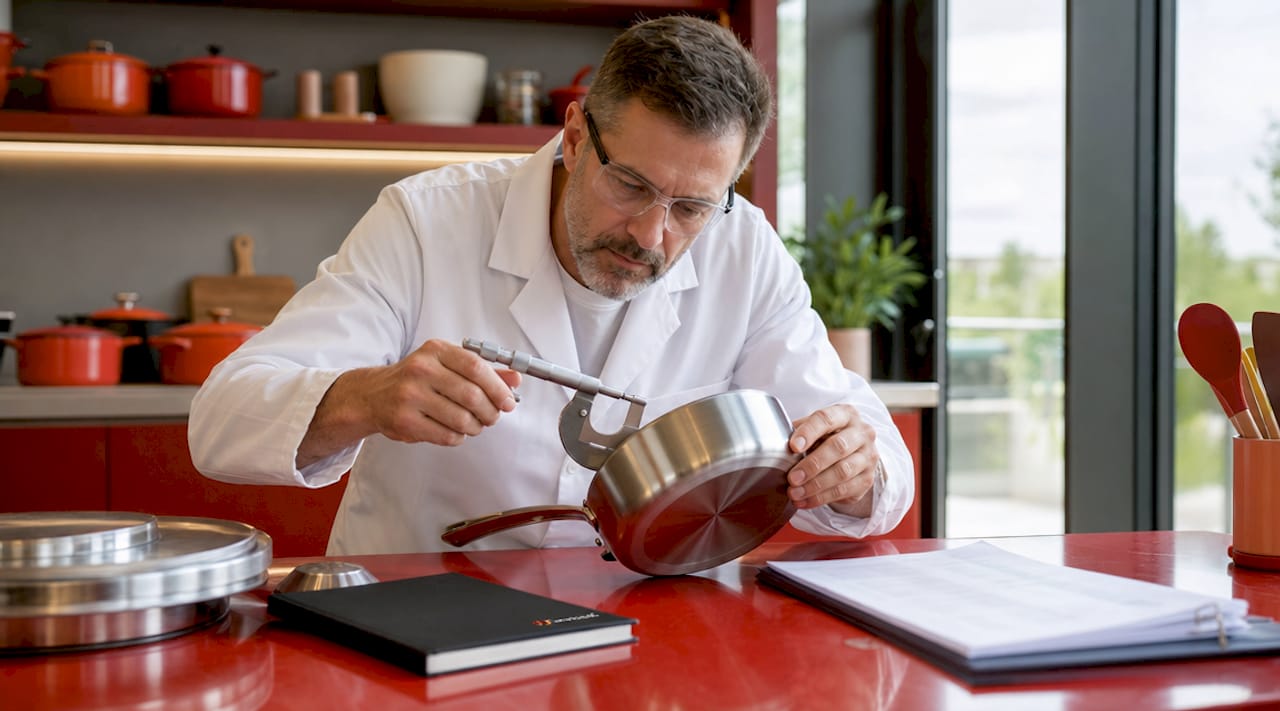
304-grade stainless steel is suitable for over 90% of commercial cookware applications. The 316 grade costs 20 to 30% more and suits specialized environments with high salt or acid exposure. The 201 grade is a lower-nickel alloy that corrodes faster, leaches metals under acidic cooking conditions, and does not meet food safety standards in most regulated markets. Manufacturers substitute 201 for 304 because the cost difference is significant at scale.
Visual inspection and magnet tests cannot reliably distinguish 304 from 201 stainless steel. The only reliable verification methods are Material Test Reports (MTRs) traceable to the steel batch and on-site XRF (X-ray fluorescence) chemical analysis. An MTR traceable to the steel batch confirms genuine food-grade 304 stainless steel and prevents substitution with lower grades. You can rent or hire XRF testing services through SGS or Intertek for factory visits.
Construction capability is equally important. The key questions to ask any factory:
- Can you produce full-clad tri-ply construction, or only encapsulated base designs?
- Do you have in-house R&D and engineering teams to handle custom specifications?
- What is your documented process for preventing warping during bonding?
Factories optimized for single-layer composite bases cannot produce high-performance full-clad tri-ply cookware without risking defects like warping or delamination. A factory that claims full-clad capability but cannot show you production line photos, tooling specifications, or sample cross-sections is almost certainly overstating what they can deliver. You can learn more about stainless steel grade differences to sharpen your technical questions before any factory conversation.
Pro Tip: Request a cross-section sample of any tri-ply product before placing an order. A legitimate manufacturer will cut one open without hesitation.
Where to find and verify stainless steel cookware factories
Geographic sourcing strategy matters more than most buyers realize. China’s cookware manufacturing is concentrated in specific regional clusters, and choosing the right cluster directly affects your supply chain reliability.
Jiangmen and Chaozhou in Guangdong province provide integrated supply chains within a 20-kilometer radius, reducing delays. These clusters offer proximity to raw materials, handle suppliers, and packaging manufacturers. This concentration means a factory in Jiangmen can source steel coils, riveted handles, and custom packaging from suppliers within the same industrial zone, cutting lead times and reducing logistics risk.
The most important distinction in sourcing is between a direct manufacturer and a trading company. Here is how they compare:
| Factor | Direct manufacturer | Trading company |
|---|---|---|
| Pricing | Factory cost, no markup | 10 to 30% markup added |
| Communication | Direct access to production managers | Intermediary relays information |
| Customization | Full OEM and ODM capability | Limited, depends on factory relationships |
| Audit access | Open to factory visits and virtual tours | Often refuses or delays factory access |
| MOQ flexibility | Typically 1,000 units per SKU | Variable, often inflated |
Verifying factory ownership through documentation and virtual factory tours helps avoid middlemen and hidden markups. Ask for the business license, which in China shows the registered company name and scope of operations. If the license shows “trading” in the business scope rather than “manufacturing,” you are dealing with a middleman.
Typical MOQs for established manufacturers are around 1,000 units with lead times of 40 to 60 days. Manufacturers quoting significantly lower MOQs without price premiums are often trading companies, not factories. Sourcing channels worth using include Canton Fair, trade shows like Ambiente in Frankfurt, Alibaba Gold Supplier listings with verified factory badges, and direct referrals from other brand owners in your network.
Citation capsule Vetting a stainless steel cookware manufacturer means verifying material grade, certifications, and quality-control systems before ordering. Confirm 304-grade steel with a Material Test Report and XRF analysis, verify ISO 9001, FDA, and LFGB certificates directly with accredited labs such as SGS or Intertek, and check that the factory runs IQC, IPQC, and OQC stages.
What quality control systems should a cookware factory have?
A factory’s quality control (QC) infrastructure tells you more about long-term reliability than any sales pitch. The industry standard is a three-stage QC framework, and any manufacturer worth working with can describe all three stages in detail.
The three stages are:
- IQC (Incoming Quality Control): Raw materials, including steel coils, aluminum cores, and handle components, are inspected and tested against documented specifications before entering production. A factory without IQC is accepting whatever the steel mill ships.
- IPQC (In-Process Quality Control): Checkpoints during stamping, bonding, polishing, and assembly catch defects before they compound. This includes dimensional checks, surface finish inspections, and bond integrity tests.
- OQC (Outgoing Quality Control): Final inspection before shipment covers heat distribution tests, handle torque testing, surface finish consistency, and packaging integrity.
Quality control should include incoming raw material inspection, in-process checks, and final outgoing inspections with defined acceptance criteria. Third-party inspection services like SGS or Intertek offer added assurance before shipment. For orders over $50,000, a pre-shipment inspection from one of these agencies is a standard commercial practice, not an optional extra.
The table below shows what to test on production samples before approving a full order:
| Test | What it reveals |
|---|---|
| Heat distribution test | Hotspot formation and base bonding quality |
| Warp resistance test | Structural integrity under thermal cycling |
| Handle torque test | Rivet or weld strength under load |
| Surface finish check | Consistency of polish grade across batch |
| Leaching test | Compliance with FDA or LFGB food contact standards |
The best cookware manufacturers have in-house R&D teams to optimize materials and resolve technical challenges beyond mere production. A factory with R&D capability can solve a handle heat transfer problem or adjust a lid tolerance without outsourcing the engineering work, which protects your timeline. You can review how professionals approach grading stainless steel quality to build a sharper checklist for your own sample evaluations.
How to finalize a manufacturer: audits, terms, and communication
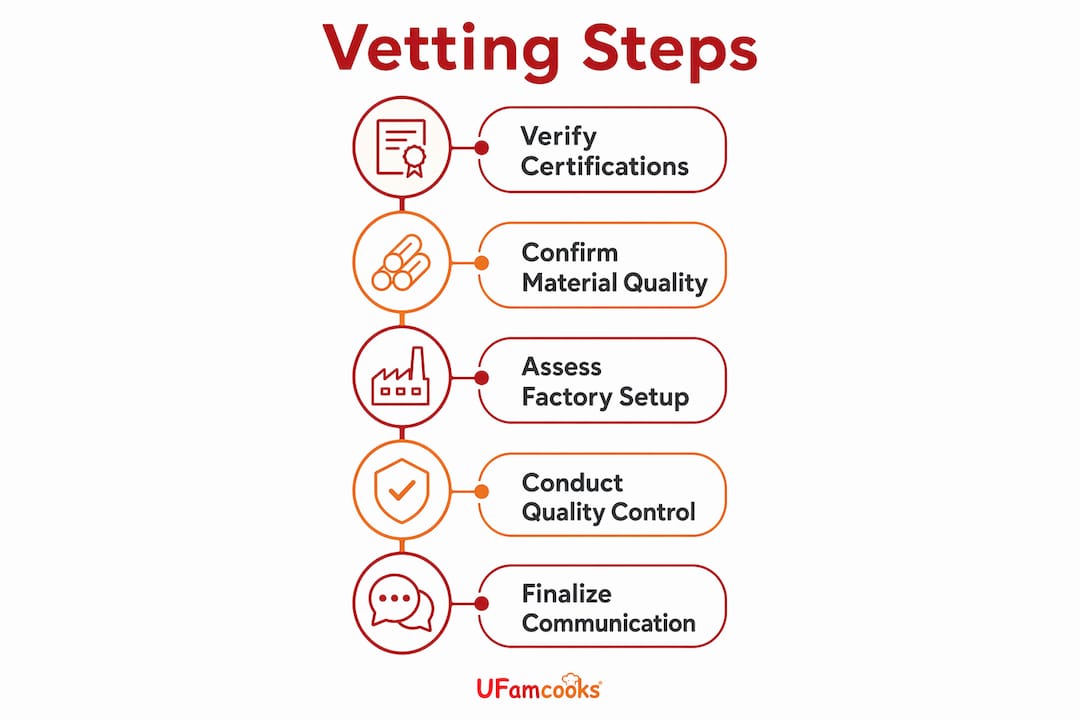
Evaluating a supplier is a structured process involving a 10-point framework, not a gut feeling. The final stage of cookware quality assessment involves three parallel tracks: communication quality, audit results, and commercial terms.
Assess communication quality first. Send a detailed technical inquiry covering material grade, construction type, and certification requirements. A factory with genuine capability responds with specific answers, not generic brochures. Response time under 24 hours and technical accuracy in replies are reliable confidence signals.
Conduct a factory audit. On-site visits remain the gold standard, but virtual factory tours via live video call are an accepted alternative for initial qualification. A reputable supplier qualification framework, such as the one outlined in the supplier qualification guide, recommends auditing production capacity, worker training records, and equipment maintenance logs alongside the physical facility.
Negotiate commercial terms in writing. Verbal agreements on tooling costs, sample fees, lead times, and payment terms create disputes. Document every commitment before transferring any funds. Standard commercial terms include 30% deposit on order confirmation and 70% balance before shipment, with tooling costs itemized separately.
Pro Tip: Never sign a purchase order based on a verbal promise about material grade or certification. Every specification must appear in the written contract, including the steel grade, construction type, and applicable certifications.
Starting with 2 to 3 product categories strengthens manufacturer relationships and builds expertise before scaling. A focused entry strategy lets you evaluate the factory’s actual performance on a manageable order before committing to a full product line.
Key takeaways
Vetting stainless steel cookware manufacturers requires verifying material grades with MTRs and XRF testing, confirming certifications with accredited labs, and auditing QC systems before placing any production order.
| Point | Details |
|---|---|
| Verify certifications directly | Confirm ISO 9001, FDA, and LFGB certificates with SGS, TUV, or Intertek, not just the supplier’s documents. |
| Test material grade independently | Use MTRs and XRF analysis to confirm 304-grade steel. Visual checks and magnet tests are unreliable. |
| Distinguish factories from traders | Request business licenses and virtual tours to confirm direct manufacturing capability and avoid markups. |
| Audit all three QC stages | Confirm IQC, IPQC, and OQC processes exist with documented criteria before approving any order. |
| Start focused, then scale | Begin with 2 to 3 SKUs to build a verified relationship before expanding your product range. |
What I’ve learned from years of watching sourcing deals go wrong
The most common mistake I see brands make is treating supplier qualification as a one-time checkbox rather than an ongoing verification process. They get a certificate, run one sample order, and assume the factory will perform identically at 10,000 units. It rarely works that way.
The second mistake is accepting a manufacturer’s word on material grade without independent testing. I have seen buyers receive 201-grade cookware after paying for 304, and the only way they discovered it was through a customer complaint about rust after six months of use. By that point, the reputational damage was done. XRF testing costs a few hundred dollars per factory visit. A product recall costs orders of magnitude more.
What actually works is building a relationship with one factory around two or three products before expanding. You learn their real capabilities, their communication style under pressure, and how they handle defects when they occur. A factory that takes responsibility for a production error and fixes it without argument is worth far more than one with a polished sales deck and no accountability culture.
Factory transparency is the clearest signal of reliability. A manufacturer who welcomes audits, shares MTRs without being asked twice, and gives you direct access to their production manager is showing you their confidence in what they produce. Opacity, delays, and vague answers to technical questions are the opposite signal. Trust the signals, not the brochure.
— Jason
Why Ufamcooks meets the vetting criteria you just read about
Ufamcooks operates as a direct factory, not a trading company, with ISO 9001, LFGB, and FDA certifications verified through accredited third-party labs. Their factory is open to virtual tours and on-site audits, and their production team provides MTRs and XRF test results as standard documentation for every material batch. Ufamcooks specializes in OEM and ODM stainless steel cookware for kitchenware brands, wholesalers, and importers, with full-clad tri-ply capability and a multi-stage QC process covering IQC, IPQC, and OQC. If you are ready to source from a manufacturer who passes the criteria in this guide, browse the full product catalog or explore their stainless steel cooking pots as a starting point for your first order.
FAQ
What certifications should a stainless steel cookware manufacturer have?
The minimum certifications for most markets are ISO 9001 for quality management, FDA compliance for the US market, and LFGB certification for the EU. Commercial foodservice buyers should also require NSF/ANSI 51.
How do I tell if a supplier is a factory or a trading company?
Request the business license and check whether the registered scope includes manufacturing. Ask for a live virtual factory tour. Trading companies typically resist direct factory access and cannot provide MTRs traceable to their own production batches.
What is the standard MOQ for stainless steel cookware manufacturers?
Established manufacturers typically require around 1,000 units per SKU with lead times of 40 to 60 days. Quotes with significantly lower MOQs and no price premium often indicate a trading company rather than a direct factory.
How do I verify that a manufacturer is using 304-grade stainless steel?
Request a Material Test Report traceable to the specific steel batch and arrange XRF chemical analysis during a factory visit or through a third-party service like SGS or Intertek. Visual inspection and magnet tests cannot distinguish 304 from 201 stainless steel.
What quality control stages should I expect from a reputable cookware factory?
A qualified factory operates three QC stages: IQC for incoming raw materials, IPQC for in-process production checks, and OQC for final pre-shipment inspection. Third-party pre-shipment inspections from SGS, Intertek, or Bureau Veritas add an independent layer of assurance.
Source from a factory that passes its own checklist
Send your specs and get a structured supplier-qualification response.
UFamcooks is a direct factory in Jiangmen, Guangdong — ISO 9001 / LFGB / FDA on request, MTRs and XRF results per batch, factory audits welcome. Tell us your grade, certifications, and target market.
Request a Quote