맞춤형 주방용품의 소재 선택: 전문가 가이드
2026년 6월 11일
Material selection in custom kitchenware is the single most consequential decision in product development, directly determining durability, food safety compliance, and long-term customer satisfaction. The role of material selection in custom kitchenware extends far beyond choosing what looks good in a catalog. It governs how a product performs under thermal cycling, dishwasher chemicals, and daily mechanical stress. Culinary professionals and kitchenware businesses that treat material choice as a procurement afterthought consistently face higher defect rates, warranty claims, and brand damage. This guide covers the specific grades, testing protocols, and evaluation frameworks you need to make material decisions that hold up in real kitchens.
How do common materials used in custom kitchenware differ?
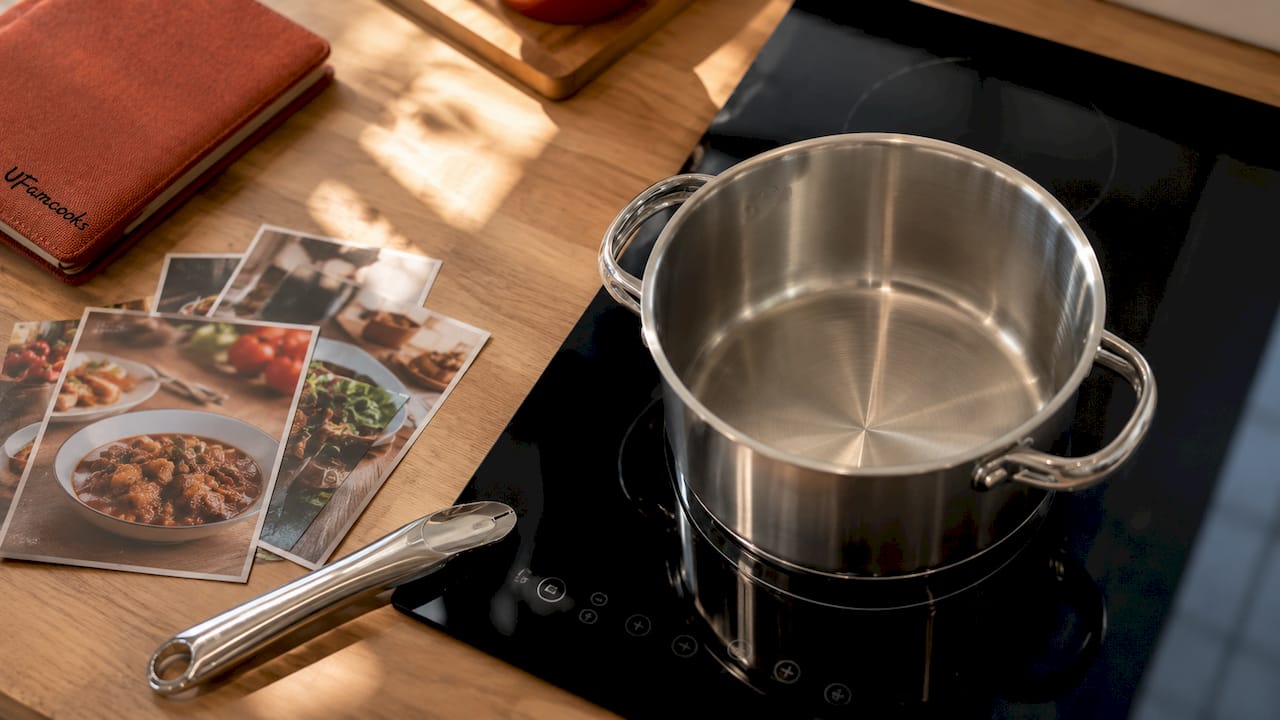
The two most widely specified metals in custom kitchenware are 304-grade and 430-grade stainless steel, and the difference between them is not cosmetic. 304-grade stainless steel (also called 18/8, referencing its 18% chromium and 8% nickel content) is the industry benchmark for corrosion resistance and food-contact safety. It resists acidic foods, salt, and repeated dishwasher cycles without pitting or leaching. The tradeoff is that 304 is not magnetic, which means it does not work on induction cooktops without a bonded base.
430-grade stainless steel contains no nickel, making it magnetic and fully induction-compatible. It costs less than 304 and performs well in lower-stress applications such as mixing bowls or storage containers. Its lower corrosion resistance, however, makes it a poor choice for cookware that contacts acidic ingredients or sits in humid environments for extended periods.
Beyond stainless steel, high-performance polymers and bio-based composites are the dominant materials for handles, lids, and storage containers. Nylon PA66, polypropylene, and glass-fiber-reinforced composites each offer specific combinations of heat resistance, impact strength, and chemical durability. The choice between them depends on the thermal load the component will face and the regulatory environment the product will be sold into.
| Material | Key Strength | Primary Limitation | Best Application |
|---|---|---|---|
| 304 stainless steel | Corrosion resistance, food safety | Not induction-compatible without bonded base | Cookware, food storage |
| 430 stainless steel | Induction-compatible, lower cost | Lower corrosion resistance | Mixing bowls, induction bases |
| 316 stainless steel | Superior chloride resistance | Higher cost | Marine, medical, premium cookware |
| Nylon PA66 | Heat resistance, rigidity | Can absorb moisture over time | Handles, structural components |
| Glass-fiber composite | High strength-to-weight ratio | Complex processing requirements | Lids, ergonomic handles |
Key performance factors to evaluate for any material in a culinary context:
- Thermal resistance: Can the material sustain repeated heating and cooling without warping or cracking?
- Chemical resistance: Does it hold up against detergents, acidic foods, and sanitizing agents?
- Mechanical durability: Will it resist impact, abrasion, and the torque loads applied during cooking?
- Food-contact compliance: Does it meet FDA, EU 10/2011, or equivalent standards for direct food contact?
- Manufacturability: Can the material be formed, welded, or molded to the required tolerances at production scale?
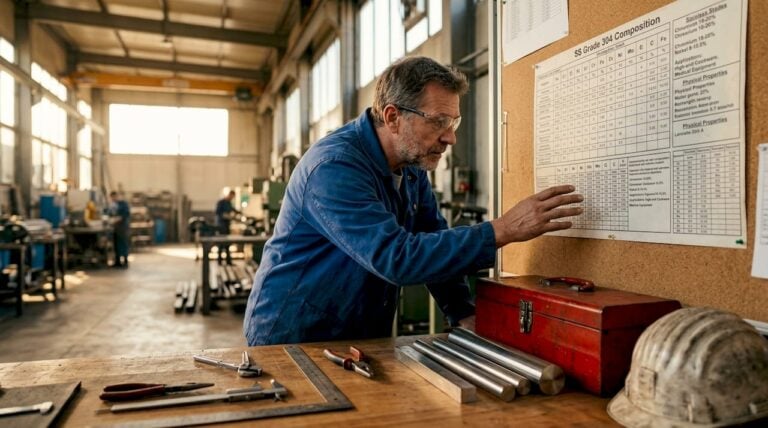
전문가 팁: When specifying stainless steel grades, always request the Mill Test Certificate before tooling begins. This document confirms the exact chemical composition of the batch you are buying, not just the grade label on the invoice.
What are the performance and safety implications of material choice?
Material behavior in a controlled prototype environment rarely predicts real-world performance. Materials often fail after months of use despite passing initial tests, because sustained heat, mechanical stress, and chemical exposure expose weaknesses that short-cycle lab tests miss entirely. A polymer handle that survives 50 dishwasher cycles in testing may become brittle and crack at cycle 200 under commercial kitchen conditions.
The consequences of material failure in kitchenware are not limited to product returns. They include regulatory action if a product leaches prohibited substances, brand reputation damage that takes years to recover from, and the direct cost of rework or recall. Early material integration is the primary lever for reducing these risks. Top manufacturers are 2.2x more likely to lock in material specifications during the design phase rather than treating them as adjustable during production. That discipline prevents the most expensive category of failure: discovering a material problem after tooling is complete.
Four specific risks demand attention during the design and sourcing phase:
- Grade substitution fraud. 201-grade stainless steel is visually identical to 304 but contains manganese instead of nickel, reducing corrosion resistance significantly. Spectrometer testing at incoming inspection is the only reliable way to catch this substitution before it reaches production.
- Thermal cycling failure. Cookware bottoms warp when the base material cannot accommodate the differential expansion between bonded layers. Wall thickness specifications and bonding method must be validated under the actual temperature range the product will experience.
- Chemical degradation. Dishwasher detergents are alkaline and abrasive. Polymers without the correct additive package lose surface integrity, become discolored, and eventually crack. This failure mode is invisible at the prototype stage.
- Weld-line cracking in polymers. Injection-molded components develop weld lines where two flow fronts meet inside the mold. If molecular orientation and gate placement are not engineered correctly, these lines become fracture points under mechanical load.
“Material selection is often mishandled as a procurement line item rather than a foundational design variable, leading to late-stage failures such as warped bottoms or handle detachments after tooling is completed.” — Kitchen product manufacturing insights
The practical implication is direct: material validation must happen before tooling payments, not after. Discovering a material problem at the production stage means absorbing the full cost of mold modification or, in the worst case, scrapping tooling entirely.
How should businesses evaluate and verify kitchenware materials?
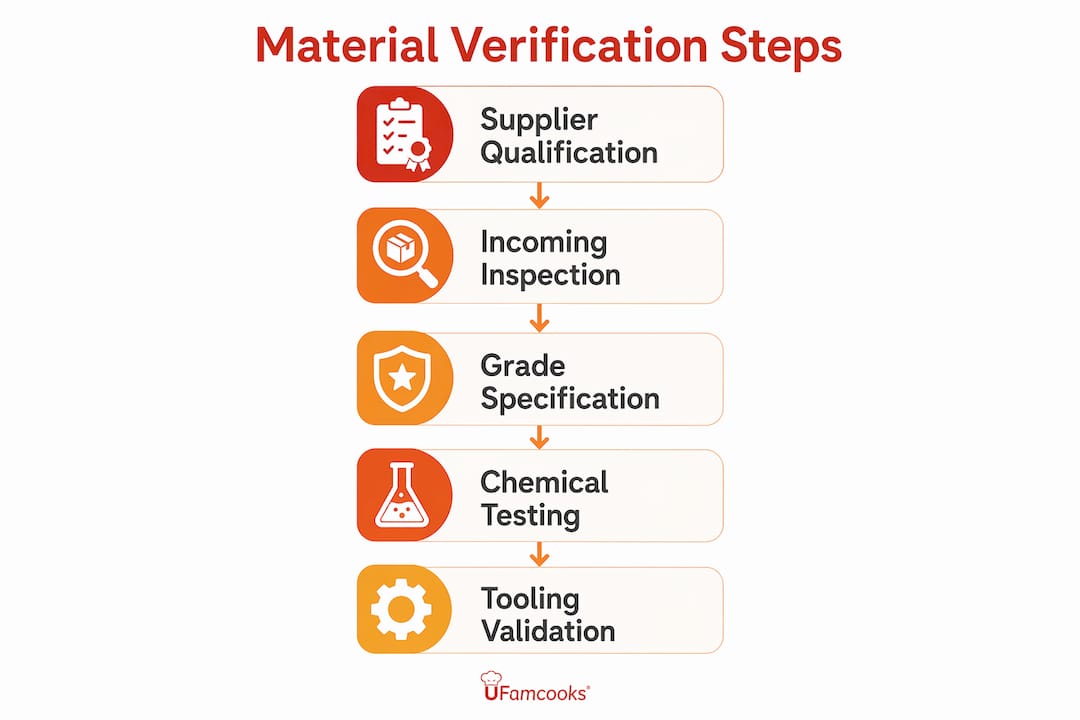
Verification is not a single checkpoint. It is a workflow that runs from supplier qualification through incoming inspection to in-process monitoring. The following framework applies to both stainless steel and polymer components.
Start with documented grade specifications. Your purchase order must name the exact grade (304, 430, or 316 stainless steel; PA66 GF30 for glass-fiber nylon; and so on) and reference the applicable standard (ASTM, EN, or GB). A grade name alone is insufficient. Specify the chemical composition range, mechanical property minimums, and surface finish requirements in writing.
Establish golden samples before production begins. Golden samples and written workflows enforce measurable specifications and reduce failure rates by giving both buyer and manufacturer a physical reference point for every quality attribute. Tie tooling payment milestones to golden sample approval, not to calendar dates.
Perform incoming material testing on every production batch, not just the first. The tests that matter most:
- XRF spectrometer analysis for stainless steel grade verification (catches 201-for-304 substitution)
- Melt flow index testing for polymers (confirms the resin grade matches the specification)
- Salt spray testing for corrosion resistance on finished stainless steel components
- Tensile and impact testing for polymer handles and structural components
- Migration testing for food-contact compliance under the relevant regulatory standard
전문가 팁: When working with a new supplier, request a third-party lab report alongside the Mill Test Certificate for the first three production batches. This establishes a baseline and signals to the supplier that your quality standards are non-negotiable.
Sustainability criteria are becoming a formal part of material evaluation. A sustainable material selection framework assigns the highest relative weight to environmental criteria at 36.4%, followed by technical performance at 25.5%, economic factors at 21.6%, and social criteria at 16.5%. This means environmental performance now carries more weight than cost in best-practice frameworks. For kitchenware businesses, this translates to specifying recycled-content stainless steel where available and selecting polymer grades with established end-of-life recyclability.
What emerging materials are shaping custom kitchenware?
Advanced thermoplastics and bio-based composites are the most significant development in kitchenware materials over the past five years. Polymer additives and design features now mitigate detergent attack and surface degradation that previously limited polymer use in commercial kitchen environments. Stabilizer packages, surface-active agents, and reinforcing fillers work together to extend service life under conditions that would have degraded earlier polymer formulations within months.
The engineering details matter as much as the material choice itself. Wall thickness, ribbing placement, and molecular orientation in injection-molded components significantly influence durability. Weld-line cracking and warpage are the two most common failure modes in polymer kitchenware, and both are preventable through detailed mold flow analysis before tooling is cut. Ribbing adds stiffness without adding mass, but incorrectly placed ribs create stress concentrations that accelerate failure under cyclic loading.
Bio-based composites derived from natural fiber reinforcement in polymer matrices are entering the kitchenware market as a response to sustainability requirements. These materials offer competitive mechanical performance in low-to-medium thermal load applications such as serving bowls, storage containers, and utensil handles. Their limitation is moisture absorption over time, which requires careful surface treatment and sealing to maintain dimensional stability.
The regulatory environment is also driving material innovation. The EU’s restrictions on bisphenol A and certain phthalates in food-contact materials have accelerated the development of alternative polymer formulations. Kitchenware businesses selling into European markets need to track these changes and verify that their polymer specifications remain compliant as regulations update.
주요 내용
Material selection in custom kitchenware determines product durability, food safety compliance, and brand reputation, and must be treated as a foundational design decision rather than a procurement variable.
| 요점 | 상세 정보 |
|---|---|
| Grade verification is non-negotiable | Use XRF spectrometer testing and Mill Test Certificates to confirm stainless steel grades on every production batch. |
| Early integration reduces costs | Locking in material specs during design prevents rework and tooling failures that cost far more than upstream validation. |
| Golden samples enforce quality | Tie tooling payments to approved golden samples with written acceptance criteria to maintain production consistency. |
| Sustainability carries real weight | Environmental criteria account for 36.4% of best-practice material selection frameworks, making eco-performance a technical requirement. |
| Polymer design details matter | Wall thickness, ribbing, and gate placement in injection-molded components directly determine whether polymer parts survive real kitchen conditions. |
Why I think most kitchenware businesses get material selection backwards
After years of working closely with manufacturers and brands on custom kitchenware projects, the pattern I see most often is this: material selection gets treated as a sourcing decision rather than an engineering one. A buyer picks a grade based on price, the factory confirms it can work with that grade, and nobody asks the harder question until a batch of pots arrives with warped bases or handles that crack after six months of use.
The uncomfortable truth is that material decisions are performance decisions, and the cost of getting them wrong compounds at every stage. A $0.15 per unit saving on a lower-grade polymer for handles looks attractive until you factor in the warranty claims, the replacement shipment, and the customer reviews that follow. I have seen brands absorb five-figure losses on orders that could have been protected by a $300 spectrometer test at incoming inspection.
The other mistake I see consistently is treating the golden sample as a formality rather than a contract. A physical reference sample with documented acceptance criteria is the only thing that prevents a factory from making “equivalent” substitutions that are not equivalent at all. If your quality workflow does not tie tooling payment to golden sample approval, you are leaving the door open for exactly that kind of substitution. Material choice not only affects functionality but also brand reputation and customer trust, and recovering from a product failure in the market costs far more than the validation work that prevents it.
— 제이슨
How Ufamcooks supports your custom kitchenware material decisions
Ufamcooks operates as a factory-direct manufacturer of stainless steel kitchenware, which means material validation is built into the production process rather than outsourced to a third party. Every custom order goes through multi-stage quality control that includes grade verification, dimensional inspection, and surface finish assessment before shipment. For OEM and ODM clients, Ufamcooks provides full documentation support including Mill Test Certificates and golden sample workflows that protect your specifications across production runs. Explore the full range of custom kitchenware products or review a specific example of material and manufacturing quality in the stainless steel cooking pot with lid to see how these standards apply in practice.
자주 묻는 질문
What is the best stainless steel grade for custom cookware?
304-grade stainless steel is the industry standard for cookware due to its corrosion resistance and food-contact safety. For induction-compatible products, a 430-grade base bonded to a 304 body is the most common solution.
How do you verify stainless steel grade in production?
XRF spectrometer testing confirms the exact chemical composition of a stainless steel batch. Requiring Mill Test Certificates from the supplier provides a second layer of verification and is standard practice for any serious quality control program.
Why do materials that pass prototype tests fail in real kitchens?
Prototype tests typically run short cycles under controlled conditions. Real kitchen use involves sustained heat, repeated dishwasher exposure, and mechanical stress that reveal degradation modes, such as brittle polymers or coating loss, that short-cycle tests do not capture.
What role does sustainability play in kitchenware material selection?
Environmental criteria carry the highest weight (36.4%) in current sustainable material selection frameworks, ahead of technical performance at 25.5% and economic factors at 21.6%. For kitchenware businesses, this means specifying recycled-content metals and recyclable polymer grades is becoming a baseline requirement, not a differentiator.
When should material specifications be finalized in a custom kitchenware project?
Material specifications must be locked in before tooling begins. Discovering a material problem after tooling is complete means absorbing the full cost of mold modification or scrapping tooling, which is the most expensive failure mode in custom kitchenware manufacturing.