18/8 Stainless Steel: Properties, Grades, and Applications
June 4, 2026
18/8 stainless steel is defined as an austenitic alloy containing approximately 18% chromium and 8% nickel, widely recognized as the standard material for high-quality kitchenware. The designation is an informal industry shorthand, not a formal ASTM or ISO grade, which creates real sourcing risks for manufacturers and chefs who rely on consistent material performance. Understanding what 18/8 actually means, how it compares to grades like 304 and 316, and how to verify authenticity separates professionals who source confidently from those who get burned by substitutions.
What does 18/8 stainless steel mean in composition and classification?
18/8 stainless steel is an informal industry nickname generally equated with austenitic grade 304 stainless steel, carrying no formal chemical limits or mechanical standardization under ASTM or ISO frameworks. The “18” refers to approximately 18% chromium content, which forms a passive chromium oxide layer on the metal surface. The “8” refers to approximately 8% nickel, which stabilizes the austenitic microstructure and improves corrosion resistance and ductility. Together, these two elements account for the material’s defining performance characteristics in kitchen environments.
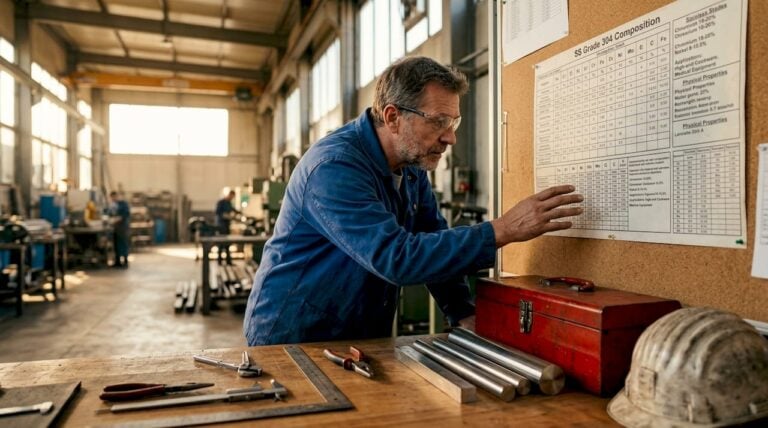
The critical distinction professionals must understand is this: 18/8 is a descriptive label, not a specification. Any supplier can stamp “18/8” on a product without guaranteeing the exact alloy composition, heat treatment, or mechanical properties. By contrast, ASTM A240 specifies exact composition ranges and mechanical minimums for 304 stainless steel, making it the traceable, auditable standard that procurement teams and quality managers should demand.
Key composition facts for 18/8 stainless steel:
- Chromium content: 18% to 20% in formal 304 grade specifications
- Nickel content: 8% to 11% in formal 304 grade specifications
- Carbon content: Maximum 0.08% to limit carbide precipitation during welding
- Manganese, silicon, phosphorus, sulfur: Present in controlled trace amounts per ASTM A240
- No molybdenum: This is the key absence that distinguishes it from 316 grade
Pro Tip: When reviewing supplier documentation, ask specifically for an ASTM A240 mill test report for 304 grade. A certificate that only says “18/8” without referencing a formal standard offers no legal or quality protection for your supply chain.
How does 18/8 stainless steel compare to 18/10, 304, and 316?
The grades most commonly confused with 18/8 are 18/10, 304, and 316. Each has a distinct composition profile that determines where it performs best and what it costs to manufacture.
18/8 and 18/10 are practically equivalent for most kitchenware, with 18/10 carrying marginally higher nickel content at 10% versus 8%. That additional nickel offers slightly better deep-drawing performance during manufacturing, which matters for complex formed shapes like mixing bowls or deep pots. For everyday cooking performance, corrosion resistance, and food safety, the difference is negligible. The reason 18/10 appears on premium flatware and cookware packaging is largely marketing positioning rather than a meaningful functional upgrade.
304 stainless steel is the formal grade that 18/8 most closely approximates. The difference is accountability. A product labeled 304 carries ASTM-traceable documentation; a product labeled 18/8 does not. For regulated food service environments, export markets, or OEM manufacturing contracts, 304 certification is the minimum acceptable standard.
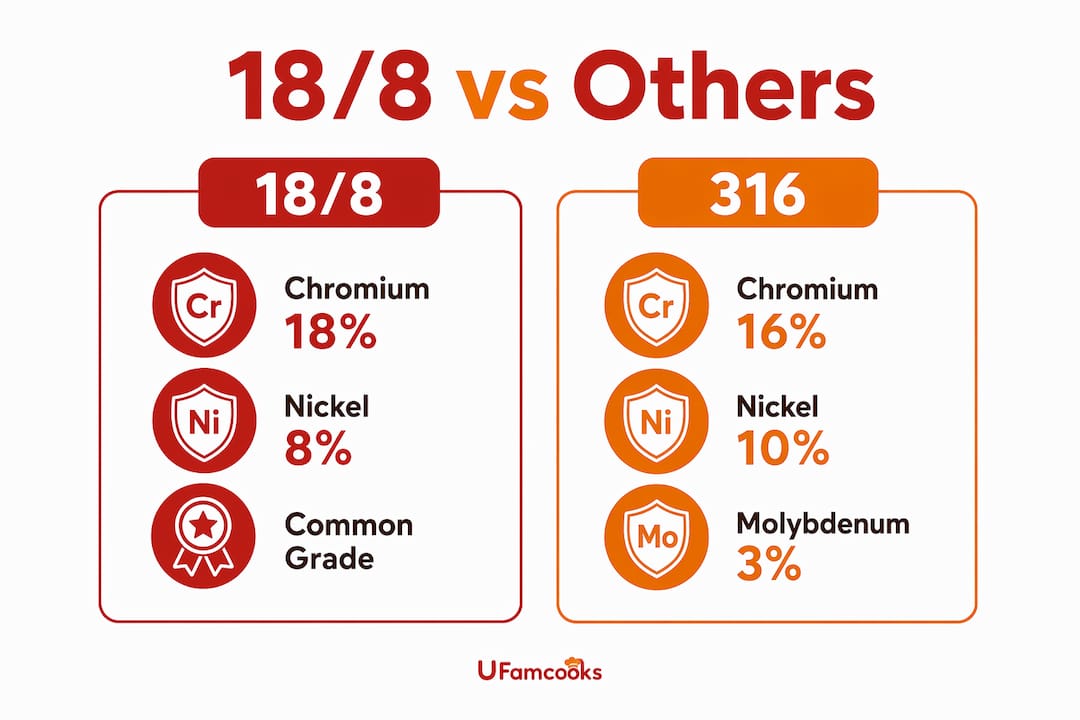
316 stainless steel adds 2% to 3% molybdenum to the base 18/8 composition, which dramatically improves resistance to chloride-induced pitting. This makes 316 the correct choice for marine environments, chemical processing, and any kitchen application involving prolonged contact with salt brines or acidic marinades. The trade-off is cost and machinability. 304 stainless steel is more machinable than 316, which work-hardens faster and carries a higher raw material price due to molybdenum content.
| Grade | Chromium | Nickel | Molybdenum | Best application |
|---|---|---|---|---|
| 18/8 (informal) | ~18% | ~8% | None | General kitchenware, cookware |
| 18/10 | ~18% | ~10% | None | Premium flatware, deep-drawn items |
| 304 (ASTM A240) | 18–20% | 8–11% | None | Certified food-grade equipment |
| 316 | 16–18% | 10–14% | 2–3% | Marine, chemical, high-salt environments |
The table makes the sourcing decision straightforward. For most commercial kitchenware, 18/8 or its formal equivalent 304 is the right call. Specify 316 only when chloride exposure is a documented risk.
What are the key properties of 18/8 stainless steel for kitchenware?
18/8 stainless steel delivers a combination of properties that make it the dominant material in commercial and residential kitchenware manufacturing. Understanding each property helps manufacturers specify correctly and helps chefs evaluate product quality before purchasing.
- Corrosion resistance. The passive chromium oxide layer provides strong protection against oxidation, rust, and most food acids. However, chloride environments rapidly degrade this layer, causing pitting and crevice corrosion. Bleach-based cleaners and prolonged saltwater contact are the two most common causes of premature corrosion in 18/8 kitchenware.
- Formability and weldability. The austenitic microstructure makes 18/8 highly formable, which is why it appears in everything from stamped sheet pans to deep-drawn stockpots. It welds cleanly with standard TIG and MIG processes, though improper welding technique can destroy the chromium passive layer locally, creating corrosion hot spots.
- Mechanical strength. 304 stainless steel carries a minimum tensile strength of 515 MPa, providing adequate structural integrity for cookware, storage containers, and food preparation surfaces under normal commercial use.
- Hygienic surface. The non-porous surface resists bacterial adhesion and tolerates repeated sanitization cycles, which is why food safety regulators and commercial kitchen operators favor it.
- Magnetic behavior. In its annealed state, 18/8 is non-magnetic. Cold-working during manufacturing, such as stamping or drawing, transforms austenite into ferromagnetic martensite, making finished products partially magnetic. This is normal metallurgy, not a defect.
Pro Tip: If you are evaluating 18/8 stainless steel cookware for induction compatibility, light magnetism from cold-working is not sufficient for induction heating. True induction-compatible cookware requires a bonded ferritic or magnetic base layer, not just cold-worked austenitic steel.
The optimal cost-performance balance that 18/8 offers is why it dominates commercial kitchenware. No other food-grade alloy at this price point combines corrosion resistance, formability, and hygienic surface properties as effectively.
What are the best practices for using 18/8 stainless steel in manufacturing and culinary settings?
Selecting 18/8 stainless steel correctly requires matching the material to the application, verifying authenticity, and following maintenance practices that preserve the passive layer over the product’s service life.
When 18/8 is the right choice:
- Standard commercial cookware including pots, pans, mixing bowls, and sheet trays
- Food storage containers where food safety and odor neutrality are priorities
- Prep surfaces and utensils in professional kitchen environments
- OEM kitchenware products destined for retail markets where cost competitiveness matters
When to specify 316 instead:
- Cookware or equipment used in coastal or marine food service environments
- Products designed for prolonged contact with salt brines, pickling liquids, or acidic marinades
- Industrial food processing equipment exposed to cleaning chemicals containing chlorides
Sourcing and verification practices manufacturers must follow:
- Demand mill test reports referencing ASTM A240 for every coil or sheet purchase. Accepting vague 18/8 labeling without documentation opens the door to material substitution. Nickel price fluctuations lead some suppliers to substitute cheaper 201 stainless steel, which has significantly lower nickel content and inferior corrosion resistance.
- Audit fabrication processes for welding quality. Improper welding destroys the chromium passive layer locally, creating corrosion points even in correctly specified material.
- Specify passivation treatments in manufacturing contracts for products that will face aggressive cleaning cycles.
Cleaning and maintenance guidance for chefs and operators:
- Wash with mild dish soap and warm water after each use. Avoid abrasive steel wool pads that scratch the surface and compromise the passive layer.
- Never use bleach-based cleaners or leave saltwater solutions sitting in stainless steel vessels for extended periods.
- Dry thoroughly after washing. Standing water, particularly in areas with high mineral content, accelerates surface staining and pitting.
- For stubborn stains, use a paste of baking soda and water rather than chloride-containing commercial cleaners.
How to identify genuine 18/8 stainless steel and assess product quality
Verifying that a product actually contains 18/8 or 304 grade stainless steel requires more than reading the label. Several practical methods help manufacturers and buyers confirm material authenticity.
- Magnet test (limited reliability). A strong magnet will not stick to annealed 18/8 stainless steel. However, cold-working induces partial magnetism in finished products, so a weak magnetic response does not confirm the material is counterfeit or low grade. The magnet test is useful for identifying obviously wrong materials like carbon steel or ferritic grades, but it cannot distinguish between 304 and 201 stainless steel.
- Mill test report review. The most reliable verification method is requesting the original mill test report from the steel producer. This document lists the exact chemical composition of each coil or batch and references the applicable standard. For food-grade kitchenware, the report should reference ASTM A240 and confirm 304 grade composition.
- Third-party chemical analysis. For high-volume procurement or when supplier documentation is unavailable, X-ray fluorescence (XRF) analyzers provide rapid, non-destructive elemental analysis. XRF testing can confirm chromium and nickel percentages within minutes at the receiving dock.
- Visual and surface inspection. Genuine 18/8 stainless steel has a consistent, bright surface finish. Uneven coloration, excessive porosity, or rapid surface staining after cleaning are warning signs of substandard material or poor fabrication.
For regulated industries and engineering applications, formal 304 grade documentation is not optional. It provides the legal traceability and consistent specifications that informal 18/8 labeling cannot guarantee.
Key takeaways
18/8 stainless steel is an informal composition label for austenitic 304 grade steel, and manufacturers who accept it without certified documentation expose their supply chains to material substitution and quality failures.
| Point | Details |
|---|---|
| 18/8 is not a formal grade | Always request ASTM A240 mill test reports for 304 grade to guarantee composition and mechanical properties. |
| Magnetism is not a quality test | Cold-working makes genuine 18/8 partially magnetic, so a magnet response alone cannot confirm or deny material authenticity. |
| 18/10 vs. 18/8 is mostly marketing | The extra 2% nickel in 18/10 improves deep-drawing slightly but offers no meaningful cooking performance advantage. |
| 316 is for chloride environments | Specify 316 stainless steel only when products face prolonged salt, bleach, or acidic liquid exposure. |
| Welding quality matters as much as composition | Improper fabrication destroys the passive layer and causes corrosion even in correctly specified 18/8 material. |
Why the 18/8 label deserves more scrutiny than it gets
I have reviewed sourcing documentation for kitchenware manufacturers across multiple production cycles, and the 18/8 label is one of the most consistently misunderstood designations in the industry. Buyers treat it as a quality guarantee when it is actually just a composition description with no enforcement mechanism behind it.
The real problem is that 201 stainless steel, which contains roughly 4% to 6% nickel instead of 8%, looks identical to 304 on a finished product. Without an XRF analyzer or a mill test report, a buyer cannot tell the difference by sight or touch. Suppliers who substitute 201 for 304 during periods of high nickel prices are not always acting in bad faith. Sometimes the specification was never clear enough to prevent it.
My position is that any manufacturer sourcing 18/8 stainless steel for food-grade products should retire the term internally and replace it with “304 per ASTM A240” in every purchase order and product specification. The informal label served a purpose when the industry was less globalized. Today, with supply chains spanning multiple countries and multiple tiers of subcontractors, vague labeling is a liability. The material itself is excellent for the vast majority of kitchen applications. The label is the problem, not the alloy.
— Jason
How Ufamcooks delivers certified 18/8 stainless steel kitchenware at scale
Ufamcooks manufactures stainless steel kitchenware directly from its factory, supplying kitchenware brands, wholesalers, and importers with OEM and ODM products built to certified 304 grade specifications. Every production run is backed by multi-stage quality control and traceable material documentation, eliminating the substitution risk that plagues informal 18/8 sourcing. Whether you need stainless steel mixing bowls with custom finishes or food storage containers built for food safety compliance, Ufamcooks handles the full product lifecycle from design to packaging. Explore the full range of certified kitchenware products and contact the team for sourcing support on your next order.
PREGUNTAS FRECUENTES
What does 18/8 stainless steel mean?
18/8 stainless steel is an informal designation indicating approximately 18% chromium and 8% nickel content, closely corresponding to formal ASTM grade 304 stainless steel. It is a descriptive label, not a certified standard, so buyers should always request ASTM A240 documentation.
Is 18/8 stainless steel magnetic?
In its annealed state, 18/8 stainless steel is non-magnetic. Cold-working during manufacturing transforms part of the austenitic structure into ferromagnetic martensite, making finished products weakly magnetic. This is a normal metallurgical effect, not a sign of inferior material.
What is the difference between 18/8 and 18/10 stainless steel?
18/10 contains 10% nickel versus 8% in 18/8, offering marginally better deep-drawing performance during manufacturing. For everyday cooking and corrosion resistance, the two grades perform equivalently, and the distinction is primarily used for marketing premium flatware and cookware.
Is 18/10 stainless steel better than 18/8 for cookware?
18/10 is not meaningfully better than 18/8 for most cooking applications. The additional nickel improves formability during production but does not change food safety, heat distribution, or corrosion resistance in standard kitchen use.
When should I choose 316 over 18/8 stainless steel?
Choose 316 stainless steel when products will face prolonged exposure to chlorides, salt brines, acidic marinades, or bleach-based cleaning agents. For standard commercial kitchenware without those conditions, 18/8 or certified 304 grade is the correct and more cost-effective choice.