

Stainless Steel Grade Classification: A Technical Guide
Stainless steel grade classification is the systematic organization of stainless steel alloys into families and specific grades based on crystalline microstructure and chemical composition. Engineers and materials scientists rely on this system, formally governed by ASTM, EN, ISO, and JIS standards, to match material performance to application requirements.
What is stainless steel grade classification and why does it matter?
The classification covers over 150 distinct grades, though roughly 10–15 are used in the majority of commercial and industrial applications. Grades like 304, 316, 409, and 430 each carry a defined performance profile that determines where they belong in a design specification.
Grade classification of stainless steel is not simply a naming convention. It encodes the material’s microstructure, alloy chemistry, mechanical behavior, and corrosion resistance into a shorthand that engineers can act on immediately. Selecting the wrong grade costs money, causes premature failure, and in critical applications, creates safety risks. The classification system exists to prevent exactly that.
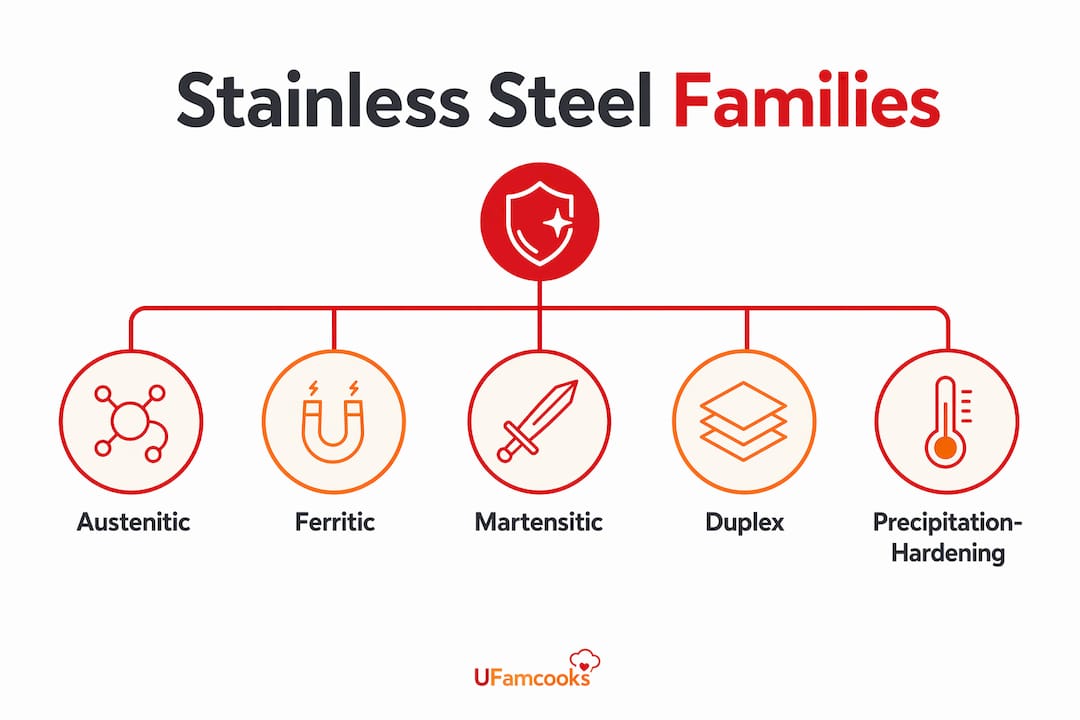
The five primary families are austenitic, ferritic, martensitic, duplex, and precipitation-hardening. Each family shares a common crystalline structure that drives its core properties. Understanding which family a grade belongs to tells you most of what you need to know before you even look at a data sheet.
Grade classification serves as a shorthand for a material’s full performance profile. Selecting grades requires consideration beyond corrosion resistance to mechanical, welding, and magnetic properties.
What are the main stainless steel families and how do microstructures shape their properties?
The five stainless steel families divide the material world cleanly. Each family’s crystalline structure directly determines its magnetic behavior, formability, strength ceiling, and corrosion response.
- Austenitic (300 series): Face-centered cubic structure. Non-magnetic when annealed. Grades 304 and 316 dominate this family. Austenitic grades represent over 50% of global stainless steel production. That market share reflects their balance of corrosion resistance, weldability, and formability.
- Ferritic (400 series): Body-centered cubic structure. Magnetic in all conditions. Grade 430 is the standard reference. Ferritic grades offer good corrosion resistance at lower cost than austenitic, but limited toughness at low temperatures.
- Martensitic (400 series): Body-centered tetragonal structure after hardening. Magnetic and heat-treatable. Grade 410 and 420 are common. These grades prioritize hardness and wear resistance over corrosion performance.
- Duplex: A two-phase structure combining austenite and ferrite. Grades like 2205 offer roughly twice the yield strength of standard austenitic grades with strong chloride resistance. Duplex grades suit structural and offshore applications.
- Precipitation-hardening (PH): Strengthened through heat treatment rather than cold work. Grade 17-4 PH reaches tensile strengths above 1,000 MPa. These grades serve aerospace, medical devices, and high-load mechanical components.
Magnetic behavior is a practical field test for family identification. Austenitic grades are non-magnetic when annealed but can develop slight magnetism after cold working. Ferritic and martensitic grades remain magnetic in all states. This distinction matters for medical imaging equipment and electronic enclosures where magnetic interference is a design constraint.
How do international standards classify stainless steel grades?
Four major systems govern how stainless steel grades are named and specified globally. Each system uses different notation, but most grades have direct equivalents across systems.
| Grade (AISI/SAE) | UNS Number | EN Designation | JIS Designation |
|---|---|---|---|
| 304 | S30400 | 1.4301 | SUS304 |
| 316 | S31600 | 1.4401 | SUS316 |
| 430 | S43000 | 1.4016 | SUS430 |
| 410 | S41000 | 1.4006 | SUS410 |
The AISI three-digit system is the most recognized grading system in daily procurement and shop-floor communication. Engineers worldwide use “304” and “316” as shorthand without specifying the standard body. That familiarity makes the AISI system the default for vendor conversations and purchase orders.
The Unified Numbering System (UNS) provides the formal specification used in technical documentation. S30400 is unambiguous in a way that “304” is not, because it maps to a precise chemical composition range. Specifying the UNS number in engineering drawings and contracts reduces the risk of receiving a nominally equivalent grade that falls outside the required tolerance.
The European EN system uses a numeric material number (1.4301) alongside a chemical symbol designation (X5CrNi18-10). Both identify the same grade. The EN system is standard in EU procurement and required for CE-marked products. The Japanese JIS system uses the SUS prefix followed by the AISI number, making cross-referencing straightforward for engineers working across Asian supply chains.
Minor compositional differences exist among nominally equivalent grades across ASTM, EN, and JIS standards. In most structural and general industrial applications, these differences are negligible. In sensitive chemical processing or pharmaceutical environments, they can affect corrosion performance enough to matter. ISO 15510 represents a global harmonization effort, but professionals must still verify alloy tolerances when switching between standards on critical specifications.
What distinguishes common grades and how do properties drive application choices?
Grades 304 and 316 account for the largest share of stainless steel specified in engineering and manufacturing. Understanding what separates them is the foundation of practical grade selection.
304 and 316 have nearly identical mechanical properties, with tensile strength around 85,000 psi for both grades in annealed condition. The decision between them is environmental, not structural. Grade 316 contains 2.0–3.0% molybdenum, which significantly improves resistance to chloride-induced pitting and crevice corrosion. Grade 304 performs well in most atmospheric and food-contact environments. Grade 316 is the correct choice for marine exposure, chemical processing, and medical implants.
The role of low-carbon “L” variants
Low-carbon grades 304L and 316L limit carbon content to 0.03% maximum. This prevents chromium carbide precipitation at grain boundaries during welding, a phenomenon called sensitization that destroys local corrosion resistance. Any welded stainless steel component that will face a corrosive environment should specify the L variant unless post-weld annealing is part of the fabrication process.
Application mapping by grade
- 304 / 304L: Food processing equipment, kitchen sinks, cookware, architectural panels, storage tanks in non-chloride environments
- 316 / 316L: Marine hardware, pharmaceutical equipment, chemical reactors, medical devices, coastal architectural elements
- 430: Automotive trim, appliance panels, kitchen equipment in dry environments
- 410 / 420: Cutlery, valve components, pump shafts, wear-resistant parts
What practical factors should professionals consider when selecting stainless steel grades?
Grade selection is a multifactorial decision. Corrosion resistance is the most discussed criterion, but it is rarely the only one that matters.
- Assess the corrosive environment first. Identify whether chlorides are present, at what concentration, and whether the exposure is continuous or intermittent. Chloride concentration and temperature together determine whether 304 is adequate or whether 316, duplex, or a higher-alloy grade is required. Coastal environments with salt spray regularly cause premature failure in 304 components specified without this analysis.
- Define mechanical requirements before choosing a family. If the application requires high yield strength, austenitic grades in annealed condition may not qualify. Duplex grades offer higher strength without sacrificing corrosion resistance. Precipitation-hardening grades reach strength levels that austenitic grades cannot match without cold working.
- Account for fabrication method. Welding, deep drawing, and machining each interact differently with grade properties. Austenitic grades work-harden rapidly during machining, which affects tooling selection and cycle time. Ferritic grades are less prone to work hardening but have lower toughness at sub-zero temperatures. Review the impact of welding on grade selection before finalizing a specification.
- Check magnetic requirements. Medical imaging equipment, electronic enclosures, and certain sensor housings require non-magnetic materials. Austenitic grades in the annealed condition satisfy this requirement. Cold-worked austenitic parts may not, depending on the degree of deformation.
- Avoid over-specification. Specifying 316 where 304 performs adequately increases material cost without improving service life. The same logic applies to duplex grades in low-chloride environments. Over-specification is a common and expensive mistake in projects where the corrosion engineer and the procurement team are not aligned.
Key takeaways
Stainless steel grade classification organizes alloys by microstructure and chemistry, and matching the right grade to the right environment is the single most consequential decision in materials specification.
| Point | Details |
|---|---|
| Five primary families | Austenitic, ferritic, martensitic, duplex, and precipitation-hardening each carry distinct structural and performance profiles. |
| Standards vary by region | AISI, UNS, EN, and JIS all classify the same grades with minor compositional tolerances that matter in critical applications. |
| 304 vs. 316 is an environmental call | Both grades share similar mechanical properties; chloride exposure determines which grade is correct. |
| L variants protect welds | 304L and 316L limit carbon to 0.03%, preventing sensitization and intergranular corrosion in welded assemblies. |
| Over-specification costs money | Specifying a higher-alloy grade than the environment demands increases cost without improving service life. |
Grade classification in practice: what the textbook does not tell you
Most engineers learn grade classification as a chart exercise. In practice, it is a negotiation between what the environment demands, what the fabrication process allows, and what the budget permits.
The most common mistake I see is treating corrosion resistance as the only selection criterion. A project specifies 316 because the environment is “corrosive,” without ever asking whether the parts will be welded, what the chloride concentration actually is, or whether the application has magnetic constraints. The result is a specification that is either over-engineered or missing a critical requirement entirely.
Magnetic behavior is the criterion that surprises people most. Austenitic grades are sold as non-magnetic, and they are, until someone cold-forms them. A 304 deep-drawn component can become measurably magnetic after forming. If that part goes into a medical device or a precision sensor housing, you have a problem that grade classification alone did not prevent.
The international standards question is underestimated in global supply chains. Specifying “304” on a drawing and receiving EN 1.4301 material is usually fine. In a pharmaceutical reactor or a high-purity chemical system, the tolerance differences between ASTM and EN can shift the corrosion performance enough to matter. The fix is simple: specify the UNS number and require the mill certificate. Most engineers skip this step until they have learned the lesson the hard way.
Grade classification is a tool. Like any tool, its value depends on how precisely you use it.
— Jason
Stainless steel grades at work in kitchenware manufacturing
Grade selection is not an abstract engineering exercise. It shows up directly in product performance, longevity, and food safety compliance. Austenitic grades dominate kitchenware because of their corrosion resistance, ease of cleaning, and food-contact safety. UFamcooks manufactures stainless steel kitchenware using carefully selected grades, with OEM and ODM programs that let brands specify material requirements from the ground up.
Browse the kitchenware rangeFAQ
What is stainless steel grade classification?
Stainless steel grade classification is the systematic grouping of stainless alloys by crystalline microstructure and chemical composition, governed by standards including ASTM, EN, JIS, and UNS. It provides engineers with a standardized shorthand for material performance and application suitability.
How many stainless steel grades exist?
Over 150 stainless steel grades exist across all families, but roughly 10–15 grades cover the majority of commercial and industrial applications worldwide.
What is the difference between 304 and 316 stainless steel?
Both grades share nearly identical mechanical properties, but 316 contains 2.0–3.0% molybdenum, which significantly improves resistance to chloride corrosion. The choice between them depends on the level of chloride exposure in the operating environment.
Why do engineers specify 304L or 316L instead of 304 or 316?
The L variants limit carbon content to 0.03% maximum, which prevents chromium carbide precipitation at weld joints. This protects against intergranular corrosion in welded assemblies exposed to corrosive environments.
Are ASTM, EN, and JIS grade equivalents interchangeable?
Nominally equivalent grades across ASTM, EN, and JIS are interchangeable in most structural applications, but minor compositional tolerances differ between standards. In sensitive chemical or pharmaceutical applications, verifying the UNS number and mill certificate is the correct practice.